Receptor binding occupancy
ID: receptor-binding-occupancy

Receptor binding occupancy is the fraction of binding sites occupied by a ligand. Consider reversible, noncooperative binding at chemical equilibrium, with homogeneous independent sites: every site has the same binding properties, and binding at one site does not change binding at another. Let denote free ligand, an unoccupied receptor site and the bound complex. In this dilute concentration model,Square brackets denote concentrations; is the total site concentration. Here the dissociation constant has concentration units. Use free ligand in excess so binding negligibly depletes it; only under that approximation may the supplied total ligand concentration substitute for . See Analysis of Receptor–Ligand Interactions: equilibrium binding and saturation.
For an illustrative dissociation constant , where , free ligand concentrations , and give , and , respectively. At , exactly half the sites are occupied in this model. Raising tenfold from to raises occupancy from to about , rather than tenfold: the finite pool of sites causes saturation.
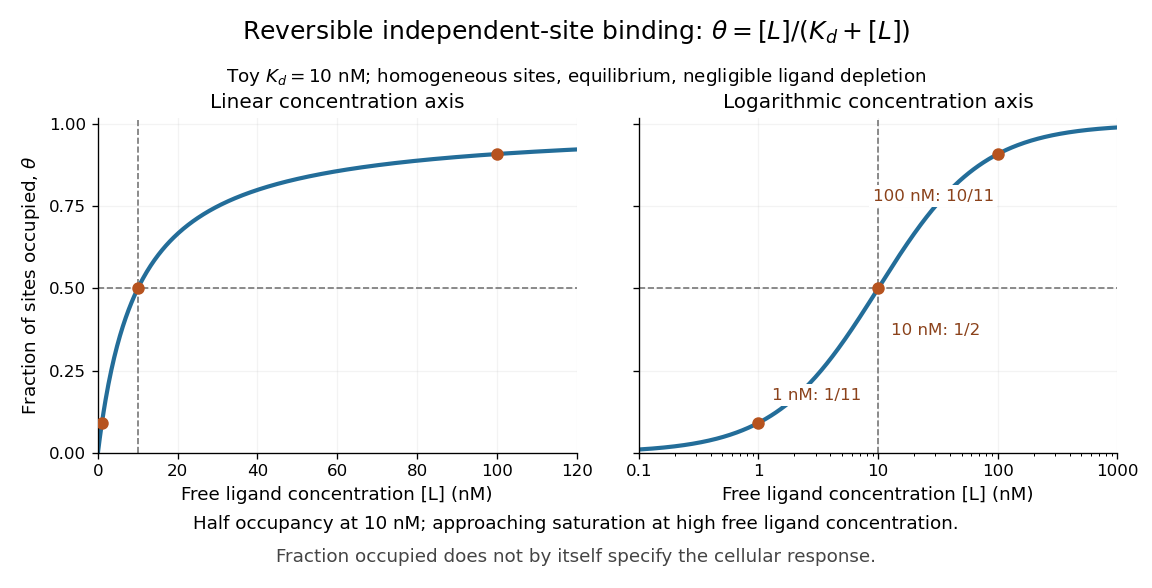

A short derivation uses the law of mass action: at chemical equilibrium, association balances dissociation, giving . Substitute this into and cancel to obtain the displayed formula. The limiting values follow directly: zero free ligand gives zero occupancy, and increasing far above drives occupancy toward one.
Receptor binding occupancy is not automatically the fraction of maximal response. Signal amplification, differing effects of bound ligands, and downstream saturation can change the relationship. Consequently, specifies half occupancy here; it does not universally specify either half-maximal or maximal cellular response. These numbers describe a toy binding model, not measured responses of every receptor. See Higham and Colquhoun, 2024: the affinity–efficacy problem.
New to topics? Read the docs here!