
For a feasible flow , each original directed edge supplies a forward residual network edge of capacity and a backward one of capacity ; zero-capacity residual edges may be omitted. The forward edge permits an increase, while the backward edge permits cancellation of existing flow. In particular, backward residual capacity is the amount already sent, rather than unused original capacity. If both original orientations exist, keep their residual contributions separate, or add capacities for contributions with the same direction. An augmenting path uses these permitted changes while preserving flow conservation and the capacity constraints.
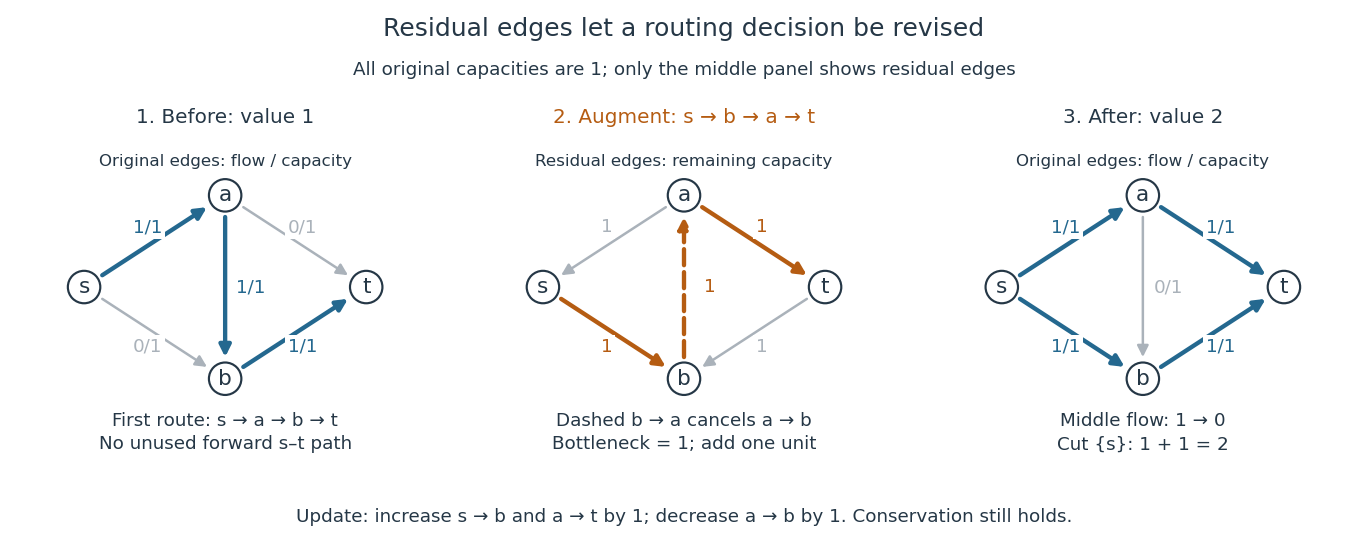
To see why cancellation matters, give all five directed edges , , , , unit flow network edge capacities. Starting from zero flow, an augmenting path carrying yieldsThe remaining unused original edges are and , which do not form a source-to-sink graph path. However, the backward residual edge has capacity . Consequently the residual network contains the augmenting path , with residual capacities .
Augment by : increase and from to , and decrease from to . The result isNow flow conservation is at and at . The final flow sends one unit along each of and . The cut of a flow network has cut capacity , proving this is a maximum flow. Traversing in the residual network revised the earlier routing decision; it did not send actual traffic along a nonexistent original edge.

New to topics? Read the docs here!