A source-to-sink cut of a flow network is a partition of a set of the vertex set of a flow network, with and . Its cut capacity sums the flow network edge capacities of directed edges leaving .[ref]
Flows (author-hosted chapter preview). Graph Theory by Reinhard Diestel; Diestel, Flows, §6.2, printed p. 158: source-side partition and cut capacity
The side may contain any selection of the other vertices; its induced subgraph need not be a connected graph. For the five-edge flow network with flow network edge capacities , gives the partition of a set . Only and leave this side, so its cut capacity is . Choosing instead puts across the boundary in the incoming direction: its flow network edge capacity is excluded.
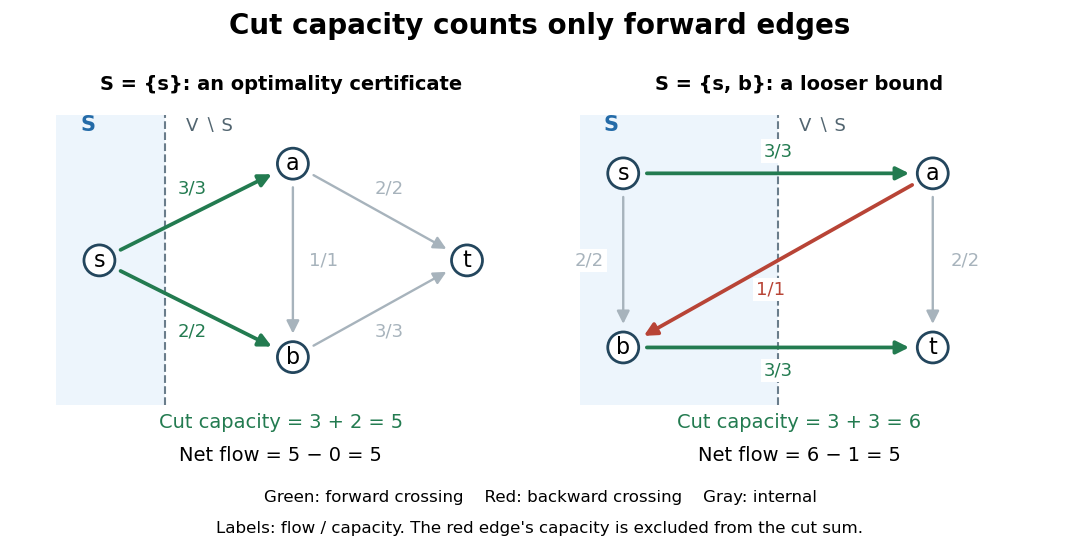

The left panel pairs a feasible flow of flow value with a cut of a flow network of cut capacity , proving that each is optimal. The right panel uses the same feasible flow but a different cut of a flow network: the outward flow is and the backward flow is , giving net flow . That cut capacity is , so it supplies a valid but less sharp bound. The dashed boundary marks a partition of a set, rather than an additional edge or a proposed route.
A minimum cut is a cut of a flow network of least cut capacity for the prescribed source and sink . The max-flow min-cut theorem equates that least cut capacity with the greatest flow value.[ref]
Flows (author-hosted chapter preview). Graph Theory by Reinhard Diestel; Diestel, Flows, §6.2, Theorem 6.2.2, printed p. 159
To certify a particular minimum cut, exhibit a feasible flow whose flow value equals its cut capacity. Every feasible flow is bounded above by every cut capacity, so this single equality proves both optimalities.[ref]
FordFulkerson.java. Algorithms, 4th edition by Robert Sedgewick and others; Sedgewick and Wayne, FordFulkerson.java, check method, lines 180–209: feasibility, source/sink membership and equality of values
In the running example, the four possible source sides , , and have cut capacities , respectively. The feasible flow of flow value therefore certifies three different minimum cuts. A minimum cut need not be unique; the optimum cut capacity is the same for all of them. Merely saturating many edges does not give this certificate: flow conservation and the particular cut of a flow network must also be checked.
On , give an adjacent edge capacity equal to the larger endpoint distance from the diagonal. The set has outgoing edges: two at each interior diagonal vertex and one at each endpoint. Every such edge has capacity one. Thus any flow from above to below the diagonal is at most ; a feasible path decomposition attaining this value certifies optimality by weak duality.
The cut capacity of , with the complement of a set, isOnly outward directed edges contribute; incoming and internal edges contribute nothing.[ref]
FordFulkerson.java. Algorithms, 4th edition by Robert Sedgewick and others; Sedgewick and Wayne, FordFulkerson.java, check method, lines 196–203: sum capacities only from the source side to its complement
Here is the accounting behind the bound, using nonnegative original edge amounts in a finite flow network. Sum the divergence of a flow over the vertices in :An edge with both endpoints in appears once with a plus sign at its tail and once with a minus sign at its head, so those contributions cancel. An outward edge appears only with a plus sign; an incoming edge appears only with a minus sign. Since , and every other vertex satisfies flow conservation, the left side is the flow value. ThusThe inequality uses two facts separately: each forward flow is at most its flow network edge capacity, and each backward flow is nonnegative. This is the weak duality bound underlying the max-flow min-cut theorem. It is an accounting proof, requiring no choice of augmenting paths.
For in the running example, explicitly add the two divergences of a flow:The internal edge cancels. The edge is a genuine original directed edge entering , so its flow is subtracted; this is different from a backward edge in a residual network. Its flow network edge capacity is neither added to nor subtracted from cut capacity, which remains .
Equality in the bound holds precisely when every outward edge is saturated and every incoming edge carries zero flow, becauseand every term is nonnegative. For the two outward edges are saturated and there are no incoming edges, so the gap is zero. For all outward edges are still saturated, but the incoming flow of gives a gap of . This explains exactly why the second cut of a flow network is not a minimum cut.
Articles by others on the same topic
There are currently no matching articles.