Resonant series RLC response
ID: resonant-series-rlc-response

Drive a series RLC circuit with electric potential difference , where and . After the free transient decays, the electric current has the same angular frequency as the source:For fixed positive , the electric current amplitude is largest exactly at . The two electrical reactance contributions cancel there, leaving only the drop from electrical resistance. In particular,Every solution approaches this periodic response because its difference from the displayed solution is a decaying free response. The peak remains at even for an overdamped RLC response; free ringing is not required for a maximum of driven electric current. [ref]
University Physics Volume 2 by Samuel J. Ling and others. OpenStax University Physics 2, §15.3: current amplitude, phase, and resonance
.For example, stipulate , , , and . Then , , and the peak electric current amplitude is . Holding the source amplitude fixed is essential when comparing responses at different frequencies.
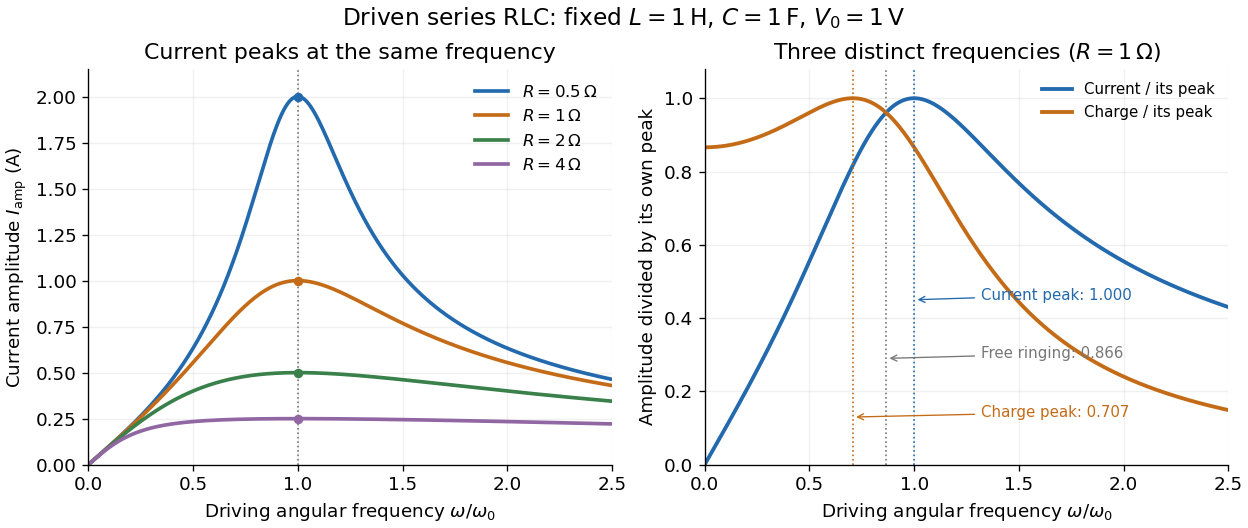

Three frequencies must be distinguished. The free underdamped RLC response rings at . Driven electric current peaks at . Driven electric charge has amplitudewhose peak occurs at only if . Otherwise it decreases from its zero-frequency limit , with no positive-frequency peak. The different peak locations follow because electric current is the time derivative of electric charge, multiplying a sinusoidal amplitude by . The limiting responses are as and as .
The Q factor measures selectivity:The average Joule heating power is . Its half-maximum angular frequencies and their separation are exactlyThese follow by setting . In the numerical example, and . Reducing makes a taller, narrower electric current peak; varying tunes the selected frequency. Measuring the drop gives a band-pass filter that suppresses very low and very high frequencies while passing a range near resonance. This is useful for selecting a radio signal, though the range must be broad enough to pass its modulation. [ref]
https://www.feynmanlectures.caltech.edu/II_22.html#Ch22-S7. Feynman lectures, II.22.7: resonant filters and radio sidebands
. New to topics? Read the docs here!