
Right ascension is the eastward angle along the reference celestial equator from the reference equinox to a direction's hour circle, conventionally reduced to . Its hours label angles: , , and . Thus radians. A minute of right ascension differs from a minute of arc, and the actual arc on a fixed-declination parallel also contains the cosine factor described under declination.
The hours become useful through sidereal time. At local sidereal time , a synthetic direction of right ascension has west-positive hour angle and has passed its upper meridian transit. Conversely, at it has hour angle and has yet to cross. Interpret these intervals in sidereal hours; ordinary civil hours are not interchangeable with them. The right ascension of the upper celestial meridian advances as the Earth turns, while the synthetic fixed target's right ascension stays unchanged.
An instrument makes this geometry tangible. DePauw University's description of McKim Observatory documents a meridian optical telescope with an angular circle, astronomical clocks and a chronograph. The circle measures zenith distance, and the crossing time supplies right ascension. Clock pulses and the observer's electrical key mark a rotating paper record, so crossing time is read relative to the clock marks. One clock kept sidereal time and another solar time. This apparatus separates two measured quantities: when a star crosses the celestial meridian, and at what angle from the zenith. [ref]
https://www.depauw.edu/about/campus/mckim-observatory/observatory-instruments/. DePauw University: McKim's meridian telescope, angular circle, clocks and chronograph
.A teaching reconstruction would fix an optical telescope to sweep the celestial meridian, align its central sighting line, and observe a recognizable reference star followed by a target. Record each central-line crossing against a clock or timestamped camera, and read the angular circle at upper meridian transit. A short sequence shows the image moving across the stationary sighting line; the central crossing supplies a repeatable event. In the ideal model, successive upper crossings of a fixed direction recur once per sidereal day, and directions with increasing right ascension cross later in the same cycle. These are predictions for the reconstruction, rather than reported McKim measurements. Tatum derives the equality between local sidereal time and right ascension at upper meridian transit. [ref]
https://www.astro.uvic.ca/~tatum/celmechs/celm6.pdf. Jeremy Tatum: Section 6.3, timing upper meridian transit
.Calibrate the clock's zero by comparing its reference crossing readout with the reference star's predicted apparent right ascension in the same date convention: the additive correction is , modulo . Then infer target right ascension if the clock rate is correct between crossings. In a purely synthetic example, and imply . A target readout therefore gives . The clock offset is in right ascension, while its local east-west angular effect at declination is approximately . The reference and target in this calculation are invented directions, with no claim about any current star's coordinates.
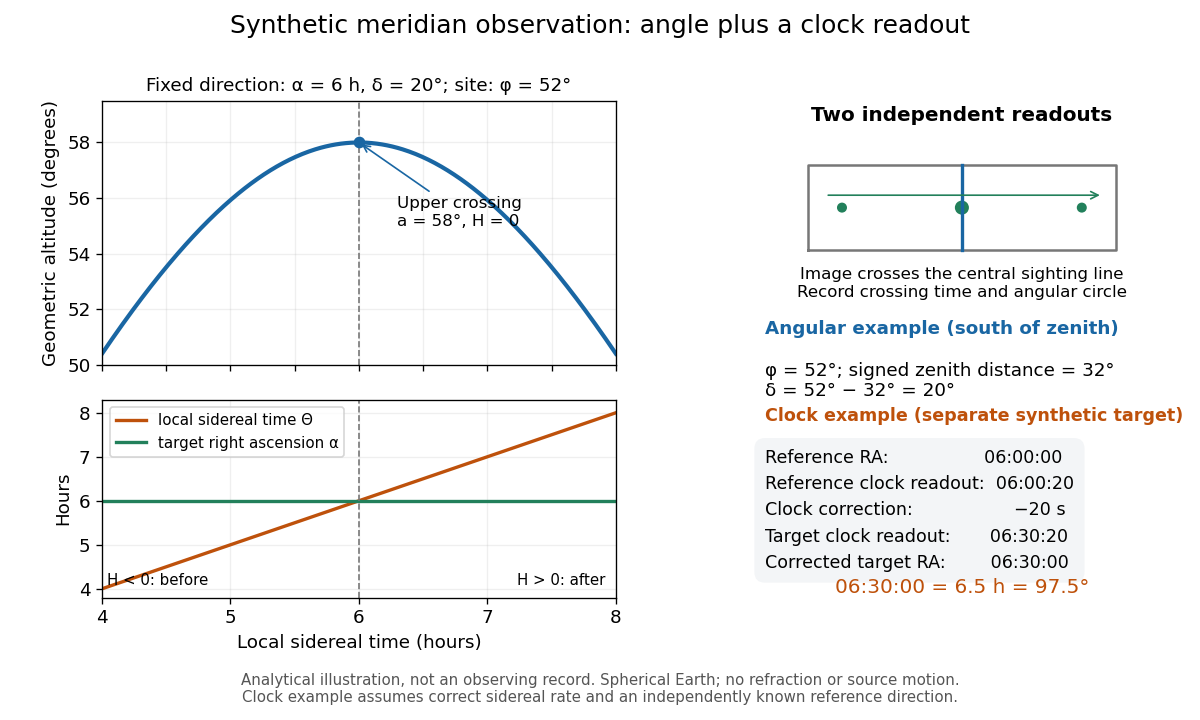
Synthetic meridian observation: changing altitude, fixed right ascension, and a calibrated sidereal-clock readout
. Details. Controls give the inference its meaning. Use independently established geographical latitude and an angular-circle zero for declination; check sighting-line alignment against several reference stars, and bracket the target in time with references to reveal clock drift. Record north or south of the zenith, distinguish upper from lower meridian transit, and account for atmospheric refraction. Convert the observing timestamp to local sidereal time using the site's east-positive longitude correction, rather than a time-zone offset; precise conversion uses the Earth's measured rotation time. A reference star calibrates a zero only after its catalogue direction has been converted to the observation convention. Repeated crossings reduce random measurement error, while an incorrect clock rate, axis alignment or catalogue convention remains a systematic limitation. [ref]
https://aa.usno.navy.mil/faq/GAST. US Naval Observatory: Local sidereal time, longitude convention and rotation-time input
. These controls are requirements inferred from the geometric and clock model, not a claimed historical observing log.

Right ascension (RA) is one of the two celestial coordinates used in the equatorial coordinate system to specify the position of an object in the sky. The other coordinate is declination (Dec). Right ascension is analogous to longitude on Earth and measures the angular distance of an object eastward along the celestial equator from a reference point known as the vernal equinox.
New to topics? Read the docs here!