
A point mass constrained to a fixed-length massless arm under uniform gravitational acceleration is a simple pendulum. With no drag its angular equation is . The small-angle approximation yields simple harmonic motion, whereas the full restoring force is nonlinear. Adding drag gives a damped pendulum.
For an ideal point mass swinging in a vertical plane, the torque about the pivot is . Dividing by its moment of inertia gives the displayed equation. Both the inertia and the gravitational torque scale with , explaining why the point mass cancels. This derivation and the small-amplitude period are given in Ling, Sanny and Moebs, University Physics, pendulums.
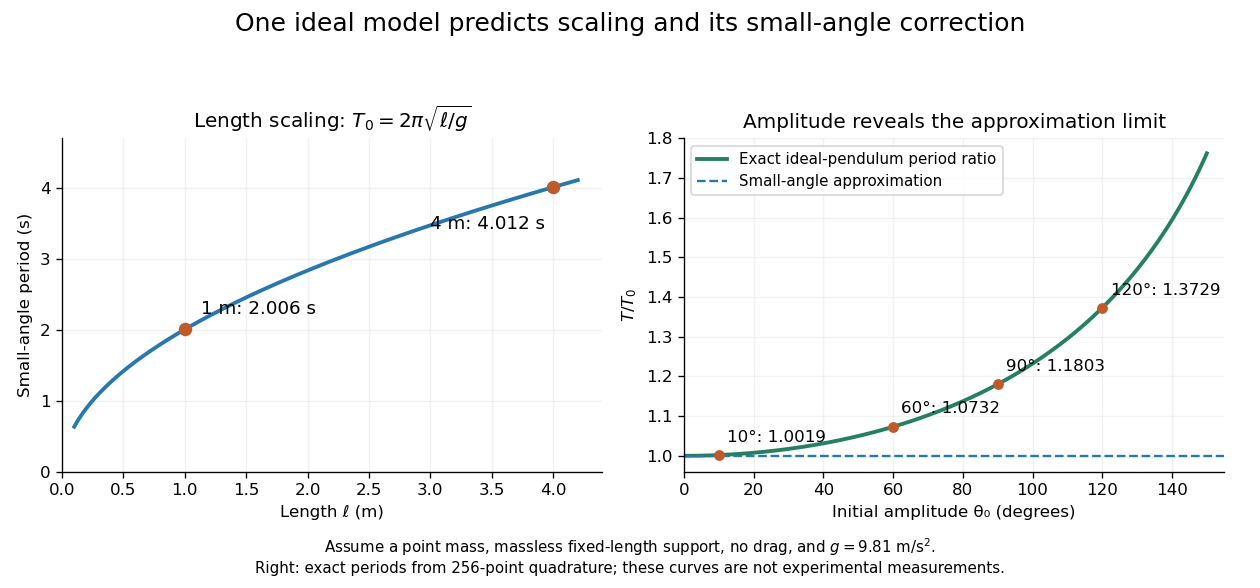
Released from rest at a small angular amplitude , the linearized solution is , with oscillation period . For , lengths one and four metres give and . This same scaling follows from dimensional analysis; the dynamical calculation supplies the coefficient .
Finite angular amplitude changes the exact ideal period. Conservation of energy gives for release from rest. Integrating a quarter oscillation and substituting givesHere is the complete elliptic integral of the first kind. The small-angle approximation gives a ratio tending to one; at , the ratios are approximately . Thus almost constant period at small amplitude has a quantitative limit. As , the period diverges, connecting to the pendulum separatrix approach takes infinite time.

These predictions assume the specified ideal system. Drag changes the mechanical energy; a massive support changes the moment of inertia. The distinction is useful in experiments: a change in period can test an approximation rather than merely indicate an arithmetic mistake.
New to topics? Read the docs here!