Solid angle of a circular cone
ID: solid-angle-of-a-circular-cone

A right circular cone with vertex selects all directions within a half-opening angle of its axis. Here is measured from the axis to a boundary direction, so the full opening in a meridian plane is . For , interpret the selected directions as a spherical cap; for , this is a region larger than a hemisphere.
The spherical coordinate system gives the area element on the sphere. Dividing by and integrating over the cap yieldsThe factor matters: a thin angular strip near a pole contains fewer directions than an equally wide strip near the equator. Treating equal intervals of both spherical coordinates as equal solid angles would overcount the polar directions.
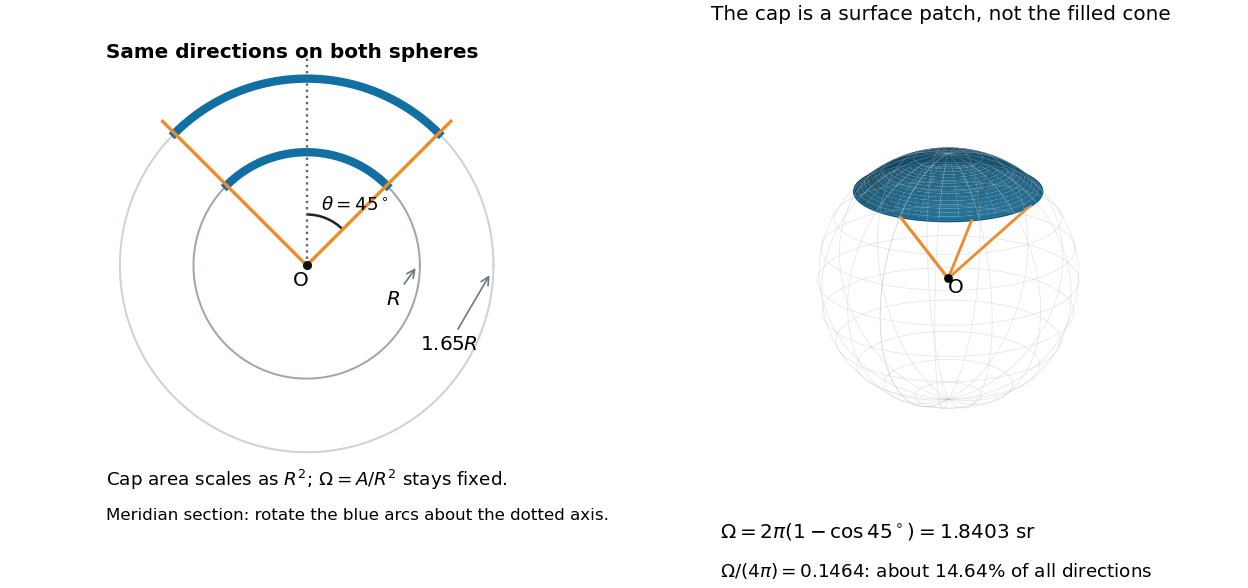

At , the solid angle is steradians, or about of all directions. At it is steradians, and at it is steradians. For a small measured in radians, the Taylor series gives the small-angle approximation . Doubling a narrow half-opening angle therefore approximately quadruples its coverage.
New to topics? Read the docs here!