
A positive integer is square-free when no square number greater than one is a divisor of . It suffices to exclude squares of prime numbers; equivalently, every prime valuation is zero or one:Thus the prime factorization of a square-free integer is a product of distinct prime factors, with no repetitions. One is included: its prime factorization is an empty product and all its prime valuations are zero. These equivalent tests are stated in Grinberg's notes. [ref]
https://darijgrinberg.gitlab.io/floor.pdf. Darij Grinberg, MIT 18.781, Floor and arithmetic functions, Definition 2.1.2 and footnote 6
For signed integers, extend the definition by requiring to be a square-free integer, where denotes absolute value. Hence and both qualify. Zero does not: every prime number has its square as a divisor of zero. The Möbius function and radical of an integer below use their existing positive integer domains, so apply them to when handling a negative integer.
For example, is a square-free integer, whereas is not, because and . Being a composite number causes no problem: are all square-free integers. A square-free integer need not be coprime to another integer: and are both square-free integers but have greatest common divisor two. In fact the only signed integers coprime to every integer are , since .
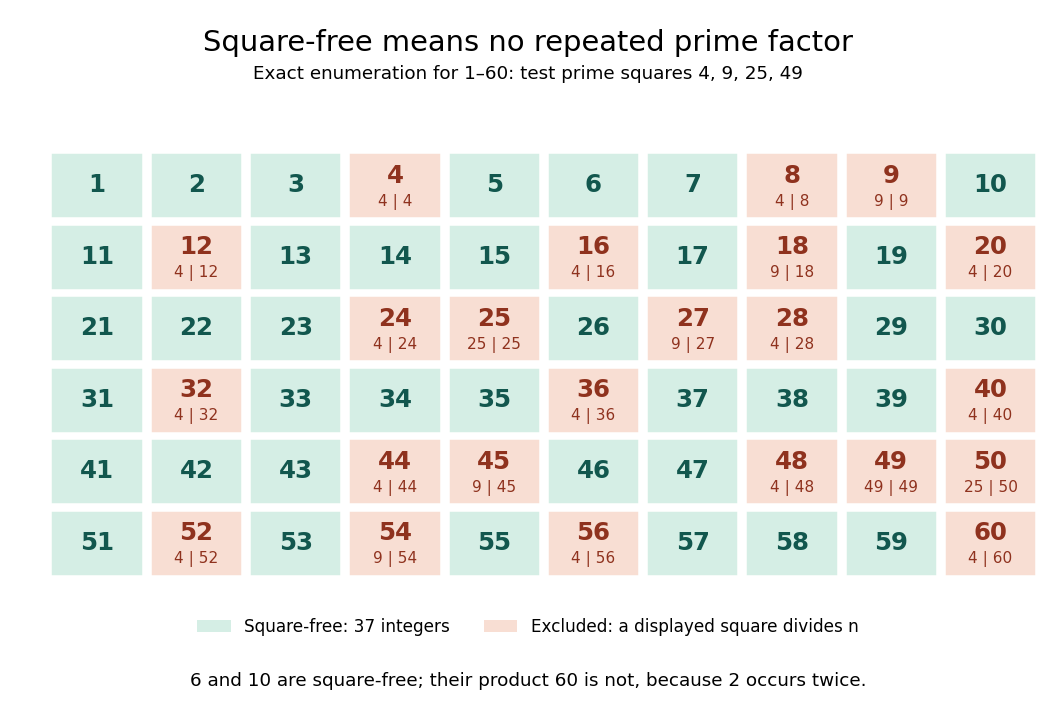
Exact square-free integer classification of the integers from one to sixty
. Green cells are square-free integers; each red cell displays a prime number square that divides its label, choosing the smallest such prime number. Only need testing in this range. There are green cells. This original finite arithmetic diagram is an exact enumeration, not a measurement or an assertion about a limiting frequency. Details.For positive integers , the useful product criterion isThe proof outline is just addition of prime valuations: can stay at most one only if neither input repeats a prime factor and no prime factor occurs in both. Thus is a square-free integer, but is not. An equivalent characterization is that every factorization into positive integers has coprime factors. If , the factorization supplies two factors sharing ; conversely, a shared prime factor forces its square to divide . For , the unordered factor pairs all have greatest common divisor one; for , the pair fails.
Two existing arithmetic functions turn the definition into practical tests:The radical of an integer keeps one copy of each prime factor, so it changes precisely the integers with a repeated prime factor. Its definition is given in Evertse's exercise sheet. [ref]
https://pub.math.leidenuniv.nl/~evertsejh/dio12-ex4.pdf. Jan-Hendrik Evertse, Diophantine approximation, Homework IV, Exercise 20
The Möbius function assigns to a square-free integer with distinct prime factors and zero otherwise; squaring forgets the sign. Consequently counts exactly the green cells. This connects a restriction on repeated prime factors with weighted counting and inclusion-exclusion. [ref]https://darijgrinberg.gitlab.io/floor.pdf. Darij Grinberg, MIT 18.781, Definition 2.1.2: the Möbius function


A **square-free integer** is an integer that is not divisible by the square of any prime number. In other words, a square-free integer cannot have any prime factor raised to a power greater than one in its prime factorization. For example: - The integer 30 is square-free because its prime factorization is \(2^1 \times 3^1 \times 5^1\); none of the prime factors are squared or higher.
New to topics? Read the docs here!