Stereographic projection
ID: stereographic-projection

Stereographic projection identifies a sphere minus one pole with the plane and supplies the standard charts of the Riemann sphere.
In the equatorial-plane convention of the Riemann sphere, draw the straight line through and a point on the unit sphere. Its intersection with the plane has complex coordinateThe inverse function, for and , isHere positive gives positive , and positive gives positive . Thus and lie on the positive and ends of the equator. The omitted north pole is assigned .[ref]
Topic 2 Notes. Complex Variables with Applications, MIT 18.04, Spring 2018; Topic 2 Notes, section 2.5.2, printed p. 7, projection formula and north pole
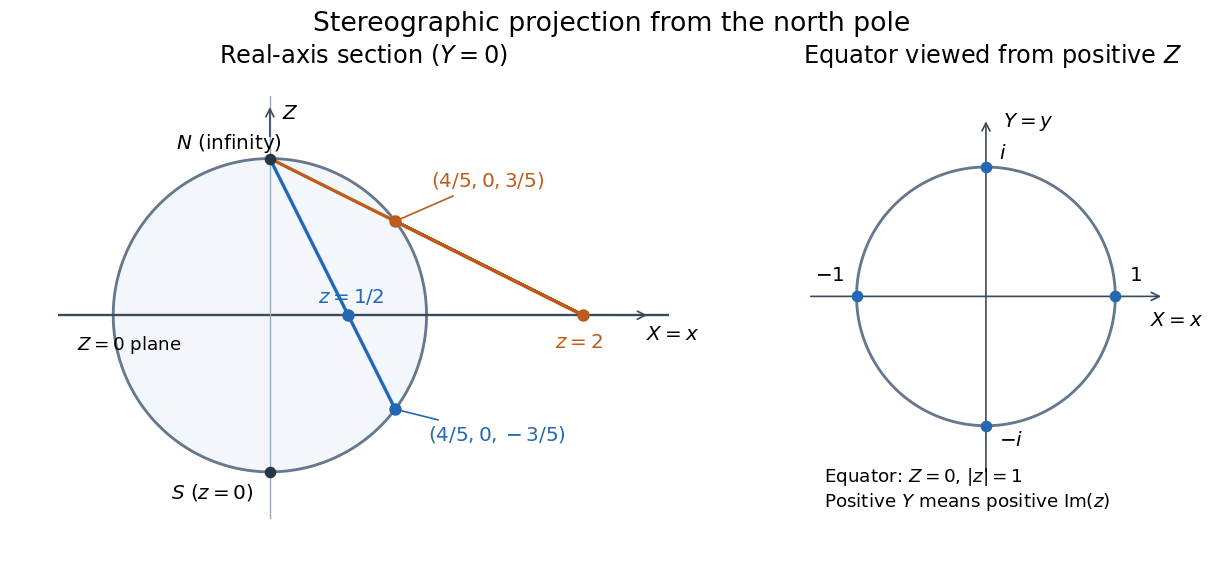
North-pole projection onto the equatorial plane: two real points and the positive complex-axis convention
. Details. For original worked points, the real numbers and lift to points with the same coordinate but opposite coordinates:Projecting back gives and . A point off the real axis checks the other sign:The coordinates satisfy , as a point on the unit sphere must. Also , and .
A short derivation starts with the line . Setting its last coordinate to zero gives , hence the projection formula. Conversely the line from to is . Substitution in the unit sphere equation givesThe root is ; the other root gives . These line intersections establish both the formula and its bijection property without guessing the inverse.
The same algebra explains how large planar distances become small spherical ones:Consequently brings to independently of direction. The last expression is twice the chordal metric distance . A whole unbounded exterior in the complex plane therefore becomes a small cap on the unit sphere.


Stereographic projection is a method of projecting points from a sphere onto a plane. It works by projecting points from the surface of a sphere onto a plane that is tangent to the sphere at a specific point. This type of projection is commonly used in various fields, including cartography, complex analysis, and computer graphics.
New to topics? Read the docs here!