An inverse function reverses a bijection. For , it is a function satisfyingEquivalently, for all and for all . We write . The superscript denotes reversal through function composition; it does not mean the pointwise multiplicative inverse . The preimage notation for a set is also distinct: a preimage exists even when no inverse function exists.
For a computed example, let be . Solving for gives . Thus and ; direct substitution gives and throughout the real line. In contrast, , which does not undo .
Why must be a bijection? If , applying gives , proving injectivity. For any , the equation supplies a source element, proving surjectivity. Conversely, a bijection supplies exactly one predecessor for each , defining a unique inverse function. A left inverse or right inverse requires only one of the two composition identities.
For on the real line, the equation has two solutions, , so its arrows cannot be reversed as one function on all inputs. The restriction to removes that ambiguity. As a bijection from onto , it has inverse function . The identity explains why works on the restricted domain of a function but fails for negative . [ref]
https://openstax.org/books/calculus-volume-1/pages/1-4-inverse-functions. OpenStax, inverse functions and domain restrictions
.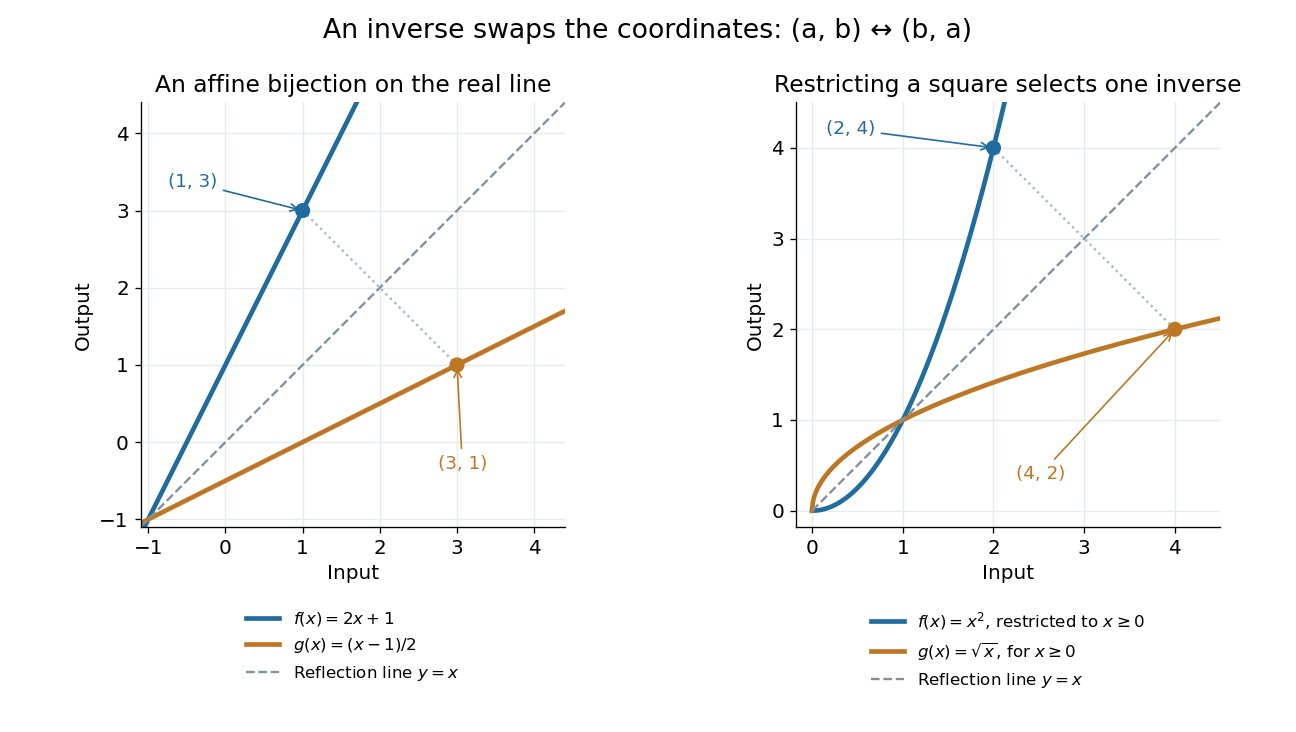
An inverse function swaps the input and output coordinates
. Left: the function graphs of and its inverse function are reflections across the line ; the points and correspond. Right: the nonnegative restriction and the square root have the same reflection relation. Their displayed portions lie in the first quadrant or on its boundary. Details.More generally, lies on the graph of a function precisely when lies on the graph of a function of its inverse function. This coordinate swap explains the geometric reflection and the horizontal line test. It also explains why inverse sensitivity is reciprocal locally: the inverse function rule divides by the original derivative at the corresponding input, when that derivative is nonzero.
For a real-valued function drawn in the plane, the horizontal line test asks whether every horizontal line intersects its function graph at most once. This is exactly injectivity, since two intersections at the same height mean two inputs have the same output. A missing height is compatible with injectivity, so an inverse function is then defined on the image of a function; it is an inverse on the entire specified codomain only when surjectivity also holds.
Suppose is continuously differentiable near with . It has a local inverse function near , andThe chain rule applied to gives the formula. The nonzero derivative condition also ensures local invertibility; it does not assert a global inverse function on an arbitrary larger domain of a function. For at , the corresponding output is , and the square root's derivative there is . At , this division is unavailable: the nonnegative restriction still has a square root inverse, but its finite derivative at zero does not exist. [ref]
https://openstax.org/books/calculus-volume-1/pages/3-7-derivatives-of-inverse-functions. OpenStax, the inverse function rule and corresponding evaluation points
.A right inverse of a function is a function satisfying . It forces to be a surjective function. A surjective linear map onto a finite-dimensional vector space has a linear right inverse: lift a basis of the target and extend by linearity.
The assertion that every surjective function has a right inverse is equivalent to the axiom of choice. Choice selects one member of each nonempty fiber of a function, giving a right inverse. Conversely, for a family of nonempty sets, the projection from the disjoint union onto is surjective. A right inverse selects one element from each , giving a choice function.

