Stereographic projection identifies a sphere minus one pole with the plane and supplies the standard charts of the Riemann sphere.
In the equatorial-plane convention of the Riemann sphere, draw the straight line through and a point on the unit sphere. Its intersection with the plane has complex coordinateThe inverse function, for and , isHere positive gives positive , and positive gives positive . Thus and lie on the positive and ends of the equator. The omitted north pole is assigned .[ref]
Topic 2 Notes. Complex Variables with Applications, MIT 18.04, Spring 2018; Topic 2 Notes, section 2.5.2, printed p. 7, projection formula and north pole
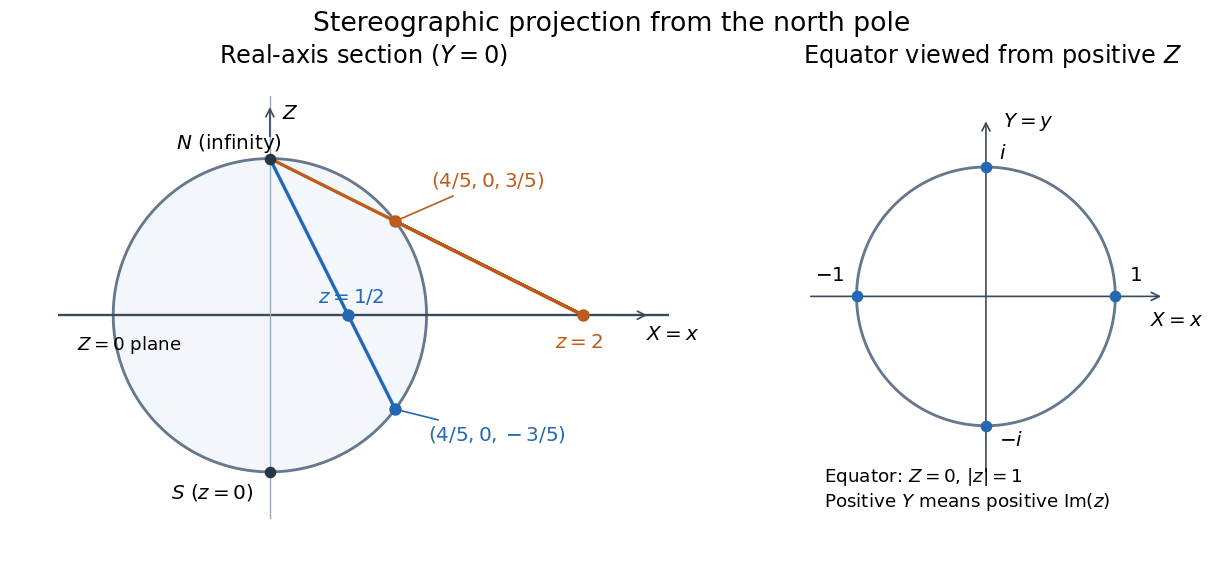
North-pole projection onto the equatorial plane: two real points and the positive complex-axis convention
. Details. For original worked points, the real numbers and lift to points with the same coordinate but opposite coordinates:Projecting back gives and . A point off the real axis checks the other sign:The coordinates satisfy , as a point on the unit sphere must. Also , and .
A short derivation starts with the line . Setting its last coordinate to zero gives , hence the projection formula. Conversely the line from to is . Substitution in the unit sphere equation givesThe root is ; the other root gives . These line intersections establish both the formula and its bijection property without guessing the inverse.
The same algebra explains how large planar distances become small spherical ones:Consequently brings to independently of direction. The last expression is twice the chordal metric distance . A whole unbounded exterior in the complex plane therefore becomes a small cap on the unit sphere.
For north-pole stereographic projection on the unit sphere, substitute into a planar circle equation. The displayed plane equation follows, and its intersection with the sphere is a circle. The plane contains the sphere's centre exactly when , giving a great circle.
A planar circle other than the unit circle lifts to a great circle exactly when it meets the unit circle at two opposite points. A great circle other than the equator intersects the equator in an antipodal pair. Conversely the plane containing a lifted circle and an antipodal pair contains their midpoint, the sphere's centre. Algebraically, adding the equations and with gives the displayed condition.
For north-pole stereographic projection on the unit sphere, the antipodal pair point has coordinate . Since , this gives when both coordinates are finite. On the whole Riemann sphere, write , pairing zero with infinity. The two axis endpoints fixed by a sphere rotation obey this relation.
Use the north-pole stereographic projection and the cross-ratio convention . Antipodes have coordinates . Rotate the first point to the south pole, whose coordinate is zero: its antipode becomes infinity, while a point at spherical distance has projected modulus . Möbius invariance of the cross-ratio then gives the displayed identity. Antipodal endpoints require the extended-value interpretation.
On the unit sphere, use away from the north pole and away from the south pole. Their overlap relation is a holomorphic map, giving a holomorphic atlas for the Riemann sphere. The opposite sign of in the second manifold chart ensures a holomorphic rather than antiholomorphic transition.
Writing the sphere coordinates as avoids confusing their height with the complex coordinate . The two manifold charts cover the whole unit sphere:On their overlap, givesThe coordinate transformation and its inverse are holomorphic, so these manifold charts make the sphere a Riemann surface. The sign in is essential. Geometric projection from the south pole with the same planar axis labels would give . The complex conjugation in that transition prevents it from being holomorphic. For , the correct second coordinate is : positive corresponds to negative imaginary part in this manifold chart.
The reciprocal chart makes infinity an ordinary coordinate origin. Its domain is the Riemann sphere minus the point ; and elsewhere. A neighbourhood of infinity becomes the open disc . In sphere coordinates this is exactly the capFor , the exterior together with infinity becomes and . The boundary itself is excluded from each open set.
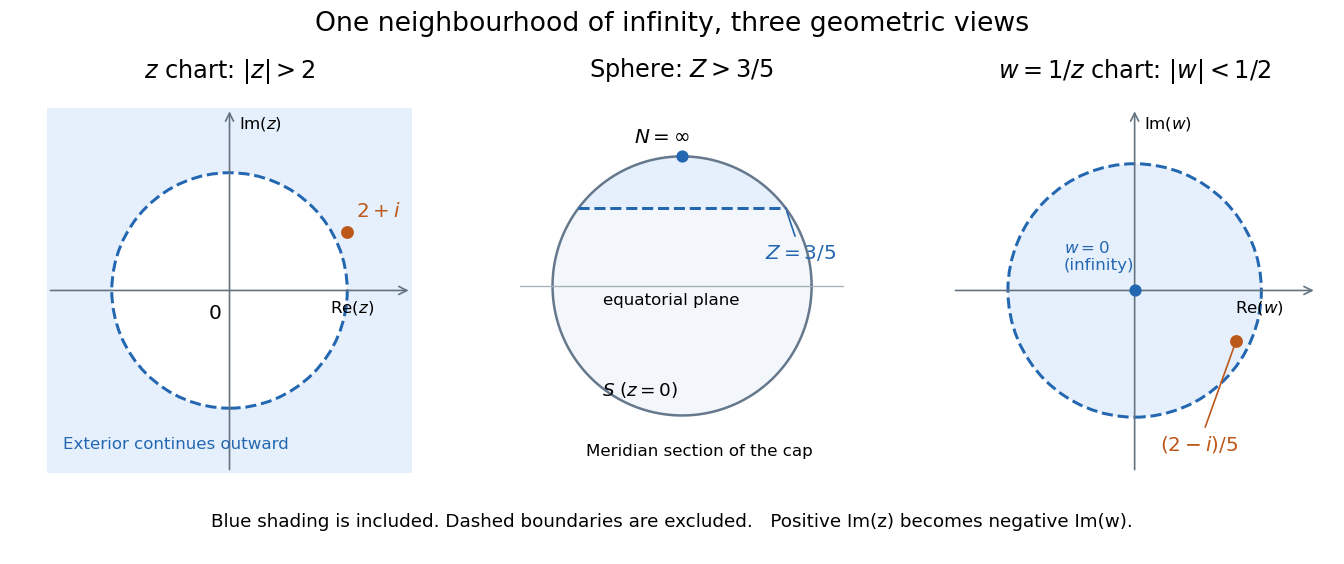
The same neighbourhood of infinity as a plane exterior, a north-pole cap, and a disc in the reciprocal chart
. Details. The point lies in this neighbourhood because . Its reciprocal coordinate is , with , and its sphere height is . The negative imaginary part of is the axis reversal required by the holomorphic stereographic atlas of the sphere.
For a complex-valued holomorphic function defined outside a large disc, having a removable singularity at infinity means that extends to a holomorphic function at . This definition reduces questions at infinity to familiar questions at a finite point.[ref]
Complex Analysis Lecture Notes by Dan Romik. Complex Analysis Lecture Notes, section 9, items 81–82, printed p. 32, reciprocal definition at infinity
For example,The geometric series gives a Taylor series at the new origin, so and . The coefficient is the derivative in the specified coordinate. In contrast, becomes , displaying a pole of order two at infinity when the target is the complex plane. As a holomorphic map to the Riemann sphere, it uses the target reciprocal coordinate , which is regular at zero.Under the stereographic projection , rotations about the third axis have representatives , and rotations about the second axis have representativesThese belong to the special unitary group . Euler-angle generation of the special orthogonal group shows that every sphere rotation becomes a Möbius transformation represented in . Representatives and induce the same transformation.
Articles by others on the same topic



Stereographic projection is a method of projecting points from a sphere onto a plane. It works by projecting points from the surface of a sphere onto a plane that is tangent to the sphere at a specific point. This type of projection is commonly used in various fields, including cartography, complex analysis, and computer graphics.