
Stereoscopy uses images from different viewpoints to convey or recover depth. In scientific photography, identifying the same feature in two calibrated views permits stereoscopic triangulation: intersecting the directions inferred from the two images.[ref]
What Is Stereo Reconstruction? by MathWorks. How Does Stereo Reconstruction Work? and Stereo Camera Calibration
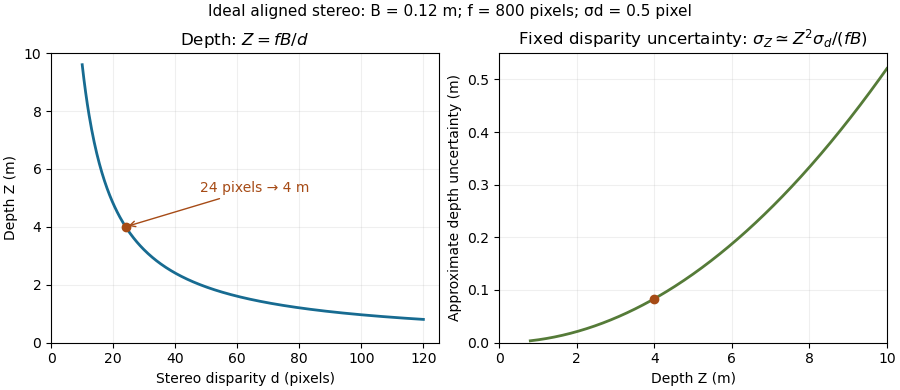
Consider ideal cameras with parallel axes, separated by a baseline . With matching forward-projection coordinates and common focal length in image-coordinate units, a point at projects toSubtracting gives the stereo disparity , hence . If and are measured in pixels, has the same length unit as .
For an original example, , pixels and pixels give . First-order propagation of uncertainty gives . Thus fixed disparity precision produces increasing depth uncertainty for more distant objects. Correctly matching the same feature is also essential; ambiguous or hidden features can defeat the reconstruction even when the geometry is known.

New to topics? Read the docs here!