Tail-model dependence of inferred density uncertainty
ID: tail-model-dependence-of-inferred-density-uncertainty

Tail-model dependence of inferred density uncertainty is the sensitivity of a density estimate's distribution to the assumed probability of very small positive thicknesses. For with fixed , a tiny thickness has disproportionate influence through . The main body of a thickness histogram can look stable while the inferred mean or variance remains model-dependent.
A gamma distribution and a lognormal distribution provide useful explicit models. NIST specifies their density functions and parameter conventions.[ref] At mean thickness and coefficient of variation , the gamma model has shape and givesThe lognormal model gives . The two agree closely for small , but that agreement concerns those model families, not every positive distribution with a similar spread.
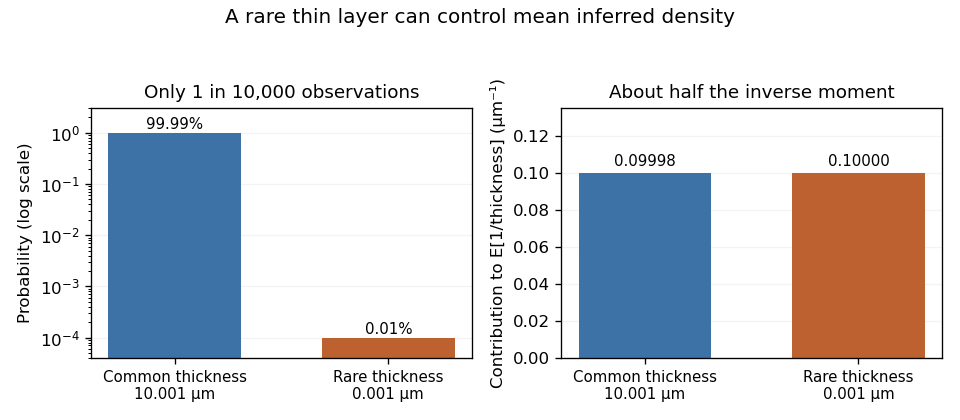
An original rare-event example makes the limitation explicit. Let thickness be micrometres with probability and micrometres otherwise. Mean thickness is exactly 10 micrometres and its standard deviation is approximately 0.10 micrometres, about 1% of the mean. Nevertheless,nearly twice the reciprocal of mean thickness. The rare component supplies about half the inverse moment. These are deliberately constructed model values, not measured polymer-layer dimensions.
Rare-thickness leverage on inverse moments can escape an apparently reassuring sample. With 1,000 independent thickness observations, the chance of seeing none of that rare component is . A finite simulation or a smooth fit to common observations need not validate the unobserved lower tail.
A useful experiment investigates whether dimensional resolution, specimen geometry or physical constraints rule out such near-zero layers. Report sensitivity to defensible alternative lower-tail models or measured lower bounds. Choosing a positive distribution guarantees positive thickness, but does not establish that its inverse moments describe the measurement process.

New to topics? Read the docs here!