Target purity versus cell-state change in microdissection
ID: target-purity-versus-cell-state-change-in-microdissection

Target purity versus cell-state change in microdissection is the distinction between changing which cells enter an assay and changing the molecular state of the target cells themselves. Microdissection can enrich a selected cell population while its per-cell gene expression stays unchanged. Conversely, a measured change can combine enrichment, a genuine cell state difference and altered molecular recovery during preparation.
An original two-population model makes the ambiguity explicit. For equal per-cell weighting, let be the target-cell fraction and the target and background per-cell signals. The measured mean isWith and , changing from to raises from to without any target-cell change. If the target signal instead falls to at the second measurement, is still , above its original . A rising mixture signal therefore does not establish increased expression within the target cell population.
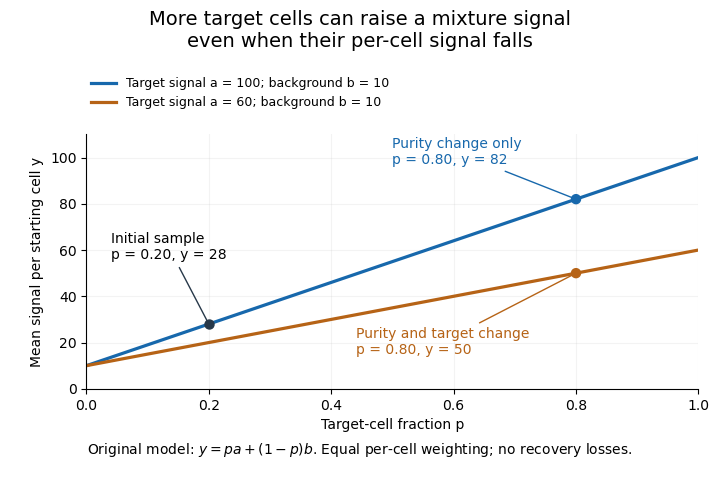
Original two-population model separating enrichment from per-cell signal change during microdissection
. Lines are stipulated mixture equations, not experimental observations. The initial point is p=0.20, a=100, b=10; the two final points share p=0.80 but have different target-cell signals. Details.
If and are independently known, then . Holding those inputs fixed, a small signal error propagates as . Purity amplifies that error fivefold, whereas amplifies it by only . Estimating purity is useful, but an uncertain purity or an unrepresentative background introduces further error.
Normalization also changes the mixing weights. If target and background cells contribute total extracted RNA amounts per cell, their fraction of the extracted RNA isAt and , of the RNA comes from target cells despite target-cell purity. A signal per unit total RNA is therefore not automatically the same observable as a signal per starting cell.
Preparation can alter the analyte without creating an original in-vivo cell state difference. In a primary study, Mathieu Clément-Ziza and colleagues compared conditions preserving RNA integrity during laser capture microdissection, including an argon atmosphere and an ethanol-based preparation. Their time-dependent RNA-quality measurements address preservation, not proof that all living-cell transcription stayed unchanged.[ref]
Useful comparisons separately document selected regions, target fraction, recovery and the normalization denominator. Before/after specimen images test what was removed; molecular quality controls test what survived; matched biological comparisons test the proposed cell state change. No one of those observations substitutes for all the others.
New to topics? Read the docs here!