Gene expression uses a gene's information to produce functional RNA or a protein. Transcription makes RNA from a DNA template; for a protein-coding gene, biological translation then uses messenger RNA to specify an amino acid chain. Many genes instead produce functional RNA, including transfer RNA and ribosomal RNA, without a translated protein product. See Alberts et al., Molecular Biology of the Cell, 4th edition (2002): from DNA to RNA.
Follow the chosen coding strand : transcription of its complementary template gives in messenger RNA. In the stated reading frame, its three codons are AUG, GCU and UAA: methionine, alanine and a stop codon. Thus nine nucleotides specify two amino acid residues followed by termination, not three residues. This is an illustrative coding segment embedded in suitable expression and initiation context, not a claim that an isolated nine-nucleotide RNA is sufficient to initiate biological translation.
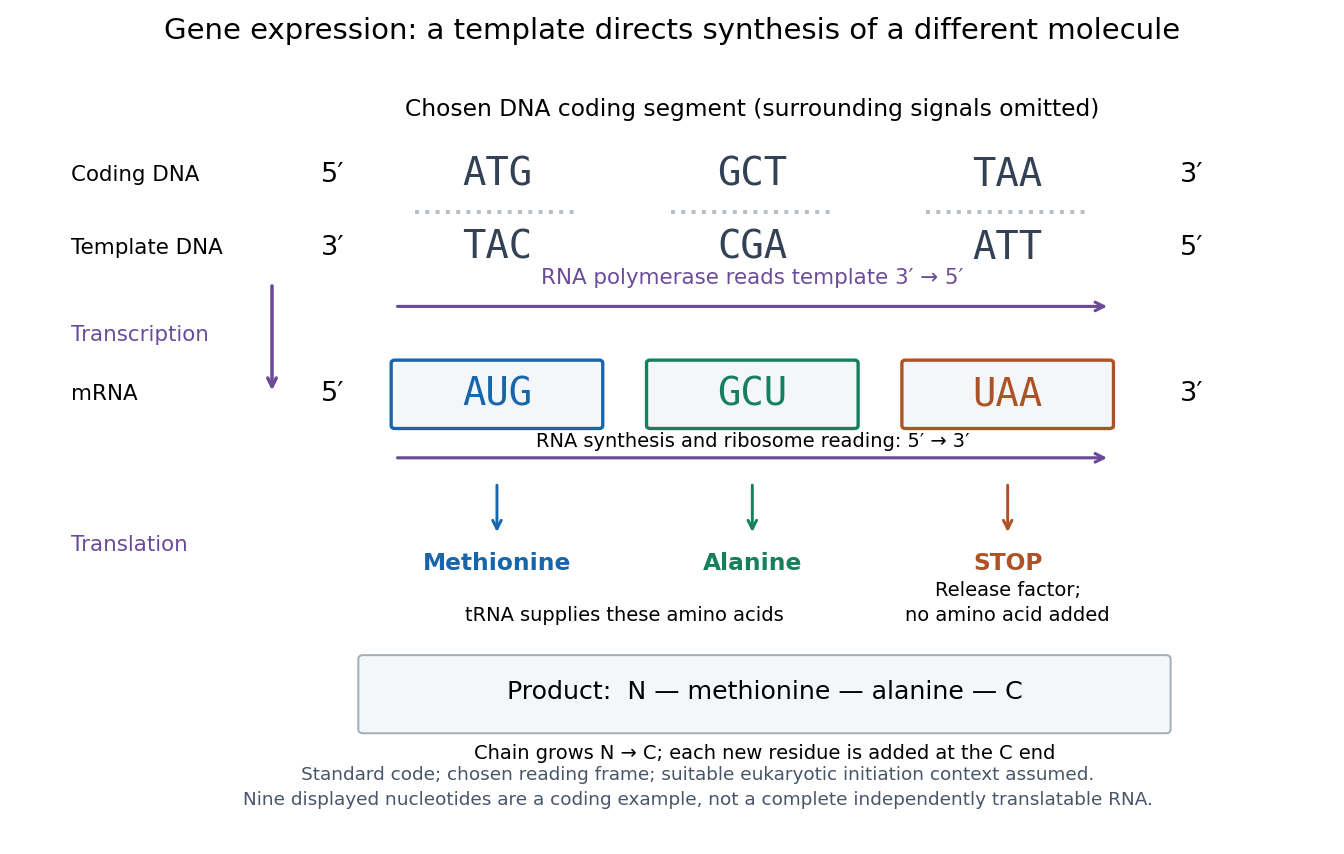
The distinction between copying and use explains how biological cells can preserve the same DNA yet produce different products. DNA replication duplicates the record; gene expression selects and uses parts of it. Transcription does not use all DNA at once, and gene expression can be controlled at several steps, including transcription, RNA processing and biological translation. See Clark, Douglas and Choi, Biology 2e: regulation of gene expression. The arrows describe template-directed synthesis: the DNA does not physically turn into a protein, and the messenger RNA does not supply the amino acids from which that protein is assembled.
In the GAL1 gene promoter system used in the yeast cross-species complementation experiment, the inducing sugar galactose promotes gene expression from the engineered construct, whereas glucose provides a noninducing comparison. The comparison concerns an imposed regulatory system, not the donor species’ native regulation. [ref]
Pathways Over Time Plasmids Engage Students in Functional Genomics Research by Clare O’Connor. O’Connor (2018), Plasmid features enable multiple student experiments and Complementation reveals conservation of function: GAL1 promoter
A gene promoter is a DNA region involved in initiating transcription. Moving a coding sequence into a nuclear genome does not guarantee that its original gene promoter can drive nuclear gene expression.
A transcription factor is a protein that regulates transcription. Combinations of transcription factors help select gene expression patterns during cell differentiation. [ref]
Anatomy and Physiology 2e by J. Gordon Betts and others. Anatomy and Physiology 2e, §3.6, Differentiation and Figure 3.35: transcription factors
Transcription is synthesis of RNA using one DNA strand as a template by an RNA polymerase. During elongation the RNA polymerase reads that template while extending RNA . Only the selected region is transcribed; other regions need not be active, and the template strand can differ between genes. See Alberts et al.: RNA polymerase and selection of transcribed DNA regions.
For the displayed example, align these three nucleotide sequences in the same left-to-right positions:The first template triplet TAC selects AUG: T pairs with A, A with U, and C with G. The next CGA selects GCU, and ATT selects UAA. The coding strand therefore matches the RNA lettering except for T versus U, whereas the template is complementary. Reading that template in its own direction gives ; orientation cannot be discarded. The gene expression diagram keeps all three rows aligned. See Clark, Douglas and Choi, Biology 2e: template and coding strands in transcription.
This correspondence makes nucleotide sequences interpretable, but replacing T by U is valid only after identifying the coding strand. Moreover, RNA may be processed after transcription, so the initial product and mature messenger RNA need not have identical uninterrupted nucleotide sequences. Transcription also makes functional RNA that will not undergo biological translation. See Alberts et al.: RNA processing and RNA as the final gene product.
An RNA polymerase used in transcription is an enzyme that synthesizes RNA from a DNA template. Unlike a replicating DNA polymerase, it can start a new strand without a pre-existing paired strand end; initiation still requires the appropriate DNA signals and associated machinery. See Alberts et al.: RNA polymerase and transcription initiation.
For a specified transcription unit, the coding strand is the DNA strand matching the initial RNA product in the direction, with T in place of U. The opposite DNA strand is the template. The name does not imply that every transcribed gene encodes a protein. See Clark, Douglas and Choi: coding and template strands.
Biological translation uses a ribosome to read messenger RNA codons and assemble the corresponding amino acid chain. Transfer RNA adaptors match codons through base pairing and carry the amino acids; the genetic code supplies the correspondence. The chain grows from the N-terminus toward the C-terminus, by adding each new residue at the C-terminus. See Clark, Douglas and Choi, Biology 2e: ribosomes, transfer RNA and protein synthesis.
In the gene expression diagram, read in the chosen reading frame. Under the standard genetic code, AUG specifies methionine and GCU specifies alanine; UAA is a stop codon. The result before any subsequent processing is the two-residue chain N–methionine–alanine–C, followed by termination. The stop codon contributes zero amino acids. See Clark, Douglas and Choi, Biology 2e: the standard genetic code. This example assumes appropriate initiation at the displayed AUG in a suitable context in a eukaryote; the diagram displays the coding segment, not a complete independently translatable messenger RNA.
Initiation establishes the starting position and reading frame, using a ribosome, an initiating transfer RNA and additional factors. At a standard stop codon, a release factor promotes release of the chain rather than delivery of another amino acid by transfer RNA. See Clark, Douglas and Choi: initiation and termination of translation. A short two-residue example illustrates decoding, not the size or folding of a typical functional protein.
The useful connection is between two different alphabets: nucleotides specify the order of amino acids through the genetic code. Base pairing helps select transfer RNA, while the ribosome catalyzes joining the delivered amino acids. The messenger RNA remains a template rather than being consumed as the chain's building material. Separating template, adaptor and product makes clear why transcription and biological translation are distinct mechanisms.
The genetic code assigns RNA codons to amino acids or termination signals. Four possible nucleobases at each of three positions give codons. In the standard genetic code, 61 specify amino acids and three are stop codons; several codons can specify the same amino acid. Variants exist, so state which genetic code is being used. See Clark, Douglas and Choi: genetic code assignments and variants.
A codon is a three-nucleotide unit read in a specified reading frame during biological translation. For example, GCU specifies alanine in the standard genetic code. Its letters are read .
In the standard genetic code, UAA, UAG and UGA are stop codons: they signal termination of biological translation rather than an amino acid assignment. See Clark, Douglas and Choi: stop codons.
A reading frame specifies how consecutive nucleotides are grouped into codons. Starting at position 1 of AUGGCUUAA gives AUG / GCU / UAA; starting at position 2 gives UGG / CUU with AA left over. The letters are unchanged but the groups differ. A possible grouping alone does not establish an actual biological translation initiation site.
Articles by others on the same topic


Gene expression is the biological process through which the information encoded in a gene is used to produce a functional gene product, usually a protein, but it can also refer to the production of non-coding RNA molecules such as rRNA, tRNA, or microRNA. This process involves several key steps: 1. **Transcription**: The DNA sequence of a gene is transcribed into messenger RNA (mRNA) by RNA polymerase.