Trypsin cleavage specificity
ID: trypsin-cleavage-specificity

Write a peptide's protein primary structure from its N-terminus toward its C-terminus. The usual simplified trypsin cleavage specificity rule places a cut immediately after K (lysine) or R (arginine), unless the next amino acid residue is P (proline). The following amino acid residue is essential: a terminal K or R has no following peptide bond to cut. The inspected institutional documentation describes proline as usually blocking cleavage, and explicitly lists sequence contexts in which that blocking is negligible. It also warns that experimental results can differ from sequence-based predictions. Thus “never before proline” is too strong.[ref]
For an original worked example, stipulate complete cleavage at all sites allowed by that simplified rule in the twelve-amino acid residue sequenceA denotes alanine, G denotes glycine, and K, R and P have the meanings above. Cuts follow positions , and . Position is R, but its following P suppresses that cut in the stipulated rule; position is terminal K. Notice that the R in ARPK is retained inside the fragment, despite being a usually favoured trypsin target.
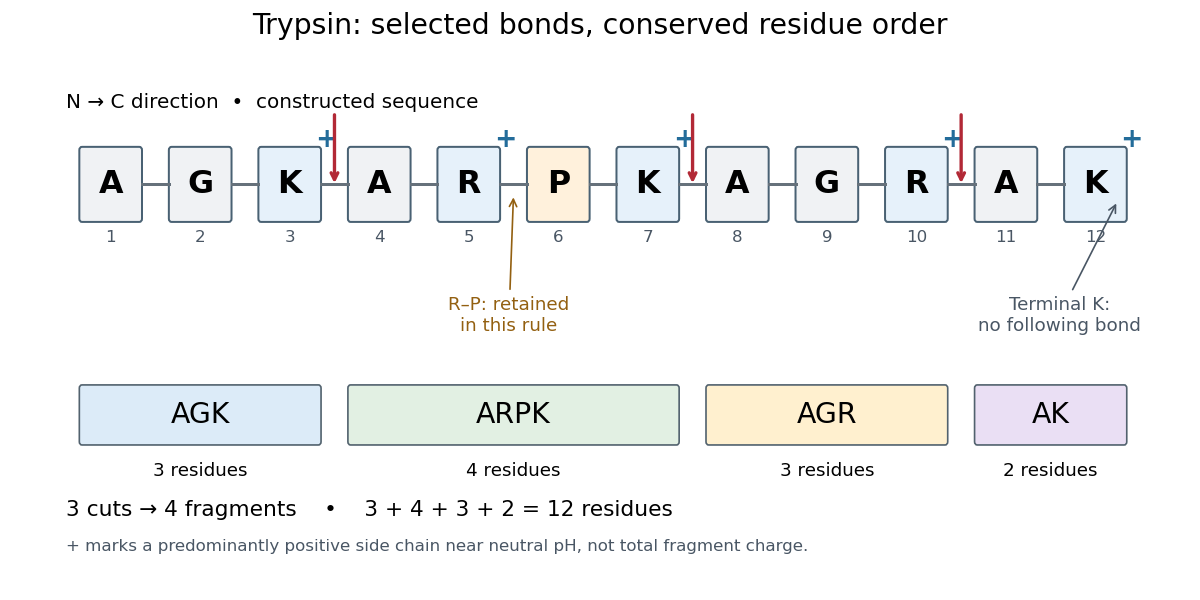
Trypsin cleavage specificity: three selected cuts make four peptide fragments
. Original sequence and prediction under the simplified K/R rule with suppression before proline. Blue plus signs identify predominantly positive lysine and arginine amino acid side chains near neutral pH, not the net electric charge of each fragment. The example is constructed, not an observed digest. Details.
Near neutral pH, the lysine and arginine amino acid side chains undergo predominant protonation and carry positive electric charge. This helps distinguish those amino acid residues from the uncharged letter symbols used to write the sequence; those symbols specify identities, not whole-fragment electric charges.[ref]
26.1 Structures of Amino Acids. Organic Chemistry by John McMurry; Table 26.1, lysine and arginine rows; concluding classification paragraph, side-chain protonation at pH 7.3
Fragment accounting checks the prediction: lengths conserve the twelve amino acid residues. The original linear chain has eleven peptide bonds; the four fragments retain , so three were hydrolysed. Three water molecules are consumed per original chain in this formal stoichiometry. More generally, cutting distinct bonds of one linear peptide makes fragments: each cut splits one connected piece into two. This argument assumes an unbranched chain without additional links joining the pieces.
A missed trypsin cleavage at position would instead give , merging two neighbouring fragments without changing their order. Even a correct cleavage preference does not guarantee complete proteolysis; predicted fragment boundaries describe a model, while actual boundaries require evidence from the digest.
New to topics? Read the docs here!