The pH of a chemical solution is the negative base-ten logarithm of its hydrogen ion thermodynamic activity:The thermodynamic activity is a dimensionless quantity, so the logarithm has a dimensionless argument. The definition uses thermodynamic activity, rather than total chemical acid concentration. Single-ion thermodynamic activities require a convention; practical pH measurements are tied to calibrated standards. See IUPAC Gold Book, pH.
In a dilute ideal chemical solution in water, a useful approximation isSquare brackets denote concentration in moles per litre. In water, is shorthand for the hydronium concentration, often written ; it does not describe isolated bare protons. Departures from ideal behavior need activity coefficients. The concentration formula approximates the thermodynamic activity definition.
For an ideal strong acid supplying one proton per initial unit, stipulate a total concentration of and negligible self-ionization of water. Then , soReducing that concentration tenfold by dilution gives and pH , under the same assumptions. More generally, dividing the hydrogen ion thermodynamic activity by ten raises pH by one. This is why the scale compresses an enormous range: equal steps of pH represent multiplicative changes, rather than equal differences in concentration. These are model calculations, rather than measured samples.
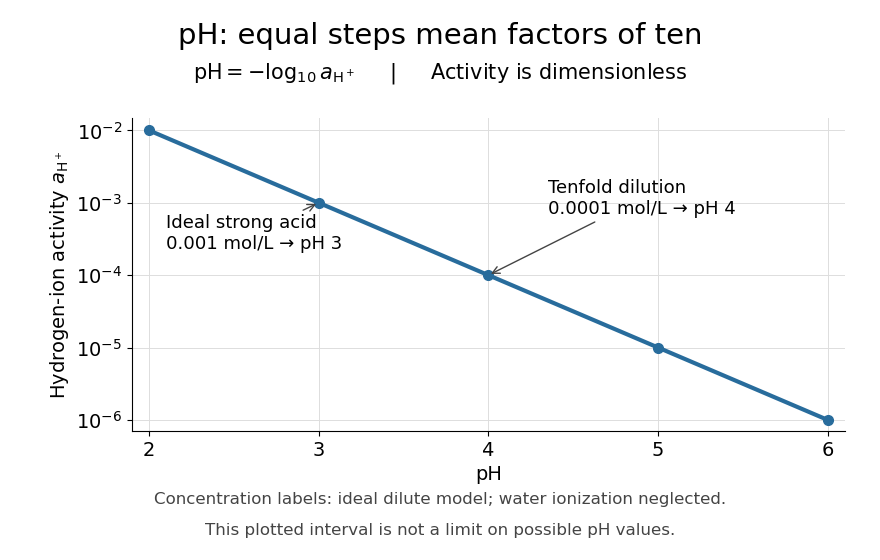
Neutrality depends on temperature. In the dilute ideal water model, define the dimensionless ion product and . Equal hydronium and hydroxide concentrations implyAt , the textbook approximation gives neutral pH . Since varies with temperature, neutrality need not mean pH . Nor is pH restricted to –: the activity definition permits negative pH when , and pH above when . High concentrations can invalidate the dilute ideal approximation. See Flowers et al., Chemistry 2e, pH and pOH.
S. P. L. Sørensen introduced pH at the Carlsberg Laboratory in 1909, as recorded in the Carlsberg Foundation historical timeline.


