Ventricular compliance
ID: ventricular-compliance

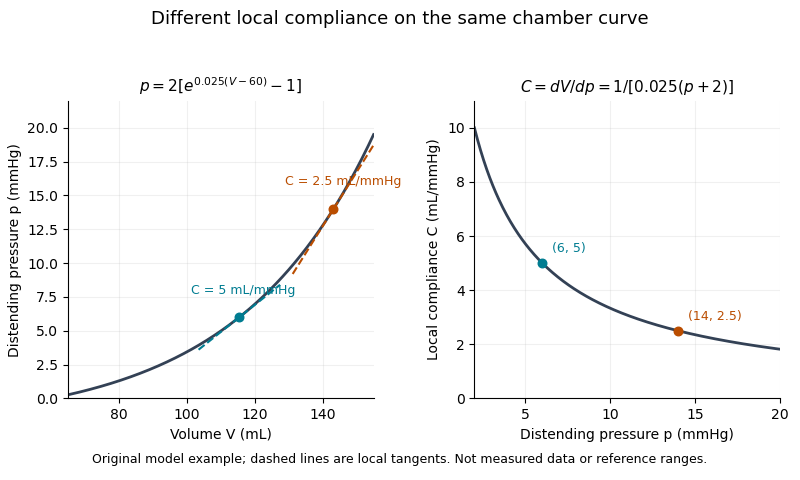
Ventricular compliance describes how much a ventricle's volume changes for a small change of distending pressure, with the mechanical state and other relevant conditions specified. For a passive chamber relation , its local value isThe distinction between intracavity and transmural pressure matters when external pressure changes. A large local compliance means a relatively large volume increment for a small pressure increment; its reciprocal is the local chamber stiffness. It is a chamber property and need not equal a material property of the muscular wall.
For a linear model , the derivative is constant. The quotient generally is not that compliance, because it also contains the reference volume . Nor does a single pressure-volume point determine a slope. The end-diastolic pressure-volume relationship instead assembles measurements at a specified phase over different filling states.
An original nonlinear model makes this distinction visible. TakeDirect differentiation givesWith stipulated mmHg and , the local compliances at pressures 6 and 14 mmHg are 5 and 2.5 mL/mmHg. The second operating point is less compliant even though the model parameters are unchanged. These are explanatory values, not human reference ranges or a diagnosis.

A primary experiment made the measurement problem concrete. Six excised dog hearts were perfused outside the body. An intraventricular balloon supplied a known volume, a micromanometer catheter recorded pressure, and echocardiography with automated boundary detection measured a mid-ventricular short-axis area. Repeated volume increments allowed pressure-area estimates to be compared with the balloon's pressure-volume reference. The reported agreement supported that experimental estimation method, while the authors explicitly left clinical validation open.[ref]
A pressure-volume trajectory during left ventricular filling also reflects time-dependent relaxation, valve flow and external constraints. Its instantaneous slope should not automatically be interpreted as the derivative of one fixed passive curve. Specifying the phase, pressure reference and conditions makes ventricular compliance a testable mechanical quantity rather than a synonym for filling volume.
New to topics? Read the docs here!