
A Vernier scale is an auxiliary graduated scale whose spacing differs slightly from the main scale. A fine displacement is read by finding which pair of graduation lines coincides. The device converts a difficult visual estimate of a small gap into a more conspicuous coincidence index. A caliper can attach the auxiliary scale to its sliding jaw.[ref]
Quick Guide to Precision Measuring Instruments: Calipers by Mitutoyo. printed pp. 16–17, scale reading and Types of Vernier Scale
For an original ideal direct vernier, let one main-scale division be and let auxiliary divisions span . Each auxiliary division isIf the auxiliary zero is displaced by beyond main mark , its graduation lies at . Coincidence with main mark gives . Thus the reading is , for the stated geometry.
With and , the auxiliary divisions are apart and the reading increment is . If the auxiliary zero is just beyond 12 mm and graduation 7 coincides, the reading is .
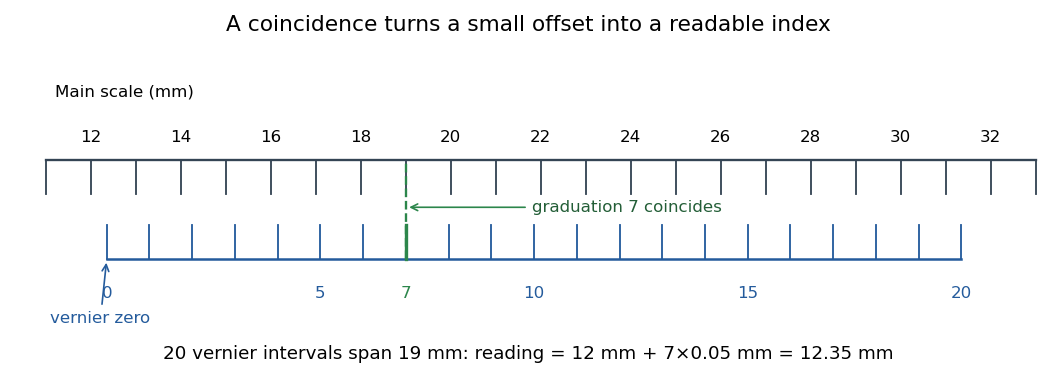
An ideal Vernier scale reading 12.35 mm: twenty auxiliary intervals span 19 mm, and graduation 7 coincides with a main-scale line
. Details. 
This is a constructed example. The manufacturer guide gives the same 0.05 mm spacing-difference principle and distinguishes a longer vernier, whose auxiliary division is 0.05 mm shorter than two main divisions. That longer scale can improve readability while retaining the same increment; the reading rule must match the actual graduation geometry.[ref]
Quick Guide to Precision Measuring Instruments: Calipers by Mitutoyo. printed p. 17, standard and long Vernier scales
A Vernier zero correction is needed when the closed or reference setting does not indicate the intended zero. For example, if the instrument reads at a true zero setting, subtracting that offset changes a later raw reading of to . The sign of the correction follows the observed error, not the direction of the object's length.
Fine graduations do not establish measurement accuracy. Jaw tilt, measuring force, thermal expansion, wear and viewing geometry can introduce errors larger than one increment. The primary guide identifies those physical sources explicitly.[ref]
Quick Guide to Precision Measuring Instruments: Calipers by Mitutoyo. printed p. 17, Sources of Error and Moving Jaw Tilt Error
Check reference closure and suitable calibrated artefacts, control contact force and record the relevant measurement uncertainty rather than treating the last readable digit as the whole error budget. New to topics? Read the docs here!