Voltage divider loading error
ID: voltage-divider-loading-error

For and , define the fractional shortfall in output magnitude from the unloaded value byThis is a loading bias relative to the unloaded target, not the uncertainty of an instrument's measurement of the connected circuit. The equality with the signed ratio also holds for negative , because the output retains its sign. The Thévenin resistance summarizes the divider's susceptibility: the relevant comparison is , not merely a large absolute .
Set and . ThenThe derivative proves that increasing the load electrical resistance always reduces this error. For equal divider arms, : gives , gives , and gives . Thus a “ten times the lower resistor” rule does not guarantee one-percent agreement with the unloaded target.
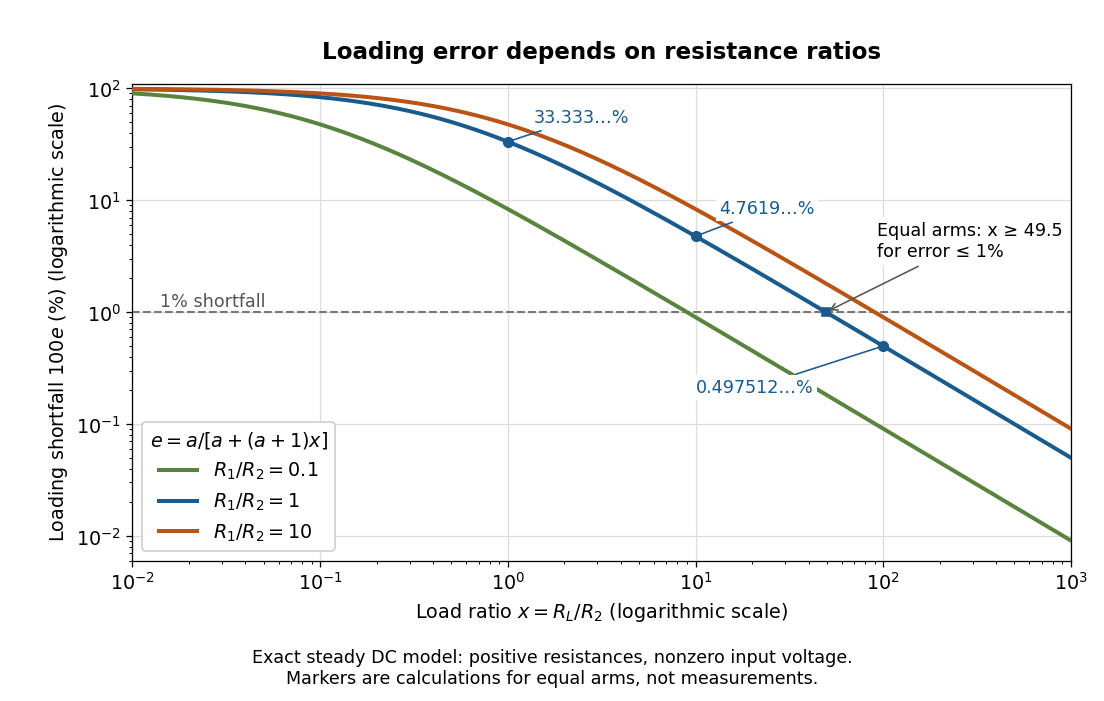
Fractional loading error falls continuously as the load resistance grows relative to the lower divider arm
. Original exact resistance-only predictions for three ratios. The logarithmic axes show the equal-arm examples , including the stipulated load on a lower arm. No points represent measurements. Source. Details.
A quantitative design requirement follows without a rule of thumb. For a specified ,For equal arms, , so one-percent loading error requires . Reducing both divider electrical resistances reduces loading but increases unloaded supply electric current and Joule heating: . The stipulated equal-arm example dissipates in total when unloaded. This tradeoff explains why the ratio alone does not determine a useful divider.
New to topics? Read the docs here!