
Use vorticity to distinguish the local spin of a fluid element from the motion of its center along a pathline. Circular streamlines can occur both with and without vorticity: the two velocity fields below even have the same circulation around the unit circle.
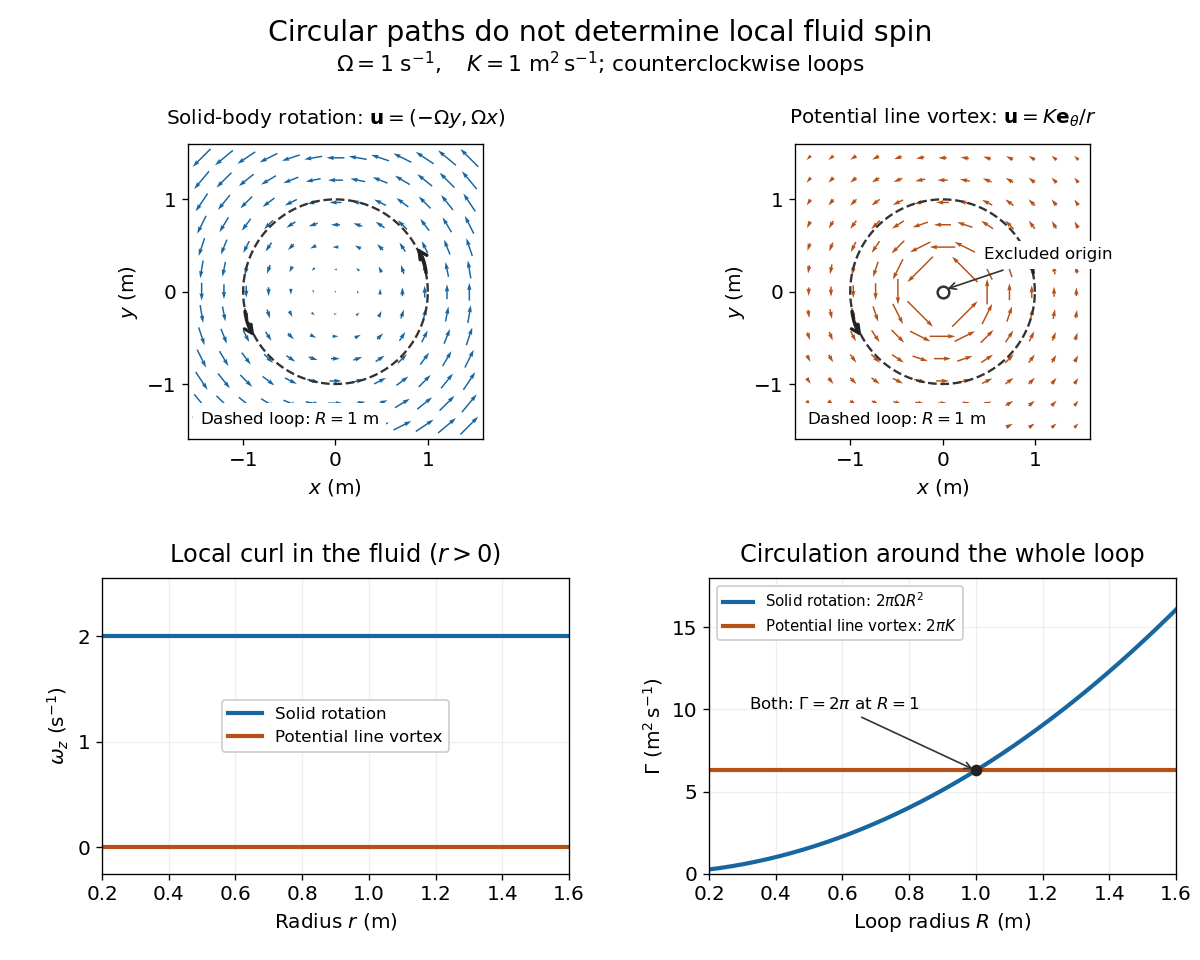
Solid-body rotation and a potential line vortex: equal unit-circle circulation, different local vorticity
. Details. For a continuously differentiable velocity field , vorticity is the curl vectorEach partial derivative divides velocity by distance, so vorticity has units . In a planar velocity field independent of , only survives. Positive points along : the right-hand rule associates it with counterclockwise spin viewed from positive toward the plane. [ref]
The local rotational angular velocity is half the vorticity, . To see the factor, split the velocity gradient into its symmetric rate-of-strain tensor and antisymmetric spin tensor . A nearby displacement has relative velocity ; its rotational part satisfies . This is a proof outline of the local spin interpretation. The rate-of-strain tensor can also change the angle of a particular material line, so that line's angular velocity need not equal .
For solid-body rotation, gives and . Taking , the vorticity is , although the angular velocity is only . For the potential line vortex, , the planar curl is wherever . Its circular pathlines therefore coexist with zero local spin.
This distinction makes vorticity useful for recognizing shear flow as well as swirling motion; taking the curl of the Euler equations also removes a pressure gradient and leads to the vorticity equation. A historical landmark is Hermann von Helmholtz's 1858 paper on fluid vortex motion, an early study devoted to vortex dynamics. [ref]
https://zenodo.org/records/1448878. H. Helmholtz, Über Integrale der hydrodynamischen Gleichungen, welche den Wirbelbewegungen entsprechen (1858)


New to topics? Read the docs here!