Worked supernova distance comparison
ID: worked-supernova-distance-comparison

Stipulate and , so . A megaparsec is parsecs. Neglect radiation in cosmology. Compare an accelerating flat model , an open matter-only model and the Einstein-de Sitter universe . Their present deceleration parameters are respectively , and . For these models,Here is dimensionless; the radial null geodesic in FLRW spacetime supplies its integral and spatial curvature of an FLRW universe supplies . The observer-to-source comoving radial distance is , whereas the transverse distance uses . Omitting the latter distinction would bias the open-model comparison.
At , numerical integration gives for the flat accelerating model and for the open matter-only model. ThusThe accelerating model is mag fainter than the open matter-only prediction at the same redshift and standardized absolute magnitude, corresponding to times the luminosity distance and times the radiative flux. These are model calculations, not observations from either collaboration.
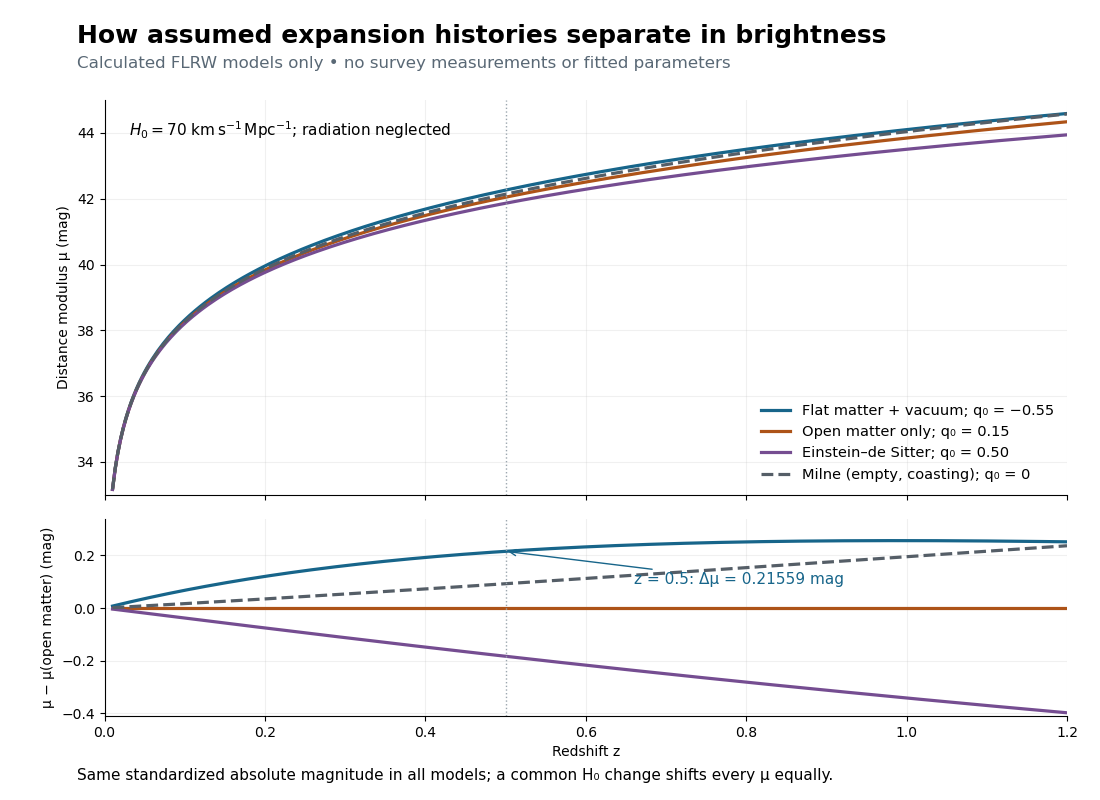

The Milne model has , and , giving and . The Einstein-de Sitter luminosity-distance relation independently checks the flat matter-only integral. At , the accelerating model exceeds the Milne model by only mag, illustrating the dependence of a residual on the chosen reference. Over a longer redshift interval, luminosity distance integrates past deceleration as well as recent acceleration; a residual need not increase forever.
Multiplying by at fixed density fractions divides every by and shifts every distance modulus by . The predicted apparent magnitude is unchanged if simultaneously increases by . This is the absolute magnitude–Hubble constant degeneracy. For example, shifts by mag and by mag. Relative curves at the same retain their separation; determining requires an external absolute magnitude calibration.
New to topics? Read the docs here!