The distance modulus compares received brightness with intrinsic brightness through , the difference between apparent magnitude and absolute magnitude in the same photometric passband and magnitude zero point. With no interstellar extinction, fixed emitted spectrum and luminosity, isotropy of emission, and the local inverse-square law, it determines Euclidean distance:The ratio inside the logarithm is dimensionless. To see the factor , use the inverse-square law in the magnitude difference formula:For example, and give , hence . A tenfold increase in distance adds five magnitudes; an increase of one magnitude multiplies distance by . The distance modulus is a logarithmic scale for distance, not a distance in length units. [ref]
https://lco.global/spacebook/distance/what-is-distance-modulus/. Las Cumbres Observatory: What is distance modulus?
.At parsecs, and . Within parsecs, the distance modulus is negative; for example, gives the positive distance . A negative distance modulus does not imply negative distance. At cosmological distances, the inference needs luminosity distance and a K correction; the simple local formula must not silently absorb these effects.
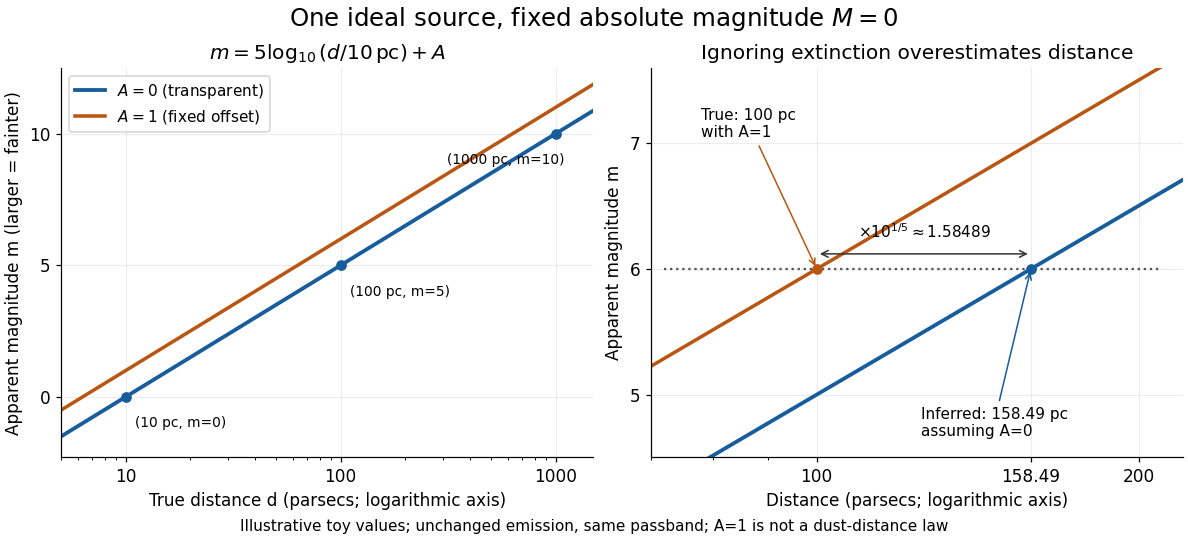
Toy source with absolute magnitude zero: inverse-square distance steps and the distance overestimate from ignoring one magnitude of extinction
. Details. Interstellar extinction increases apparent magnitude. The observed distance modulus then includes both geometric dimming and attenuation; extinction bias in photometric distance explains how to separate them.
Let be the interstellar extinction in magnitudes in the specified photometric passband. Compared with the same unobscured source at the same distance, its radiative flux is multiplied by , so its apparent magnitude increases by . Consequently,Here is the extinction-corrected distance modulus. The correction subtracts before using the distance formula. Caltech's NED distance-method documentation explicitly distinguishes an apparent distance modulus from an extinction-corrected distance modulus. [ref]
https://ned.ipac.caltech.edu/Library/Distances/distintro.html. NASA/IPAC NED: Cepheid apparent and reddening-corrected distances
.Ignoring positive interstellar extinction attributes too much dimming to distance, producing an overestimate:As an illustrative toy, put the source with at parsecs behind magnitude of interstellar extinction. The measured apparent magnitude is . Setting incorrectly gives , a factor too large. Subtracting the known recovers parsecs. The diagram's fixed offset is a controlled illustration, not a model of how actual interstellar extinction grows with distance, and none of its values are star catalogue measurements.
Articles by others on the same topic


The distance modulus is a mathematical expression used in astronomy to relate the distance of an object (like a star or a galaxy) to its absolute magnitude and apparent magnitude. It is a key concept in determining how far away celestial objects are based on their brightness.