Zeta series truncation error
ID: zeta-series-truncation-error

For a real exponent and a positive integer , the series truncation error in the defining Riemann zeta function series isThe integral comparison for the positive decreasing function gives the explicit boundsOn each unit interval, the area under lies between its endpoint heights. Summing from the first omitted term gives the lower integral from to infinity and the upper integral from to infinity. This uses positivity and monotonicity, not an assumption that the last computed term equals the remaining error.
At , the bounds are , whereas . The errors above fit both intervals. Merely looking at the eleventh term would give for squares, far smaller than the actual remaining .
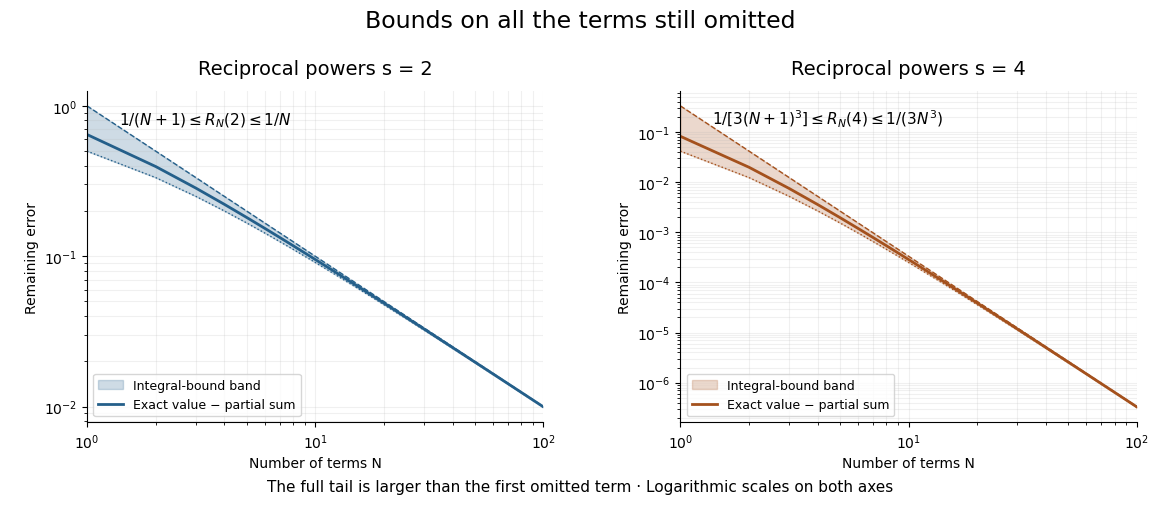

For a chosen absolute error target , the sufficient condition is , rounded upward to an integer. Thus requires by this bound for squares but only for fourth powers. This is a guarantee from an upper bound, not a claim that those are the smallest successful term counts.
New to topics? Read the docs here!