Articles by others on the same topic

The complex conjugate of is . It keeps the real part and negates the imaginary part. In the complex plane, this is a reflection across the horizontal axis. Thus and its complex conjugate have the same modulus , with opposite arguments modulo .
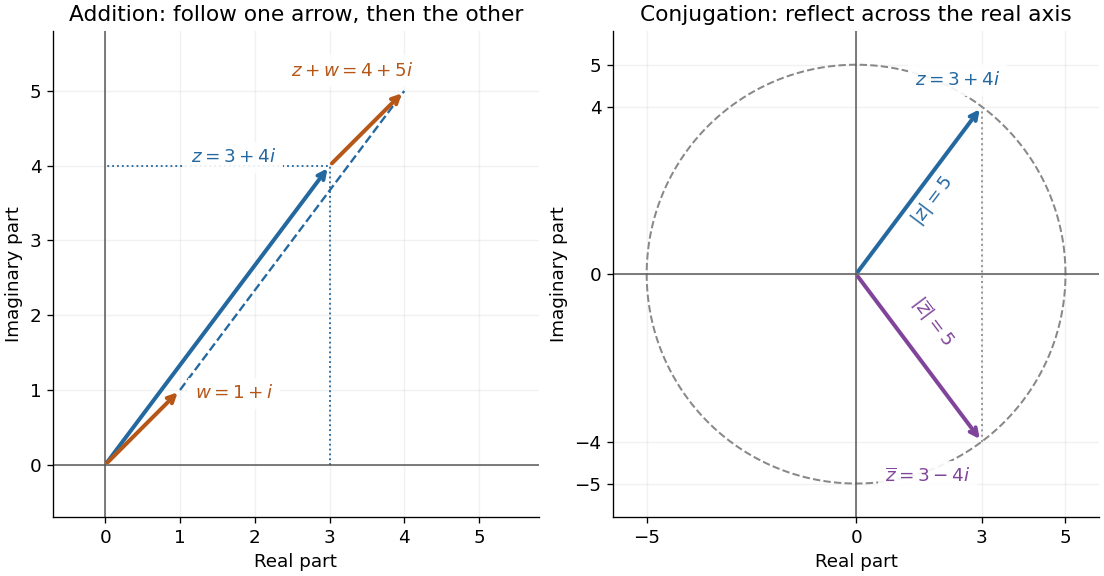
The product with the complex conjugate is a nonnegative real number:In our example, and . Its modulus is . Geometrically, taking the multiplicative inverse reverses the argument and reciprocates the modulus; the reflected direction alone is only part of the operation.
Applying the complex conjugate twice returns the starting point. Moreover, a complex number equals its own complex conjugate exactly when its imaginary part is zero. The horizontal axis is therefore characterized algebraically by .
The complex conjugate also recovers the two coordinates without reading them off explicitly:For , the numerator of the second expression is , giving . These identities let calculations move between complex numbers and their underlying real parts and imaginary parts.


The complex conjugate of a complex number is obtained by changing the sign of its imaginary part. A complex number is typically expressed in the form: \[ z = a + bi \] where: - \( a \) is the real part, - \( b \) is the imaginary part, and - \( i \) is the imaginary unit with the property \( i^2 = -1 \).