The prototypical example of it is the complex dot product.
Note that this form is neither strictly symmetric, it satisfies:where the over bar indicates the complex conjugate, nor is it linear for complex scalar multiplication on the second argument.
Bibliography:
;
Articles by others on the same topic

A Hermitian form is a sesquilinear form on a complex vector space satisfying conjugate symmetry,Hence is a real number for every vector. In a basis, the matrix of a Hermitian form has and obeys , equivalently : it is a Hermitian matrix. The coordinate rule remains . Conjugate symmetry does not imply positivity.[ref]
https://sites.math.washington.edu/~burke/crs/554/lectures/b-lecture4.pdf. Burke, Linear Analysis, Lecture 4, Hermitian symmetry
The diagonal contains more information than might be expected. For any complex sesquilinear form , put . Expanding four expressions gives the complex polarization identity in the linear-first convention:This is an algebraic identity, with no positivity assumption. If every is real, interchanging preserves the first difference and negates the second: use for . The identity then gives . Thus a complex sesquilinear form is a Hermitian form if and only if all its diagonal values are real. Testing only the basis vectors is insufficient: the off-diagonal example in sesquilinear form has zero diagonal entries in its matrix but a nonreal value at .
Consider the indefinite Hermitian formIts values at are . Moreover and are nonzero isotropic vectors: , yet . These vectors do not belong to the radical of a Hermitian form, and the usual Cauchy-Schwarz inequality would incorrectly require . An indefinite Hermitian form records signed geometry rather than defining a norm by .
There is a separate boundary case: is a positive semidefinite Hermitian form, since , but . Its radical of a Hermitian form is the entire second coordinate line. Positive definiteness is exactly the additional condition in a Hermitian inner product. The three examples below show why these distinctions matter: on the real slice , has an ellipse as its unit level, has hyperbolas, and has two parallel lines. These are slices of the complex examples, not drawings of their full four-dimensional domains.
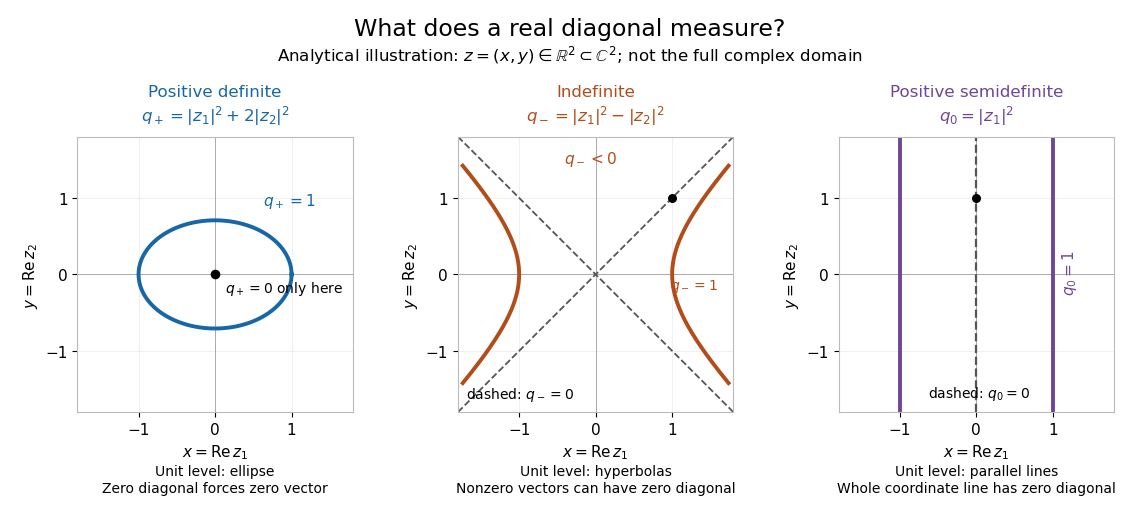
Analytical illustration: real slices of positive definite, indefinite, and positive semidefinite Hermitian forms
. Details. 