This basically adds one more ingredient to partial differential equations: a function that we can select.
And then the question becomes: if this function has such and such limitation, can we make the solution of the differential equation have such and such property?
Control theory also takes into consideration possible discretization of the domain, which allows using numerical methods to solve partial differential equations, as well as digital, rather than analogue control methods.
Articles by others on the same topic

Control theory studies how to choose control inputs for a dynamical system so that its plant output follows a reference signal, despite control disturbances and imperfect knowledge of the controlled plant. A controller turns the available information into a control signal. The design must consider both the resulting response and stability theory: a rule that corrects a small mismatch can still produce growing deviations if the interconnection is badly chosen. [ref]
https://www.fbswiki.org/wiki/index.php/Introduction. Åström and Murray, Feedback Systems, Chapter 1: Introduction
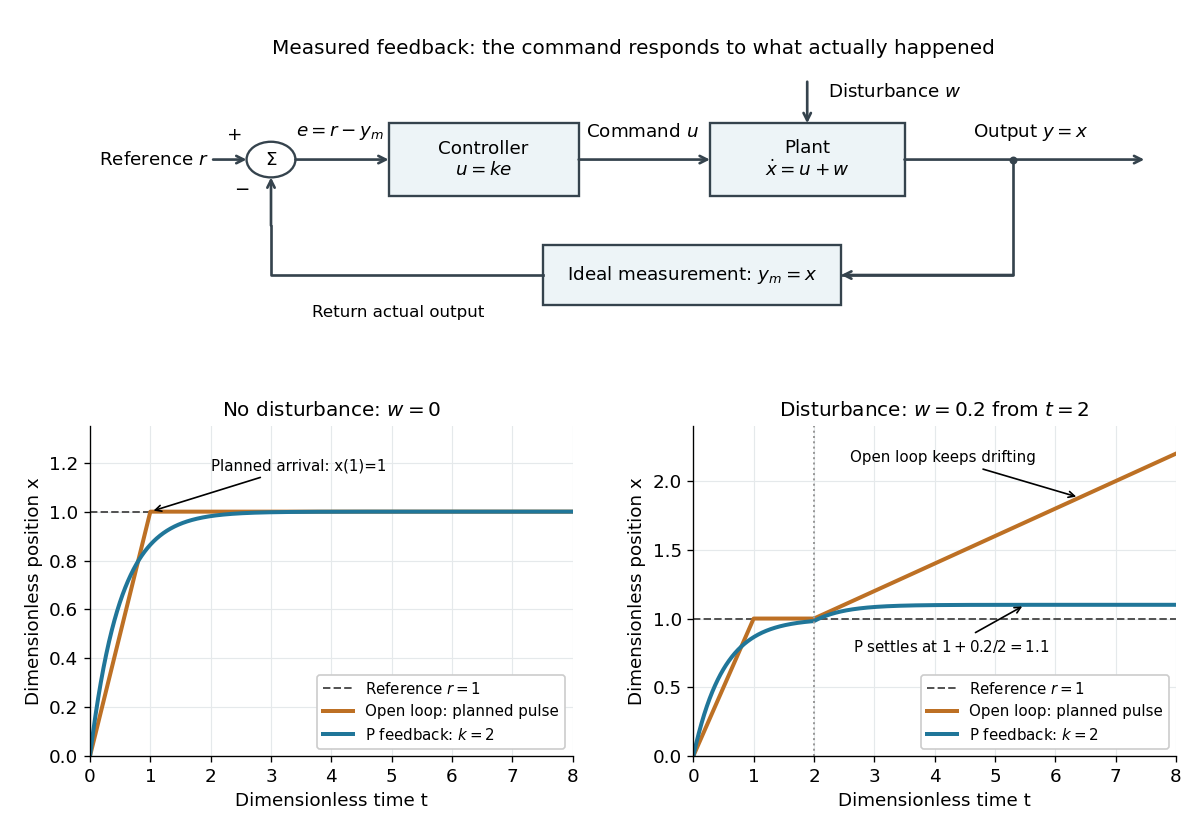
The central distinction is informational. Open-loop control executes planned commands; feedback control uses the measured output of the actual controlled plant to update those commands. A reference signal can describe a destination, while control disturbances describe influences that the controller did not command. A model can predict where the controlled plant should be; measurement tells the controller what actually happened. The authors provide a free full-book PDF through [ref]
https://www.fbswiki.org/wiki/index.php/Feedback_Systems:_An_Introduction_for_Scientists_and_Engineers. Feedback Systems, second edition: authors' book and download page
.For a concrete comparison, all examples below use the same ideal scalar controlled plant:Here is an illustrative position, the control input, a control disturbance, and the measured output. Both and are dimensionless quantities; the numbers are chosen to expose the mechanism, with no empirical interpretation. The ordinary differential equation says that the present control input and control disturbance accumulate into . The measured output equals the entire state only in this ideal example; a general plant output need not reveal the entire state.


Control theory is an interdisciplinary branch of engineering and mathematics that deals with the behavior of dynamic systems. It focuses on the design and implementation of controllers that manage the system's behavior to achieve desired objectives. Control theory is used in various applications, including aerospace, automotive, robotics, manufacturing, and process control. At its core, control theory strives to develop mathematical models of systems and to analyze their behavior over time.