Where is Anatomy Encoded in Living Systems? by Michael Levin (2022)
Source.- we are very far from full understanding. End game is a design system where you draw the body and it compiles the DNA for you.
- some cool mentions of regeneration
How genes form bodies.
Developmental Genetics 1 by Joseph Ross (2020)
Source. Talks about homeobox genes.Some good mentions at: Video "Where is Anatomy Encoded in Living Systems? by Michael Levin (2022)".
It is quite mind blowing when you think about it, that the huge majority of your body's cells is essentially just there to support a tiny ammount of germline, which are the only cells that can actually pass on! It is fun to imagine the cell type tree for this, with a huge branching of somatic cells, and only a few germline going forward.
One of the simplest known seems to be: en.wikipedia.org/wiki/Trichoplax
www.u-tokyo.ac.jp/focus/en/articles/a_00220.html "The simplest multicellular organism unveiled" from 2013 mentions Tetrabaena socialis.
- youtu.be/1v6cgSkiHik?t=513 multicellularity is polyphyletic, e.g. evolved separately on plants, fungi and animals.
- youtu.be/1v6cgSkiHik?t=668 describes how unicellular organism choanoflagellates form colony, and how animals are characterized by certain key types of cellular interaction: adhesion, communication, regulation (cell differentiation) and extra cellular matrix production
It is hard to distinguish between colonies of unicellular organism and multicellular organism as there is a continuum between both depending on how well integrated they cells are.
From Wikipedia:and:
Multicellularity has evolved independently at least 25 times in eukaryotes
Complex multicellular organisms evolved only in six eukaryotic groups: animals, symbiomycotan fungi, brown algae, red algae, green algae, and land plants.
Articles by others on the same topic

A multicellular organism has a body of multiple biological cells whose growth and activities are integrated into the life of the whole organism. Extensive cell differentiation is common in complex examples, but specialized biological cells are not a prerequisite for every simple form. Ask how the body develops, how its parts cooperate and how it produces descendants, rather than counting attached biological cells alone. The boundary with a biological colony depends on the degree of integration and the criteria being investigated; there is no universal cell-count threshold. See the Queller and Strassmann account cited under unicellular organism.
Specialization makes the whole capable of combinations that one general-purpose biological cell cannot achieve in the same way. In an animal, a neuron transmits signals while a red blood cell carries oxygen; each still requires a working cell membrane and metabolism. A mature mammalian red blood cell lacks a cell nucleus and mitochondria, illustrating how a useful part need not retain the equipment of a self-reproducing organism. See Clark, Douglas and Choi, Biology 2e, 40.2: red blood cell specialization. Cell differentiation generally involves different gene expression, rather than a different inherited genome for each function. Biological development must coordinate growth, position, interactions and specialization: increasing the number of biological cells is only one component. See Alberts et al., Molecular Biology of the Cell, chapter 21 (2002): construction of multicellular bodies.
A motivating experiment: select for a property of groups. Ratcliff, Denison, Borrello and Travisano's 2012 study began with Saccharomyces cerevisiae growing as unicellular organisms. Daily transfer favored rapidly settling material. Their initial protocol allowed a culture to settle for , discarded the upper , and transferred the bottom into fresh medium. After seven days, they instead sampled and centrifuged it at times gravitational acceleration for , again transferring the bottom . Faster settling made it more likely that a lineage would seed tomorrow's culture; the procedure selected a physical outcome without specifying how it must arise. These protocol details are explicitly recounted in Gulli, Herron and Ratcliff, Evolution of altruistic cooperation among nascent multicellular organisms (2019): original settling protocol.
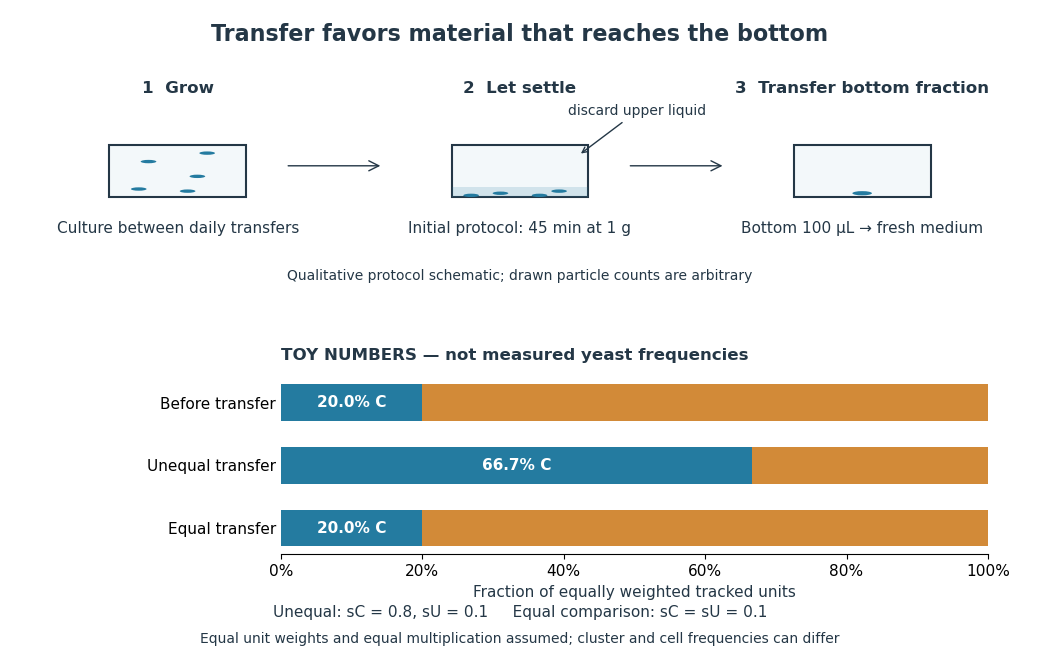
Settling selection and an explicitly stipulated enrichment example
. Original qualitative transfer schematic with toy numerical bars. The workflow represents the initial settling protocol described above. The lower panel assumes equally weighted tracked units and transfer probabilities and ; these values and the resulting frequencies are invented for explanation, not fitted to snowflake yeast measurements. The equal-transfer comparison is a model control, distinct from the experimental comparisons described below. Details.
The primary 2012 paper reports snowflake yeast dominating all ten initial replicate populations by 60 transfers. To distinguish the joining of previously separate biological cells from clonal development, the researchers enzymatically separated clusters and followed individual biological cells for : attached descendants rebuilt clusters, with no such joining observed. Staining localized attachments at bud scars. Time-lapse observations also showed clusters releasing smaller multicellular offspring, called propagules; small clusters grew before they reproduced. See Ratcliff et al., Experimental evolution of multicellularity (2012), figures 1–3: emergence, development and reproduction.
The experimental comparisons ask different questions. Competition with the unicellular organism ancestor showed a reported advantage under settling selection. Without settling selection, the estimated disadvantage had a one-sided , so it was suggestive rather than decisive evidence of a cost. Separately, three populations derived from one evolved isolate retained the cluster form through 35 transfers without settling selection. That persistence tests stability, not whether clusters always outperform single biological cells. See Ratcliff et al. (2012), figure 2 and the cluster-formation results cited above.
A 2015 follow-up added a causal test: deleting the gene ACE2 in the unicellular organism ancestor produced snowflake yeast, while supplying functional ACE2 to one evolved isolate restored separation into single biological cells. Sequence changes altering the encoded protein were found in ACE2 in five of ten examined lineages; the study did not identify that same sequence-change mechanism in every lineage. The deletion and restoration comparisons support a mechanism beyond the observation that clusters settle quickly. See Ratcliff, Fankhauser, Rogers, Greig and Travisano, Origins of multicellular evolvability in snowflake yeast (2015), figure 1.
What follows, and what does not. The evidence supports inherited cluster formation, clonal development and a reproducing collective whose properties can respond to natural selection. Calling these simple multicellular organisms recognizes those demonstrated properties; it does not turn every clump into an animal or establish animal-like cell differentiation. This laboratory route also does not reconstruct the actual ancestry of animals or show that complex developmental integration must follow. The interesting achievement is narrower and testable: a change in how descendants remain connected creates a new scale at which growth and reproductive success can be measured.
For the toy figure, let be the fraction of tracked units of type C before transfer and let be the respective probabilities of transfer for C and U. Assume equally weighted units and equal multiplication between transfers. When overall transfer probability is nonzero, conditioning on transfer givesWith , and , the numerator is and the denominator , giving . If both types have the same nonzero transfer probability, the fraction stays . This is conditional probability, not a model of the full experimental life cycle: real cluster sizes, growth and fragmentation affect which quantity a frequency measures. In particular, a fraction of clusters is not automatically a fraction of biological cells.