
Past exam of the mathematics course of the University of Cambridge 2022 ii Paper 2 40C c Created 2026-09-23 Updated 2026-09-24
Past exam of the mathematics course of the University of Cambridge 2022 ii Paper 2 40C b Created 2026-09-23 Updated 2026-09-24
Past exam of the mathematics course of the University of Cambridge 2022 ii Paper 2 40C a Created 2026-09-23 Updated 2026-09-24
Past exam of the mathematics course of the University of Cambridge 2022 ii Paper 2 3K Solution Created 2026-09-23 Updated 2026-09-25
A discrete memoryless channel has finite input alphabet , finite output alphabet , and transition probabilities ; successive outputs are conditionally independent given the corresponding inputs. The Shannon second coding theorem states that rates belowadmit block codes with error probability tending to zero, whereas rates above cannot have vanishing error.
For any joint input law of , conditional independence of the product channel givesChoose and independently with capacity-achieving input laws for their respective channels. Then the inequality becomes equality, so the product-channel capacity is
Past exam of the mathematics course of the University of Cambridge 2022 ii Paper 2 39C b Created 2026-09-23 Updated 2026-09-24
Past exam of the mathematics course of the University of Cambridge 2022 ii Paper 2 39C a Created 2026-09-23 Updated 2026-09-24
Past exam of the mathematics course of the University of Cambridge 2022 ii Paper 2 38D c Created 2026-09-23 Updated 2026-09-24
Past exam of the mathematics course of the University of Cambridge 2022 ii Paper 2 38D b Created 2026-09-23 Updated 2026-09-24
Past exam of the mathematics course of the University of Cambridge 2022 ii Paper 2 38D a Created 2026-09-23 Updated 2026-09-24
Past exam of the mathematics course of the University of Cambridge 2022 ii Paper 2 37A e Created 2026-09-23 Updated 2026-09-24
Past exam of the mathematics course of the University of Cambridge 2022 ii Paper 2 37A d Created 2026-09-23 Updated 2026-09-24
Past exam of the mathematics course of the University of Cambridge 2022 ii Paper 2 37A c Created 2026-09-23 Updated 2026-09-24
Past exam of the mathematics course of the University of Cambridge 2022 ii Paper 2 37A b Created 2026-09-23 Updated 2026-09-24
Past exam of the mathematics course of the University of Cambridge 2022 ii Paper 2 37A a Created 2026-09-23 Updated 2026-09-24
Past exam of the mathematics course of the University of Cambridge 2022 ii Paper 2 36D Solution Created 2026-09-23 Updated 2026-10-14
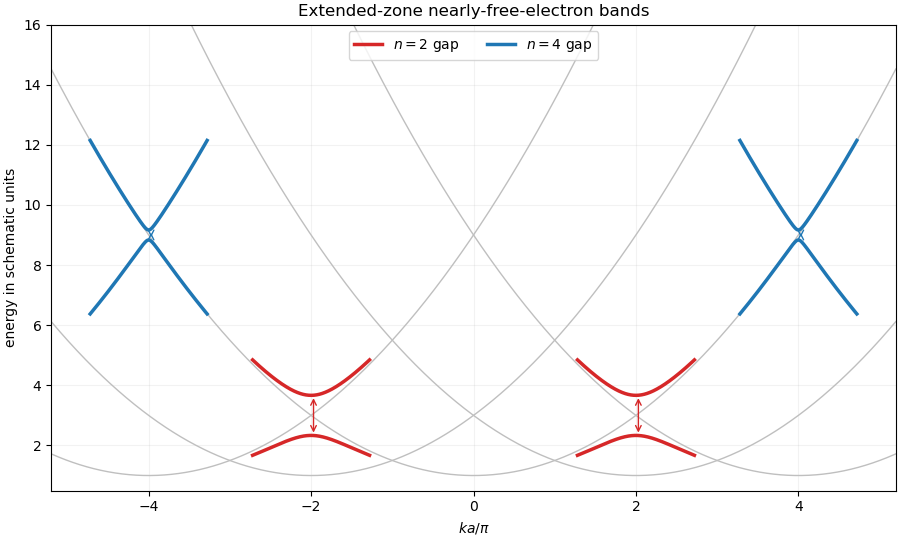
Let . The free states and are degenerate at the Bragg point . Sincedegenerate perturbation theory restricts the Hamiltonian near this crossing toWriting and diagonalizing gives the nearly-free electron dispersion near a one-dimensional band gapThus the two continuous bands avoid crossing, and at their separation isThis is the nearly-free electron model. The dispersion relation is the relation between energy and Bloch wavevector.
For the specified potential,Henceand all other nonconstant Fourier coefficients vanish. The gaps are thereforeTheir centre energies are respectivelyThe extended-zone sketch consists of the free-particle parabolas shifted upward by , with avoided crossings of these two widths at the listed Bragg points; elsewhere they meet to this order because the corresponding Fourier coefficients vanish.

Past exam of the mathematics course of the University of Cambridge 2022 ii Paper 2 35A c Created 2026-09-23 Updated 2026-09-24
Past exam of the mathematics course of the University of Cambridge 2022 ii Paper 2 35A b Created 2026-09-23 Updated 2026-09-24
Past exam of the mathematics course of the University of Cambridge 2022 ii Paper 2 35A a Created 2026-09-23 Updated 2026-09-24
Past exam of the mathematics course of the University of Cambridge 2022 ii Paper 2 34E Solution Created 2026-09-23 Updated 2026-09-25
For , writeThe given evolution of the discrete scattering data givesSolving the resulting two scalar linear equations for the components of and substituting in the reconstruction formula givesChoosing the additive multiple of so that as and integrating in yields the One-soliton solution of the sine-Gordon equation in light-cone coordinatesIt depends only on exactly when the two positive coefficients in the exponent agree:The unique positive solution is , and then
The transformations satisfy , is the identity map, and , so they form a one-parameter group. Ifthen the chain rule givesThus is a Lie point symmetry. Applied to the one-soliton family, it replaces by . Taking gives , so every member is transformed to the function found above.
For the stated solution, set and . When , its two arguments reduce toAt fixed , only varies, so the Sine-Gordon breather has fundamental period
Finally put . Under the same symmetry, the parameters becomeand hence . Choosing makes this sum , proving that every solution in the family is symmetry-equivalent to the normalized breather.
Past exam of the mathematics course of the University of Cambridge 2022 ii Paper 2 33B b Created 2026-09-23 Updated 2026-09-24
There are unlisted articles, also show them or only show them.