Conditional independence
ID: conditional-independence

Random variables and are conditionally independent given when, for every pair of Borel sets , the following identity holds almost surely:Here conditional probabilities are conditional expectations of the corresponding indicator random variables given the sigma-algebra generated by . This defines the condition even when . In terms of regular conditional distributions, the conditional joint law is the product of the conditional marginal distributions for almost every conditioning value.
For discrete random variables, at every with , the condition becomesWhere , this is equivalent to . Once is known, observing provides no further information about .[ref]
Information Theory I — Scene Setting and Statistical Applications (Lecture 9). Information Theory I — Scene Setting and Statistical Applications, Lecture 9, section Conditional independence and conditional mutual information: conditional factorization and predictive irrelevance
For a worked example, suppose a latent variable chooses between two environments with . Given , take to be independent and identically distributed with a Bernoulli distribution of parameter , where and . Think of two separate trials run under the same quiet or active environment. Their conditional joint probability mass functions, with rows and columns , areEach is exactly the product of its own conditional marginal distributions: for , and for . Thus are conditionally independent given .
If the environment is unobserved, the law of total probability averages the two tables:Both unconditional marginal distributions are fair, but . The law of total expectation gives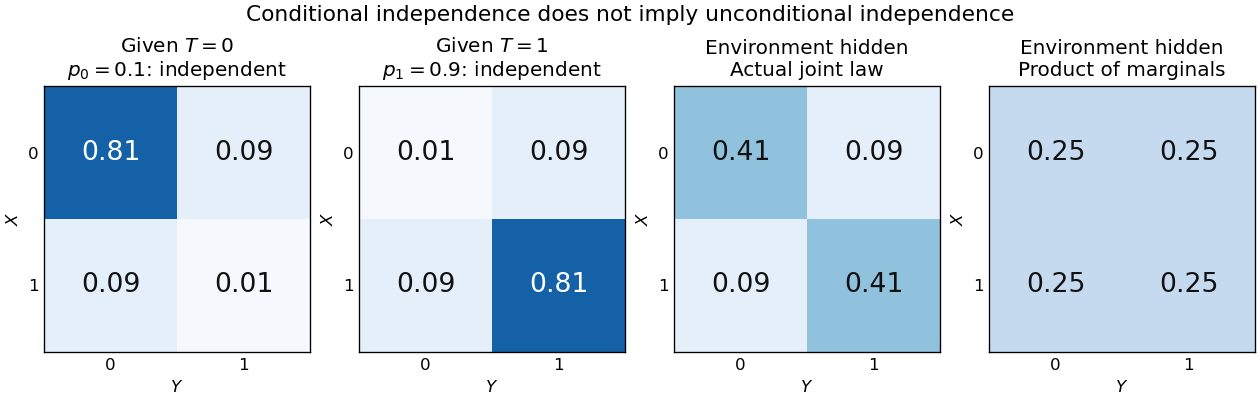
Figure 1.
An unobserved shared environment creates statistical dependence between conditionally independent trials
. The first two tables show independent Bernoulli trials at conditional success probabilities and . Averaging them with equal weights gives the third table. The fourth table is the product of the resulting unconditional marginal distributions, which differs from the actual joint table. These are stipulated model probabilities, not observed frequencies. Details.
Observing makes the active environment more plausible, so it raises to . Knowing the actual environment removes this source of statistical dependence. The covariance induced by a shared latent variable lemma explains the calculation without listing all the outcomes.
This is why conditional independence is useful in statistical modelling: a model can multiply simple conditional laws and then average over a shared latent variable. The resulting observations can remain statistically dependent. Conditional independence graphs organize such information relations; their interpretation as causes requires additional assumptions from causal inference. Conditioning describes the information available to an observer. It does not, by itself, describe what would happen if an experimenter changed a variable.
New to topics? Read the docs here!