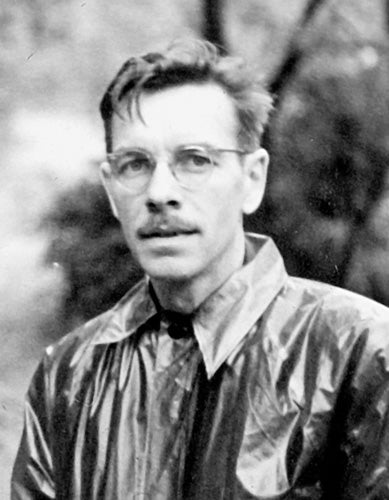
Alfred Day Hershey was a researcher in bacteriophage genetics. The Cold Spring Harbor Laboratory archive explicitly gives his full name and describes his collaboration with Martha Chase on the different roles of phage DNA and protein. His original A. D. Hershey byline remains a preserved name for the same person.[ref]
Alfred D. Hershey archive biography at Cold Spring Harbor Laboratory. Opening biographical paragraph and account of the Hershey–Chase work
The Hershey-Chase experiment combined chemical tracers with a physical separation. The archive describes phage protein being sheared from bacterial surfaces while much of the phage DNA remained with the bacteria. The original paper further compared transfer of parental labels to progeny: less than of parental sulfur label versus or more of parental phosphorus label was recovered there.[ref]
Alfred D. Hershey archive biography at Cold Spring Harbor Laboratory. Historical experiment account
[ref]Independent functions of viral protein and nucleic acid in growth of bacteriophage by A. D. Hershey and Martha Chase. Summary point 6: label transfer to progeny
An original two-component model shows why selective labelling and measurement controls matter. Suppose component A has a measured retention fraction and component B has . If a mixed preparation contains an unknown A-associated fraction of its label, then ideal retention isAn observed would implyThis is an illustrative tracer model, not a reanalysis of the 1952 data. It assumes that the label tracks the components faithfully, the end-member fractions are known, and recovery does not depend on an unmodelled third component. If , the denominator vanishes: retention cannot distinguish the components at all.
The point is methodological. Separating material and measuring radioactivity provide evidence only through a defined relation between the tracer and the biological question. Labelled atoms are not themselves a count of functional genomes or a direct measurement of genetic information. Hershey's credited work is significant because physical, chemical and biological observations were brought into a common argument about heredity.
Articles by others on the same topic
There are currently no matching articles.