Deoxyribonucleic acid, or DNA, is a nucleotide polymer that stores biological information in its nucleotide sequence. The crucial variable is order: two DNA molecules can contain the same numbers of each nucleobase yet carry different nucleotide sequences. This makes a physical molecule an inheritable record, rather than merely a mixture of ingredients. Genes are functional regions of that record; the whole DNA nucleotide sequence is not one long gene. See NHGRI: DNA fact sheet.
Each DNA strand has a backbone of alternating deoxyribose sugars and phosphate groups joined through covalent bonds. Attached nucleobases supply the familiar four-letter alphabet: adenine A, thymine T, guanine G, and cytosine C. In ordinary double-stranded DNA, base pairing matches A with T and G with C. The backbone connects successive nucleotides along a strand; base pairing connects partners across strands. Keeping these two connections distinct explains how strands can separate while each retains its own nucleotide sequence.
The two backbones have directions, conventionally labelled and after numbered carbon chemical atoms in deoxyribose. They form antiparallel nucleic acid strands: following one from to takes you opposite to the other's -to- direction. For the chosen DNA nucleotide sequence , write its partner directly underneath as . Now read that partner from its own end: its reverse complement is . Complementing letters and reversing their order are separate operations. See Alberts et al., Molecular Biology of the Cell: the structure and function of DNA.
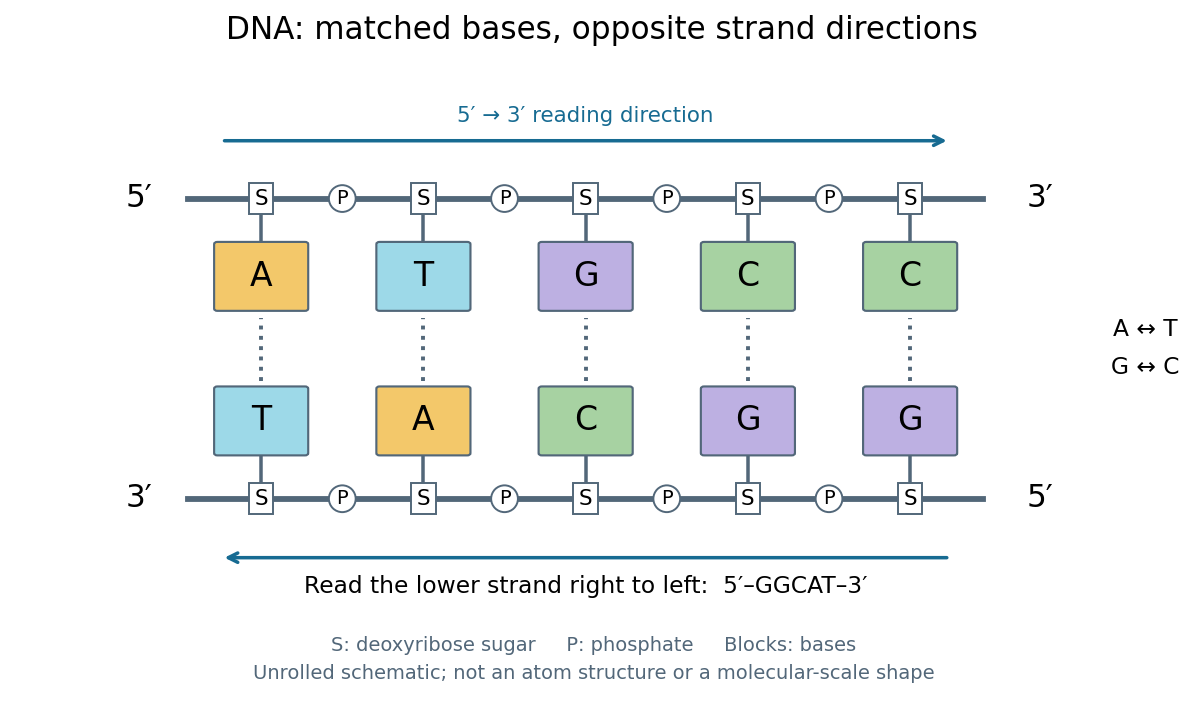
DNA base pairing and antiparallel nucleic acid strands: an unrolled ladder for ATGCC and its reverse complement
. Details. 
The diagram's rails represent sugar–phosphate backbones and its coloured blocks represent nucleobases, not individual chemical atoms. Reading left to right gives five matched positions: A–T, T–A, G–C, C–G, C–G. There are two A–T-type base pairs and three G–C-type base pairs; the complete two-strand example contains ten nucleotides. Reversing the bottom row changes the reading convention, not the physical partners. Real double-stranded DNA winds into a nucleic acid double helix; the flattened ladder emphasizes base pairing and direction without pretending to show its three-dimensional geometry.
The motivating consequence is copying by a template. After strands separate, each existing DNA strand specifies which incoming nucleotides should accompany it through base pairing. DNA replication uses enzymes to build complementary strands, allowing the record to persist through successive biological cells. Base pairing supplies a selection rule, while enzymes perform the chemistry: a matching diagram alone is not a complete copying mechanism. The connection between structure and copying was already central to the model published by Watson and Crick on 25 April 1953. See Watson and Crick, Molecular Structure of Nucleic Acids, Nature 171, 737–738 (1953).
Stored information needs interpretation. Some DNA regions specify proteins through RNA; others contribute to functional RNA or regulate gene expression, and some have no known function. Non-coding DNA means sequence that does not specify a protein's sequence of amino acids, not automatically useless sequence. Nor does a DNA nucleotide sequence alone determine an organism's fate: phenotypes also depend on biological context and environment. See NHGRI: non-coding DNA. Its double-stranded form is often modeled mechanically as a worm-like chain, with elasticity and effective excluded volume depending on solvent conditions.
A deoxyribozyme, or DNAzyme, is a DNA molecule with catalytic activity. Its nucleotide sequence permits a functional folded structure that accelerates a specified chemical reaction. Catalytic function is distinct from merely recognizing or binding a target, as an aptamer can do. The term identifies the catalytic material; it does not imply that every DNAzyme catalyzes the same reaction.
A motivating primary experiment by Ronald R. Breaker and Gerald F. Joyce selected DNA molecules that promoted cleavage of an RNA linkage. Their 1994 paper started with a large randomized DNA population and used repeated selection and amplification to enrich activity. The selected catalyst required lead ions under the tested conditions, and an intermolecular version achieved repeated substrate turnover. This established catalytic DNA in a laboratory selection system, rather than demonstrating a naturally occurring cellular enzyme.[ref]
A DNA enzyme that cleaves RNA by Ronald R. Breaker and Gerald F. Joyce. Abstract, Background, Results and Conclusions
A DNAzyme turnover experiment can distinguish a catalyst from a one-use reagent. For a constructed molecular count, suppose a preparation contains active DNA catalyst and produces specifically cleaved product. The ratiomeans ten reactions per active catalyst molecule on average. This interpretation requires controls for uncatalyzed product formation and an appropriate count of active molecules. The ratio alone gives neither a reaction rate nor a turnover number per unit time.
A time-resolved experiment additionally measures initial reaction rates while varying substrate concentration and holding other conditions fixed. A selected sequence, its inactive or altered controls and a substrate-only reference answer different questions about sequence dependence and background cleavage. Yingfu Li and Ronald R. Breaker's primary measurements of chemically driven RNA degradation illustrate why that baseline matters when quantifying catalytic enhancement.[ref]
Kinetics of RNA Degradation by Specific Base Catalysis of Transesterification Involving the 2′-Hydroxyl Group by Yingfu Li and Ronald R. Breaker. Abstract: defined substrates and background cleavage mechanism
A catalyst changes the rate of approach to a chemical equilibrium without supplying unlimited chemical free energy. Its performance depends on folding, molecular recognition, reaction chemistry and product release; observing binding alone does not establish all of these functions.
A DNAzyme turnover experiment measures how much reaction product a DNAzyme forms over time relative to the amount of active catalyst. Its central distinction is between one productive event per catalyst molecule and repeated substrate processing. The original deoxyribozyme paper reported an intermolecular catalyst with repeated turnover, rather than merely stable binding to its target.[ref]
A DNA enzyme that cleaves RNA by Ronald R. Breaker and Gerald F. Joyce. Abstract, Results: intermolecular catalytic activity and turnover
The observable should be chemically identified product, for example a resolved cleavage product quantified from an appropriately calibrated gel electrophoresis signal. Record a time course and distinguish the catalyst-dependent contribution from initial product and substrate-only background. An altered-sequence control tests sequence dependence; it does not automatically replace a measurement of background chemistry.
For a constructed example, suppose the initial substrate concentration is and active catalyst concentration is . Background-corrected product reaches after 20 minutes. ThenThe first is a dimensionless cumulative count; the second is an interval-average rate. Neither is automatically the turnover number at saturating substrate. Substrate depletion, changes in active catalyst and product inhibition can make the time course nonlinear.
A rapid initial product burst followed by a slower nearly linear phase can indicate different kinetic stages. For illustration,contains a burst amplitude and later slope . Such a curve motivates investigating DNAzyme product-release limitation, but does not uniquely prove that mechanism: catalyst heterogeneity or inactivation can also alter the trace. Independent perturbations and product-release observations are needed to distinguish explanations.
A background reference matters especially when the substrate can cleave chemically without the DNAzyme. The primary analysis of chemically driven RNA degradation provides the relevant distinction between baseline cleavage and catalytic enhancement.[ref]
Kinetics of RNA Degradation by Specific Base Catalysis of Transesterification Involving the 2′-Hydroxyl Group by Yingfu Li and Ronald R. Breaker. Abstract: background cleavage and interpretation of rate enhancement
DNAzyme product-release limitation is a kinetic regime in which slow departure of cleaved products delays reuse of a DNAzyme, even when the chemical cleavage step is fast. Product formation and regeneration of free catalyst are separate events. A DNAzyme turnover experiment must therefore distinguish one cleavage per catalyst from repeated cycles.
Consider an intentionally simplified saturated-substrate cycle,Here is an enzyme-substrate complex and a catalyst–product complex. If the two irreversible steps have exponential waiting times and binding of fresh substrate is effectively immediate, the mean DNAzyme catalytic-cycle waiting time is the sum of their means:With stipulated and , the average cycle takes 101 s and . Making chemistry ten times faster reduces the cycle only to 100.1 s. The slow release dominates this model; the numbers are not measurements of a particular DNAzyme.
Under those assumptions a rapid first cleavage can precede much slower continued production. A burst alone is not a unique identification of slow release: catalyst inactivation or mixed active populations can also change the trace. Comparing chemical cleavage with independent product-dissociation observations is more informative than assigning a mechanism from curve shape alone.
The regime is not a definition of every DNAzyme. The primary kinetic analysis by S. W. Santoro and Gerald F. Joyce instead reported substrate-binding limitation of catalytic efficiency for their RNA-cleaving DNA enzyme under the studied conditions.[ref]
Mechanism and utility of an RNA-cleaving DNA enzyme by S. W. Santoro and G. F. Joyce. Abstract: kinetic measurements and substrate-binding limit
Different concentrations and measured quantities can expose different limiting steps; a claim about efficiency at low substrate is not automatically a claim about the slowest saturated turnover step.DNA melting is local or extensive separation of the two strands when stabilizing base pairing and stacking no longer maintain a duplex. Temperature, chemical environment or proteins can favour opening; a transcription initiation bubble is a localized example.
An assay asking whether nucleic acid remains inaccessible to a nuclease under specified conditions. Protection can reflect protein binding or compartmental enclosure; appropriate disruption controls distinguish them.
DNA hybridization is association of nucleic-acid strands through complementary base pairing. It can form DNA-DNA or DNA-RNA duplexes, depending on the partners.
Sequence complementarity, temperature, ionic conditions, and strand concentration affect the equilibrium and rate of association. Mismatches can weaken binding, which makes hybridization useful for sequence-selective detection without making it an absolute all-or-nothing identity test.
A chemical or structural alteration of DNA that can disrupt its normal function or copying. Damage, activation of a damage response and successful repair are separate measurements.
Physical discontinuity of a chromosome. Fluorescent locus splitting or undercondensation can suggest vulnerability but needs additional evidence before being equated with a break.
DNA recovered from historical or prehistoric biological material. Authentication must distinguish endogenous sequence from contamination and account for short fragments and damage.
DNA looping brings separated sequence positions into spatial proximity through bending and folding of the DNA. In transcriptional regulation it can permit a distant regulatory protein to influence promoter-associated machinery, although proximity alone does not prove productive activation.
Negative supercoiling describes torsionally constrained DNA with linking number below its relaxed reference value. Under appropriate conditions this stress can favour local strand opening or a transition to a different helical conformation, including Z-DNA.
The minor groove of duplex DNA exposes a different set of base edges from the major groove. Similar chemical patterns for some oriented base-pair alternatives limit simple direct readout, but groove shape, hydration and electrostatics can still contribute to specificity.
The major groove of an ordinary B-DNA duplex exposes base-pair edges whose donor, acceptor and hydrophobic patterns distinguish oriented base pairs. Groove accessibility changes with helical conformation, and protein recognition can combine these patterns with backbone and shape contacts.
A DNA double helix contains two antiparallel, base-paired DNA strands wound around a common axis. Handedness and groove geometry can change between conformational families without changing the basic fact of duplex pairing.
Z-DNA is a left-handed duplex family with a zigzag backbone and alternating nucleotide conformations. Alternating purine–pyrimidine sequences can favour it; local torsional stress and binding partners influence its occurrence. Left-handed nucleosome wrapping is a different structural level.
B-DNA is the familiar hydrated right-handed duplex family, with predominantly C2′-endo sugars and accessible major groove base edges. Its local geometry varies with sequence and bound molecules; approximately 10.5 base pairs per turn is an average rather than an exact universal repeat.
A-DNA is a right-handed duplex family with predominantly C3′-endo sugar puckering, tilted and displaced base pairs, and a deep narrow major groove. Double-stranded RNA and many DNA-RNA hybrids have related A-form geometry.
Twisting of the axis of double-stranded DNA associated with torsional constraint. Supercoiling can influence the energetic cost of local strand opening.
heteroduplex DNA is a duplex whose strands originate from different parental molecules. Related but nonidentical sequences can introduce mismatches; heteroduplex formation does not require that every position be mismatched.
double-stranded DNA contains two associated DNA strands, ordinarily paired through base pairing. Their separation and re-pairing underlies DNA strand exchange.
single-stranded DNA is DNA present as one polymer strand rather than an ordinary paired duplex. It can form secondary structures or associate with proteins; single-stranded does not imply an entirely straight, unstructured chain.
A DNA lesion is physical or chemical damage to DNA, such as an altered nucleobase or strand break. DNA repair can restore the sequence before a lasting mutation occurs.
Articles by others on the same topic
There are currently no matching articles.