Consider the rational functionInside the unit circle are a double zero of a function at and a simple pole at . The simple zero of a function at is outside. Thus , , and the winding number is one. The factorization checks the count exactly; the plot illustrates how the boundary records it.
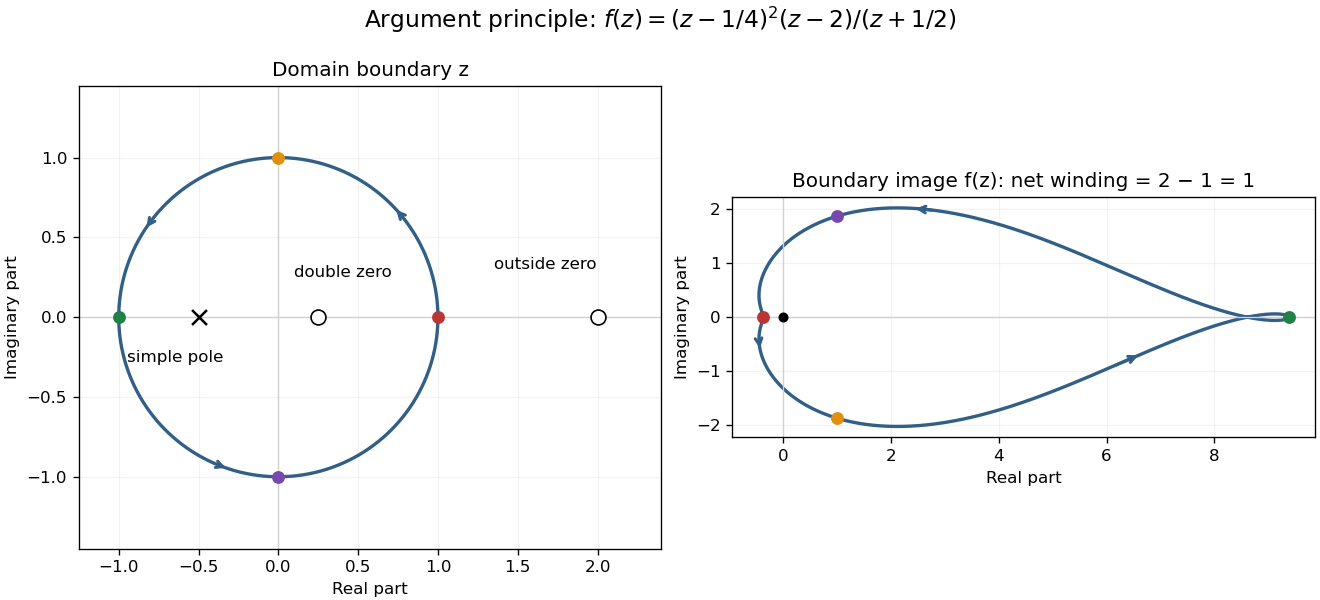

For the concentric circle , the winding number is zero for , two for , one for , and two for . At or , the boundary contains a zero of a function; at , it contains a pole. The theorem does not apply at those three radii. Moving a boundary changes the count only when it crosses an object being counted; homotopy invariance of winding number describes the unchanged count between crossings.
Articles by others on the same topic
There are currently no matching articles.