For a function and a subset , its image isThe full image of a function is . The set notation ignores repeated outputs: in the finite example above, , rather than a list containing zero twice. A function collision can therefore reduce the cardinality of an image.
Images of a function preserve unions:An output reached from the union is reached from at least one of its two input sets. For intersections, however, onlyholds in general. In the finite example, take and . Their intersection is the empty set, so . But , giving . Distinct witnesses in the two input sets can produce the same output.
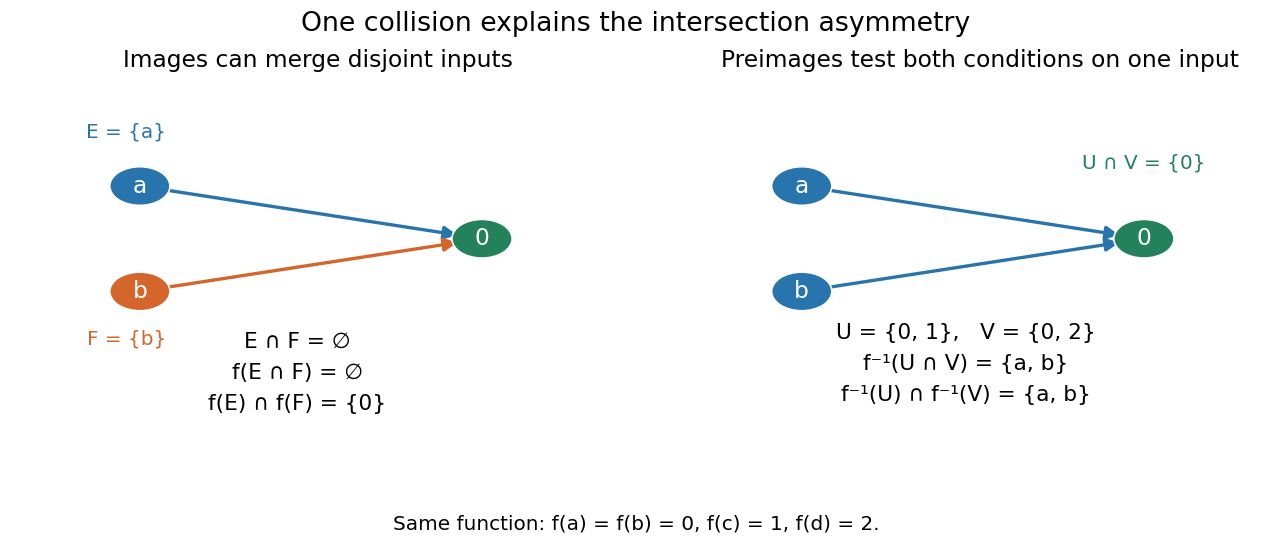
An image of a function can merge disjoint inputs, while a preimage tests both output conditions on the same input
. Details. 
For an injective function, an output shared by and must come from the same input. That input lies in , so equality holds. Conversely, preserving intersections for every pair of input subsets forces injectivity: two distinct inputs with the same output would give the singleton counterexample above. The image and preimage laws are stated in Jiří Lebl, Basic Analysis I, Propositions 0.3.15–0.3.16; the finite example makes the missing reverse inclusion visible.
Articles by others on the same topic
There are currently no matching articles.