In a metric space , an open ball of radius about is . A closed ball instead uses . The strict inequality matters: a point at distance exactly belongs to the closed ball and is excluded from the open ball. In particular, is excluded from all three open unit balls above, and included in all three closed unit balls.
The three closed unit balls centred at zero are , , and . Their shapes are a diamond (a rotated square), a disk with a circle as its boundary, and an axis-aligned square. A ball need not look round! The corresponding open balls are the interiors of these shapes. At , Manhattan distance from zero is and Euclidean distance is , whereas Chebyshev distance is : only the square's open unit ball contains this point.
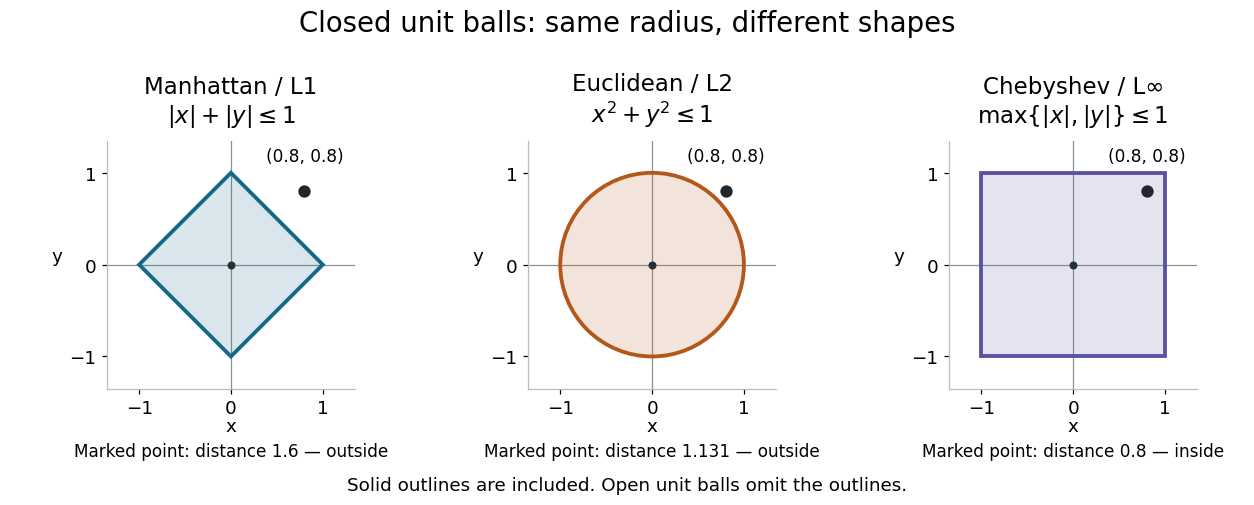
Three closed unit balls on the same coordinate scale
. Details. These shapes illustrate , with either the open ball or closed ball convention used consistently. Their outlines are included in the displayed closed balls. In an arbitrary metric space, however, points at distance exactly need not form the topological boundary; the discrete metric below shows why this distinction matters.
Articles by others on the same topic


In mathematics, the term "ball" typically refers to a set of points in a metric space that are at or within a certain distance from a central point. Specifically, a ball can be defined in different contexts, such as in Euclidean spaces or more abstract metric spaces.