An isolated qubit that acquires only a global phase has unchanged measurement probabilities. To reveal the Berry phase, use two coherent paths of a Mach-Zehnder interferometer, represented by a path qubit. In one arm the internal spin one-half qubit follows the loop; in the reference arm it stays in its starting energy eigenstate. Assume equal arm amplitudes, identical final internal states, cancelled relative dynamical phases, and calibrated fixed apparatus phases. In the model above, hold the reference Hamiltonian operator at its initial value for the same duration. Both arms then have energy eigenvalue and acquire the same dynamical phase , so their relative dynamical phase vanishes in the ideal limit of the adiabatic theorem.
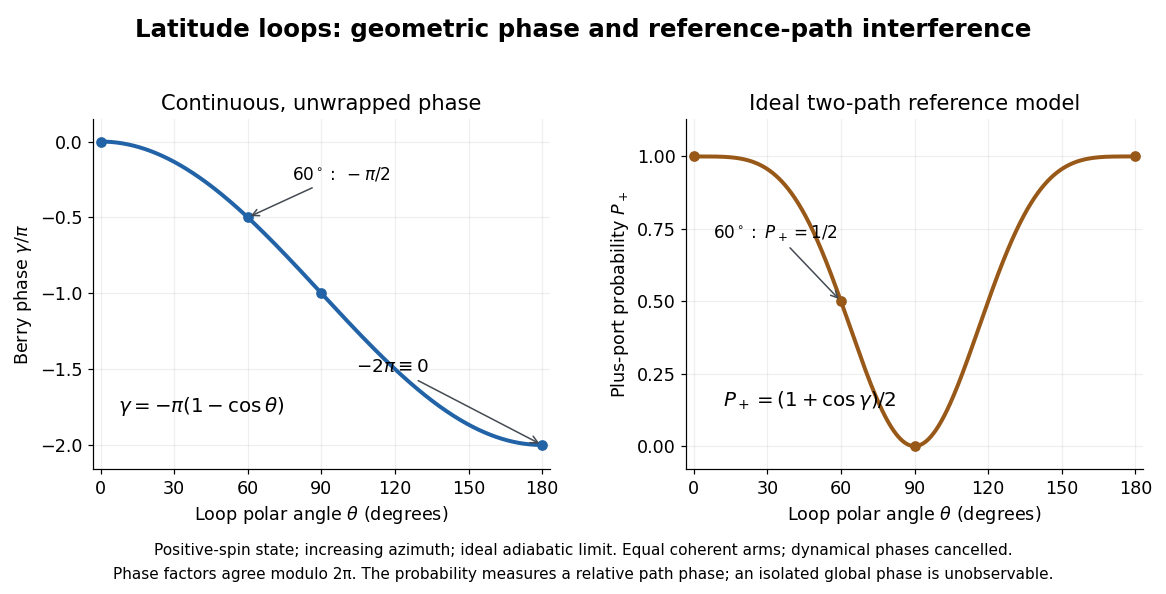
The joint quantum state before recombination then factors asThe Berry phase is now a relative quantum phase between the two paths. The calibrated plus output projects onto . The Born rule givesFor the Berry phase of a Bloch-sphere latitude, the plus-port probabilities at are respectively . This ideal Mach-Zehnder interferometer measurement cannot distinguish from or by itself; scanning a known reference phase can resolve the sign. An uncancelled relative dynamical phase would shift the fringe as well.

Articles by others on the same topic
There are currently no matching articles.