For a real sequence , the partial sum of is exactly . Consequently it is a convergent series if and only if has a finite limit , and its sum is . Cancellation takes place inside each finite partial sum; taking a limit is a separate step.[ref]
5.2 Infinite Series. Calculus Volume 2, §5.2 Telescoping Series: general boundary sequence, finite partial sums and finite-limit convergence criterion
The partial fraction telescoping example has and therefore limit . In contrast, let . Its first entry is , so . The even partial sums are zero and the odd partial sums are negative two. Both finite cancellations are correct, but the sequence has no single limit, giving a divergent series.
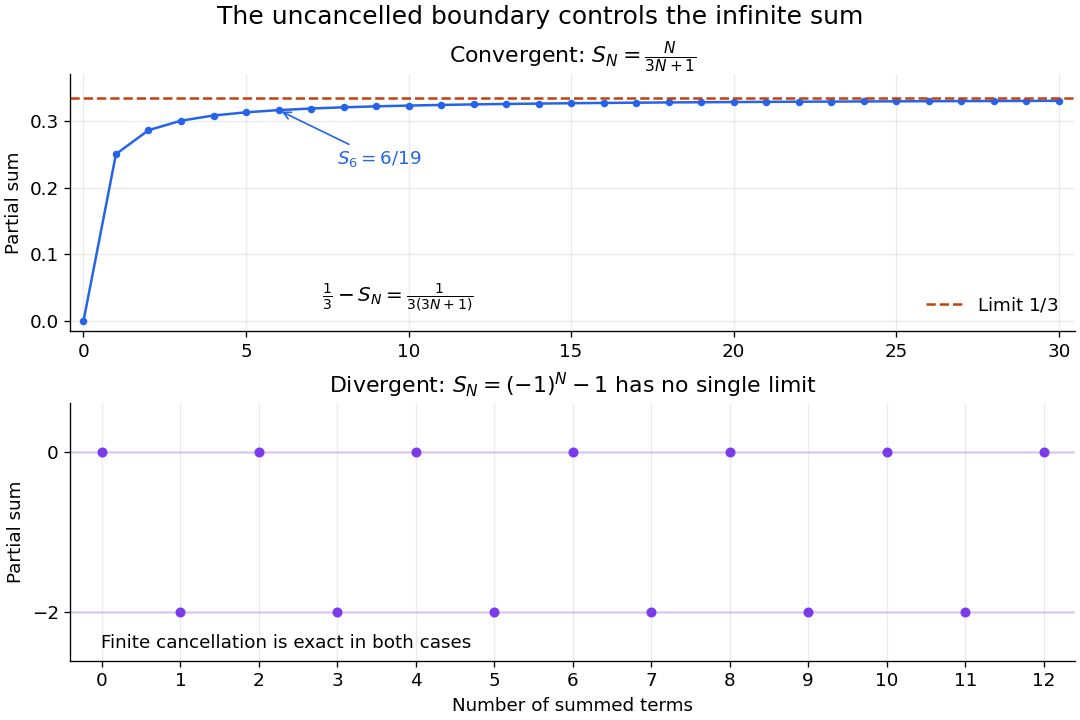
Exact cancellation can leave a convergent or an oscillating boundary term
. Original calculated partial sums. Top: approaches , with known series remainder . Bottom: alternates between zero and negative two. The dots are finite partial sums, not observed data. Details.
It is also essential to keep the two contributions paired. For example, is a convergent series with sum one, as its finite partial sum is . Writing it instead as asks to subtract two divergent series. The permitted finite cancellation does not define that separate subtraction. Working through partial sums keeps the indices aligned and the operation meaningful.
Articles by others on the same topic
There are currently no matching articles.