Let be three distinct buffer cache keys on one device. Use two initially empty slots, LRU replacement refreshed at each completed request, and synchronous successful buffer cache writeback of a dirty victim. Each request acquires its target, finishes any fill, reads or partially modifies it, and releases the client reference. An explicit pin on remains after request 2 through request 7; pin and unpin do not refresh recency. No other references, invalidations, background writes or durability operations occur. Initial backing contents are represented by the integers ; partial writes change the tracked value of to 11 and then 12 while preserving the unshown remainder.
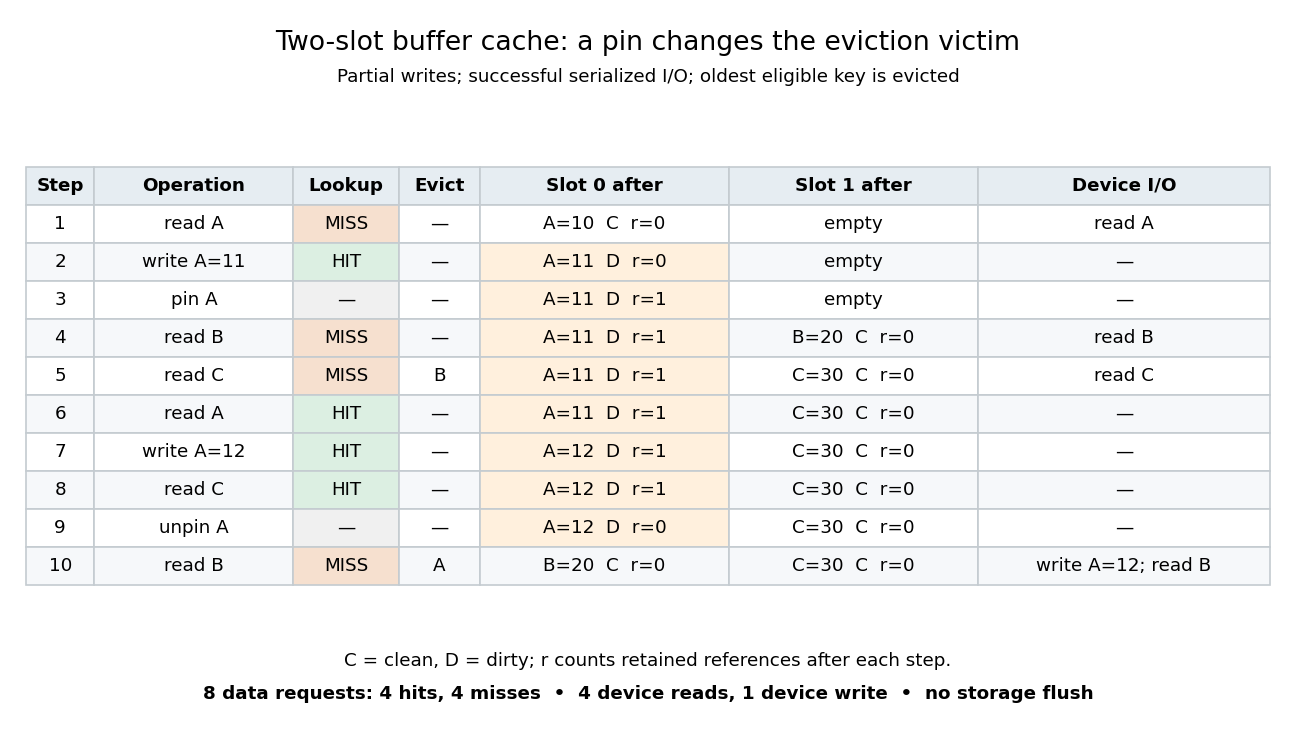
Exact cache hits, cache misses, retained references and buffer cache evictions in a two-slot buffer cache
. Details. 
The eight data requests are read , write , read , read , read , write , read , and read after unpinning . They yield four cache hits, four cache misses, four device reads and one device write. The pin and unpin are lifetime operations, excluded from the data-request count. At the read of , is older than but pinned, so the clean buffer for is evicted instead. Reading then returns 11 without device access even though its backing value is still 10. The second write supersedes 11; reading makes the older entry again. After unpinning, the final read of writes back 12 before evicting . After that request, backing contains 12, while the resident keys are .
This example exposes the value of retaining modified contents: a cache hit can return a newer value than a device read would. It also exposes the cost of reference counting constraints: a pinned older entry forces a different victim. An independent capacity sweep gives two cache hits, six cache misses and two device writes with one slot and no pin, but three cache hits, five cache misses and two device writes with two slots and no pin. With one slot and the stipulated pin, the read of cannot proceed. With three slots, both pin choices give five cache hits, three cache misses and no eviction-triggered write; remains dirty with value 12, so the absence of a device write does not establish file-system transaction durability.
Articles by others on the same topic
There are currently no matching articles.