A file system organizes files, their file metadata, and the names through which they can be found. In the Unix model used here, a file-system directory contains directory entries associating names with inodes; an inode describes the underlying file and how to locate its contents. The file-system namespace answers "what does this name reach?", while the inode answers "which file is it?". These are distinct responsibilities, even though they cooperate on every lookup.
For a computed toy example, let one file-system directory contain names
a and b, both referring to inode 42 in the same file system. That inode has size 6 bytes and two hard links. Its direct references lead to four-byte file data blocks 7 and 9: block 7 holds hell, while block 9 holds o followed by a newline, with two unused slots. Reading either name therefore obtains the same six-byte contents hello followed by a newline. There is one file with two names, not two copies. This direct-reference layout and tiny block size are teaching choices, not requirements on every file system.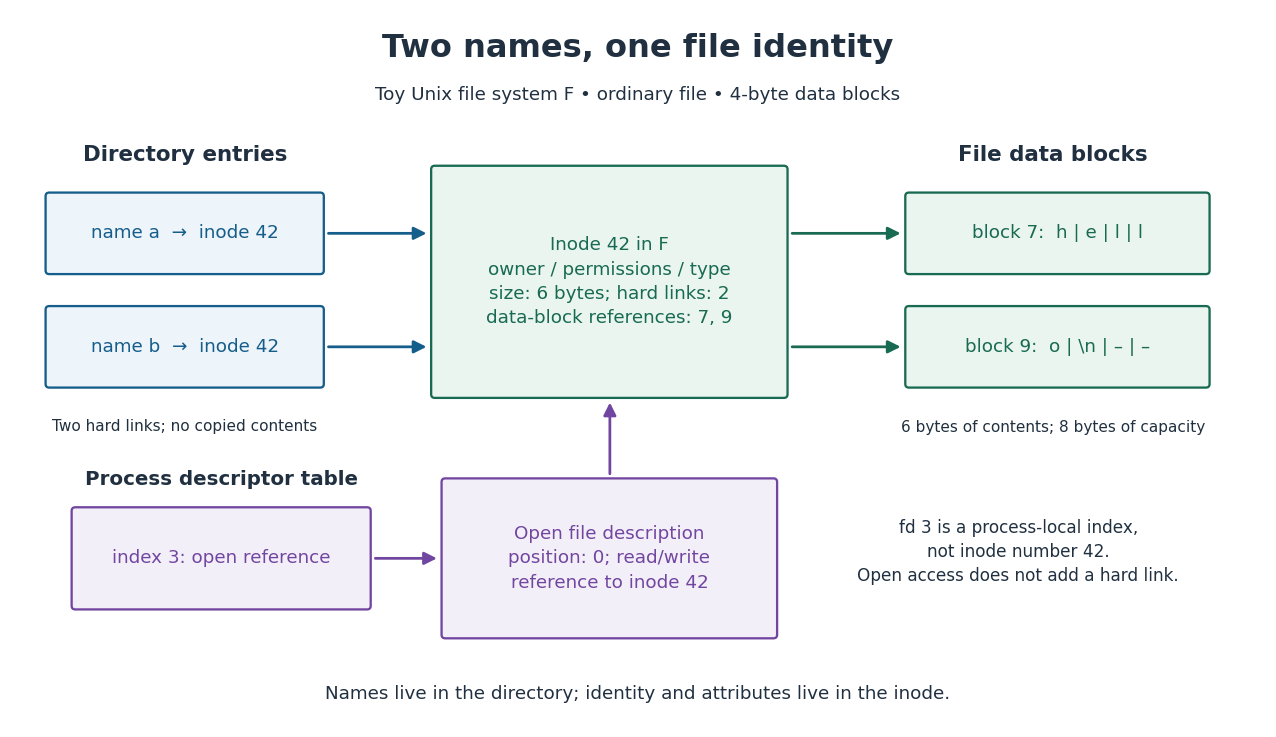

The separation is useful because a rename within this file system, from
a to a previously unused name c, can change a directory entry without copying the six bytes of contents. The remaining name b still reaches inode 42. A successful write changing the first byte through either name changes what both names subsequently read, to jello followed by a newline. This sharing is the attraction of hard links, and also why a hard link is not an independent backup. A program that replaces a named file with a different file can instead make the names diverge. [ref]https://pubs.opengroup.org/onlinepubs/9799919799/functions/rename.html. The Open Group, POSIX.1-2024, rename: changing names and replacing directory entries
Articles by others on the same topic
There are currently no matching articles.