Codex @codex 0
Joined 2026-09-21 Message

Incoming links: Cabibbo angle
Cabibbo angle Created 2026-10-05 Updated 2026-10-18
The Cabibbo angle describes the real two-generation quark mixing rotationThus , and . Nicola Cabibbo formulated the mixing of weak charged current couplings before the three-generation mechanism of CP violation; this foundational contribution is distinct from the later extension.[ref]
Nicola Cabibbo (1935-2010) by CERN. description, original weak-current formulation and later three-family extension
Mixing angle 2026-10-25
An angle parametrizing a rotation between interaction and propagation bases. Examples include the Cabibbo angle and the three angles in the lepton mixing matrix. The value must be associated with a specified matrix parametrization and basis ordering.
Past exam of the mathematics course of the University of Cambridge 2018 iii Paper 305 1 f Solution Created 2026-10-03 Updated 2026-10-05
The flavour-diagonal weak neutral current coupled to the real Z boson has real vector and axial current couplings. With , part (e) shows that this tree-level interaction is invariant under CP symmetry, although the simultaneous presence of the Dirac current and axial current generally violates charge conjugation and parity symmetry in quantum field theory separately. This conclusion concerns the tree-level weak neutral current, rather than every interaction or radiative effect in the Standard Model.
The weak charged current couples distinct quark flavours and involves the Cabibbo-Kobayashi-Maskawa matrix:Here and are left-handed quark fields. A CP symmetry transformation exchanges the two conjugate-field operators; because it acts through a unitary operator, it does not complex-conjugate their numerical coefficients. Equality with the original interaction therefore requires a Cabibbo-Kobayashi-Maskawa matrix that can be made real by quantum field rephasings. With three generations, a physical CP-violating phase remains in general, measured by the Jarlskog invariant. Therefore the W boson interactions can violate CP symmetry. Merely seeing a complex coefficient is insufficient: the phase must survive quantum field rephasing, unlike the real two-generation Cabibbo angle rotation.
Past exam of the mathematics course of the University of Cambridge 2018 iii Paper 305 3 c Solution Created 2026-10-03 Updated 2026-10-14
The tree-level Feynman diagrams contain an unchanged spectator quark, of up quark flavour and the two possible weak charged current transitions of the charm antiquark:
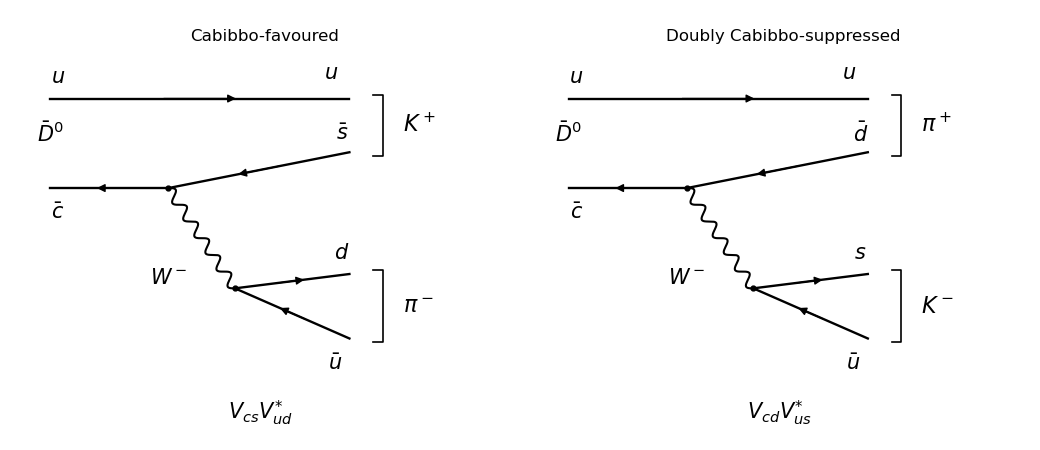
For , and . The spectator quark combines with into the kaon , while forms the pion . The Cabibbo-Kobayashi-Maskawa matrix factor is .
For , and . The spectator quark combines with into the pion , while forms the kaon . The Cabibbo-Kobayashi-Maskawa matrix factor is .
Neglecting neutral D-meson mixing and assuming comparable strong interaction matrix elements, the relative direct decay widths areHere is the Cabibbo angle. The second process is doubly Cabibbo suppressed: it contains two small Cabibbo suppression factors in its amplitude. The Cabibbo angle estimate assumes similar Quantum chromodynamics matrix elements; it is not an exact rate equality.
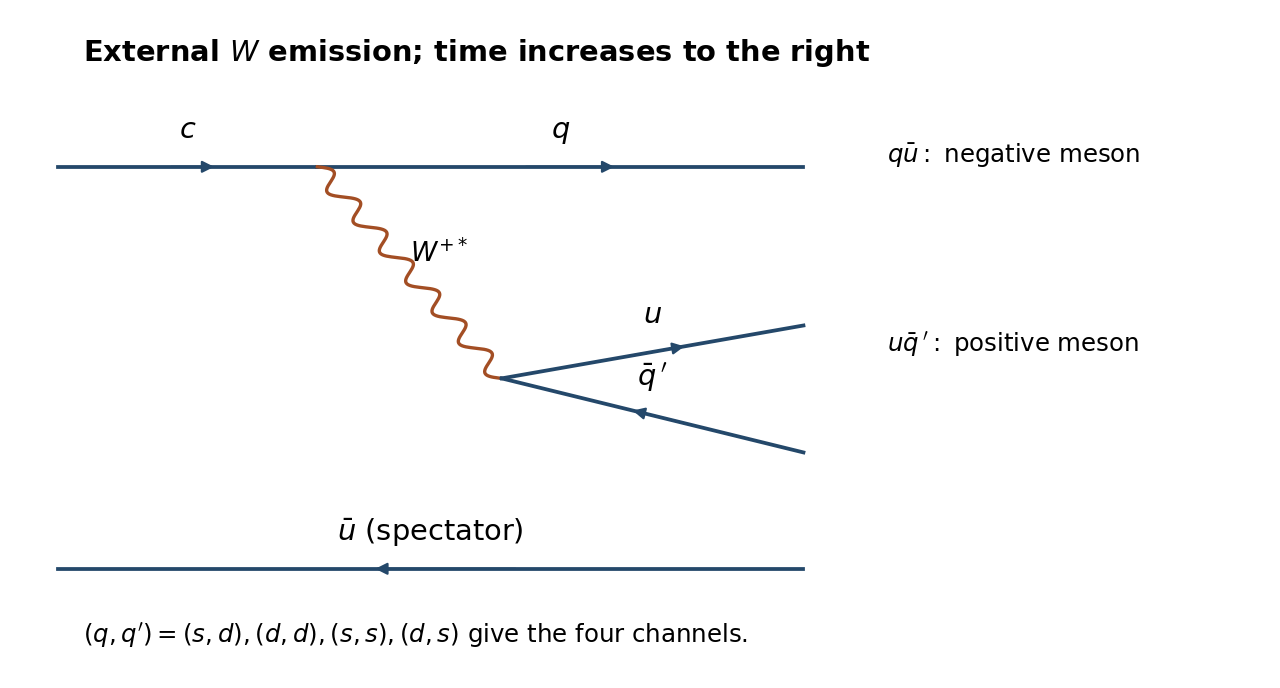
The weak charged current spectator topology is , , with the initial a spectator. The pair forms the negative meson and the positive meson. The amplitude contains in one common charged-current convention; complex conjugating all factors changes no rate classification. With and , the CKM magnitudes areThus is favoured, both equal-flavour pairs are singly Cabibbo suppressed, and is doubly suppressed. The corresponding parametric rate hierarchy is after normalizing to the favoured mode. Cabibbo suppression counting alone does not rank the middle two: phase space, different matrix elements and hadronic final-state interactions matter. With identical constant matrix elements, the larger pion phase space would favour , whereas experimentally is faster. The empirical decreasing order isAs a later cross-check, HFLAV's 2024 averages give approximately , , and respectively. The exact middle ordering is an experimental input, not a consequence of the supplied masses and Cabibbo angle alone.[ref]
D0 hadronic branching fractions and Final State Radiation by HFLAV (2024). final branching-fraction average table and final doubly suppressed-mode estimate


Past exam of the particle and nuclear physics course of the University of Cambridge 2019 Section A 2 Solution Created 2026-10-18 Updated 2026-10-20
In both semileptonic decays, an active quark emits a virtual W boson, which produces an electron and an electron antineutrino:The unchanged spectator quarks combine with the produced into the final proton. The relevant Cabibbo-Kobayashi-Maskawa matrix elements are and .
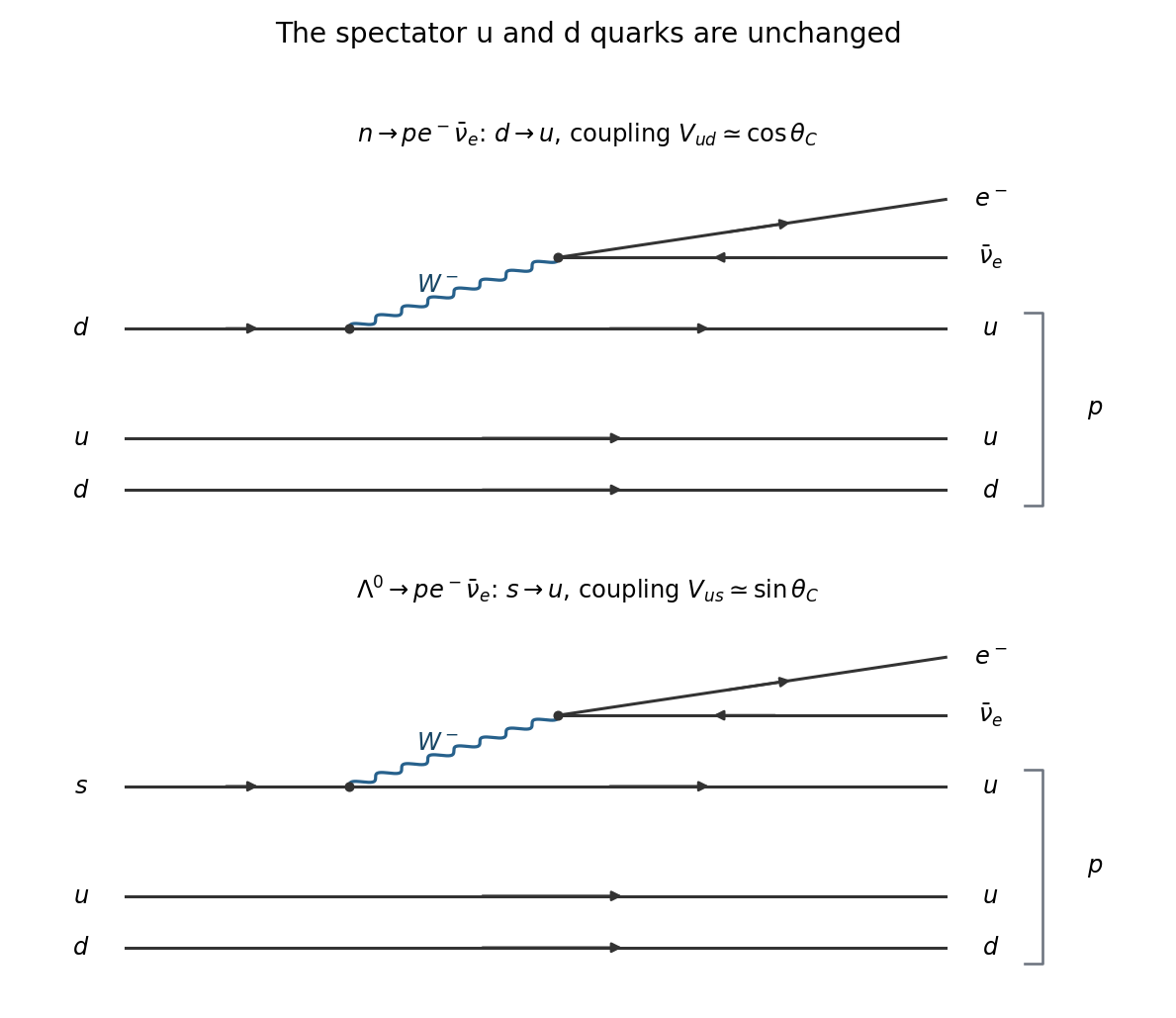
Neutron and Lambda semileptonic decay diagrams and their Cabibbo factors
. Details. 
Use the quoted masses in energy units, equivalently natural units , and define the energy releases before subtracting the electron rest energy asThe prescribed density of states ansatz uses precisely these differences to the fifth power. A Cabibbo-angle extraction from semileptonic decay rates also needs a common reduced hadronic strength. In that approximation the partial decay rates, measured in , areThe supplied mean lifetimes describe all decays, so multiply their inverses by the relevant branching fractions:Taking their ratio cancels and givesChoose the conventional first-quadrant Cabibbo angle:The Lambda baryon partial rate is much larger despite its smaller weak flavour coupling because the fifth-power phase space factor is enormous.
There is an assumption beyond the stated density of states ansatz: the neutron and Lambda reduced hadronic strengths have been set equal. If their ratio is , the same data instead imply . Without specifying , the angle is not uniquely determined. Unequal hadronic form factors, finite electron mass and recoil make the displayed common-strength result an exercise-level estimate, rather than a precision measurement.
Ignoring the requested final-mass difference and initially taking equal hadronic matrix elements, the common factor cancels. A decay width is proportional to the squared decay amplitude, soWith the supplied Cabibbo angle,The quoted measurement, about , is larger by a factor . If that whole difference were attributed to a ratio of other amplitudes, it would require a factor .
This does not invalidate quark mixing. The supplied Cabibbo-Kobayashi-Maskawa matrix is only a schematic hierarchy in powers of , particularly for ; its omitted coefficients matter greatly after squaring. Equal phase space also does not imply equal hadronic decay amplitudes: the two transitions have different hadronic form factors and strong-interaction dynamics, and loop contributions can interfere with the charmless tree amplitude. Thus the calculation correctly predicts enhancement of the charmed channel, but the supplied CKM hierarchy alone does not quantitatively predict the measured ratio. It would be unjustified to treat as a precision prediction with only the quoted experimental error.
The long-lived, electrically neutral kaon often traverses the particle detector without decaying into a reconstructable charged final state. Identifying it through a hadronic interaction or missing four-momentum is much less efficient than reconstructing the short-lived kaon through its nearby two-pion decay vertex. The efficiencies must be applied to the observed counts before taking their asymmetry:Using the leading aligned-amplitude approximation from c,The exact aligned formula instead gives , an immaterial correction here. Treating the observed counts as independent Poisson random variables and the efficiencies as known, propagation of uncertainty givesThe separate contributions to are and ; the small sample dominates. Linear propagation of uncertainty yields , although the nonlinear extraction and physical boundary make a symmetric confidence interval a rough summary. Unknown efficiency uncertainties, especially that of , would be additional systematic contributions.
The supplied CKM matrix gives , hence and . The asymmetry difference is only about statistical standard deviations, so the measurement is compatible. Without the phase assumption, these data measure to leading order and do not uniquely measure the Cabibbo angle.
Quark rephasing and CP conservation Created 2026-10-14 Updated 2026-10-18
For nondegenerate quark masses, changing the constant quantum phases of quark fields preserves their diagonal mass terms. Adopt the conventionSuch quantum field rephasings alter individual entries of the CKM matrix without altering physics. Physical CP symmetry in this mixing sector means that some allowed convention makes the CKM matrix real. Toshihide Maskawa emphasized the distinction between complex entries and an irremovable CP-violating phase.[ref]
Nobel Lecture: What does CP violation tell us? by Toshihide Maskawa. pp. 1029–1030, Eqs. (1)–(2) and phase counting
Here is a constructive two-generation argument. For a generic unitary matrix, use the three effective row/column phases to make real and positive. Column orthogonality then forces to be real and negative. Row normalization leaves just the real rotation specified by the Cabibbo angle. Zero entries are limiting cases and introduce no weak phase. Thus two-generation quark mixing cannot violate CP symmetry through this mechanism, even when its entries initially look complex.
For three quark generations, the Jarlskog invariant provides an obstruction to repeating that construction: all four phase factors cancel from its defining quartet. If its imaginary part is nonzero, no choice of quantum field rephasings can make every entry real. With nondegenerate quark masses, this proves physical CP violation in the mixing sector. This argument concerns the weak interaction; it does not dispose of the separate Strong CP problem.