The weak neutral current couples the Z boson to a fermion without changing its electric charge. Its vector and axial-vector coefficients depend on weak isospin, electric charge, and the weak mixing angle.
The neutral current transfers no electric charge at a fermion vertex; “neutral” does not mean that every participating particle is uncharged. For example, transfers energy and momentum to an electron through Z boson exchange. By contrast, a charged current can convert a muon neutrino into a muon, as in . Both processes conserve total electric charge. A photon also carries no electric charge, but an active neutrino has no electromagnetic charge coupling: its neutral current is a distinct weak interaction.
The experimentally useful contrast on a nucleon target iswhere is a nucleon and is an allowed final state of hadrons. The charged current makes a charged lepton available for identification; the outgoing neutrino in a neutral current leaves no bubble-chamber track. A sample of hadronic events without an identified muon therefore poses an experimental question: how many could instead be neutron interactions, or charged current events whose muon was missed? The answer requires a detector-response and background analysis, not merely an inspection for an absent line.
Gargamelle was a heavy-liquid bubble chamber at CERN. Its 1973 collaboration report, Observation of neutrino-like interactions without muon or electron in the Gargamelle neutrino experiment, by F. J. Hasert and colleagues, described hadronic events with no identified muon or electron and evaluated rates relative to charged current events. This is evidence for a neutral current, rather than direct production or photography of a Z boson.[ref]
Observation of neutrino-like interactions without muon or electron in the Gargamelle neutrino experiment by F. J. Hasert. Physics Letters B 46 (1973), pp. 138–140, title, abstract and author list
CERN's Gargamelle account identifies the target liquid as and distinguishes hadronic events from the separate isolated-electron signal. The latter is an antineutrino transferring momentum to an electron, whose electromagnetic particle shower supplies visible tracks. These are different final states, not two names for one event.[ref]
Forty years of neutral currents by Cian O’Luanaigh. Forty years of neutral currents, 19 July 2013, chamber description and isolated-electron caption
A neutrino beam uses protons striking a target to produce charged pions and kaons; focusing selects parents that undergo particle decay in flight. Their neutrinos pass through shielding into the target. Scanning photographs locates vertices and classifies outgoing tracks.[ref]
Expansion prepares a bubble chamber's superheated liquid; ionization by charged secondaries seeds bubbles for photography.[ref]
The recorded light reveals bubbles, not a directly visible incoming or outgoing neutrino. Reconstructing a vertex and classifying bubble-chamber tracks connects that optical record to a hypothesis about a particle interaction.
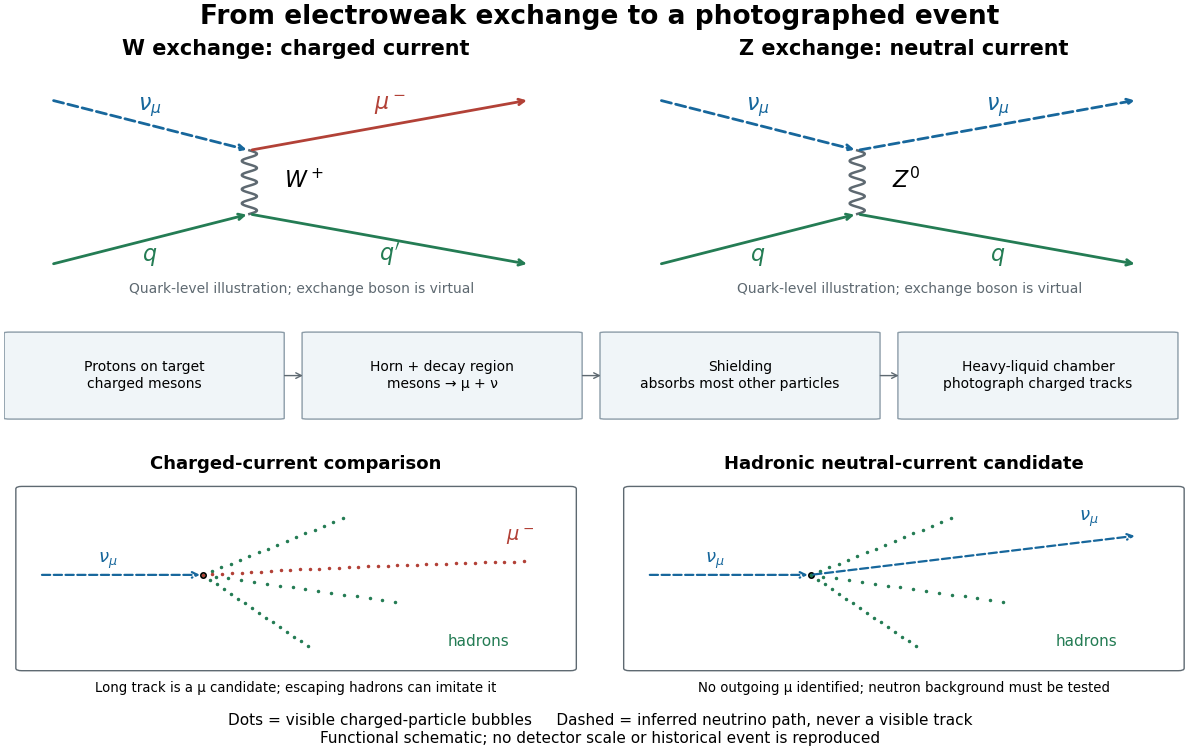
The collaboration compared samples with matched hadronic cuts. A flat longitudinal vertex distribution resembled neutrino interactions, but sideways neutrons and multi-step cascades could also flatten it. The background estimate combined visible parent-interaction/secondary-neutron pairs with a cascade calculation including surrounding material. Later proton exposures tested the predicted cascade lengths. Escaping charged hadrons could imitate muons; there was no independent perfect muon tag.[ref]
The inference combines positive evidence for an interaction with controlled alternatives for its visible final state. Shielding suppresses unwanted beam components, yet interactions in surrounding material can generate secondary neutrons; shielding alone cannot certify a neutral current. Nor does a successful neutral current search by itself establish every coupling or the Higgs mechanism. Its importance for the electroweak interaction is that the theory predicts an additional weak channel, with coupling relations that further cross section measurements can test.
For an especially simple neutral current example, scatter a muon neutrino elastically from an initially stationary unpolarized electron:Here is the final electron kinetic energy, is the incident neutrino energy, and is the Weinberg angle. These are electron chiral couplings in the vertex convention of neutral-current vector and axial couplings. The chosen muon neutrino elastic channel has no additional W boson exchange amplitude; the electron-neutrino elastic channel would have one. Other charged-current final states can become kinematically accessible at sufficiently high incident energies and are not part of this elastic model.
Use natural units , retain only tree-level Feynman diagrams, and take the contact limit with . Neglect electron-mass terms relative to , radiative corrections and detector response. Then is the Fermi constant. The approximate endpoint replaces the exact elastic endpoint . The omitted leading mass-dependent interference term in is . Thus the approximation is not appropriate for arbitrarily soft neutrinos.
The shape follows from the two chiral contributions to the massless scattering amplitude. The spin sum gives terms proportional to and in Mandelstam variables; in this limit , giving the square . The two electron chiralities do not interfere when the relevant mass corrections are dropped. Replacing the neutrino by its antineutrino exchanges which coupling multiplies each kinematic term. This is the same chiral angular weighting that appears in neutrino scattering on an antiquark, now with a target whose couplings are particularly simple.
Integrating the two elementary terms givesFor an original teaching example choose , so and . This is a stipulated parameter, not a measurement of the Weinberg angle. ThenThe normalized probability density function is , not the unnormalized differential cross section. Its endpoints have ratio two, and the fraction with is . The antineutrino spectrum happens to coincide at this chosen parameter because ; this equality is not a general prediction for arbitrary Weinberg angles.
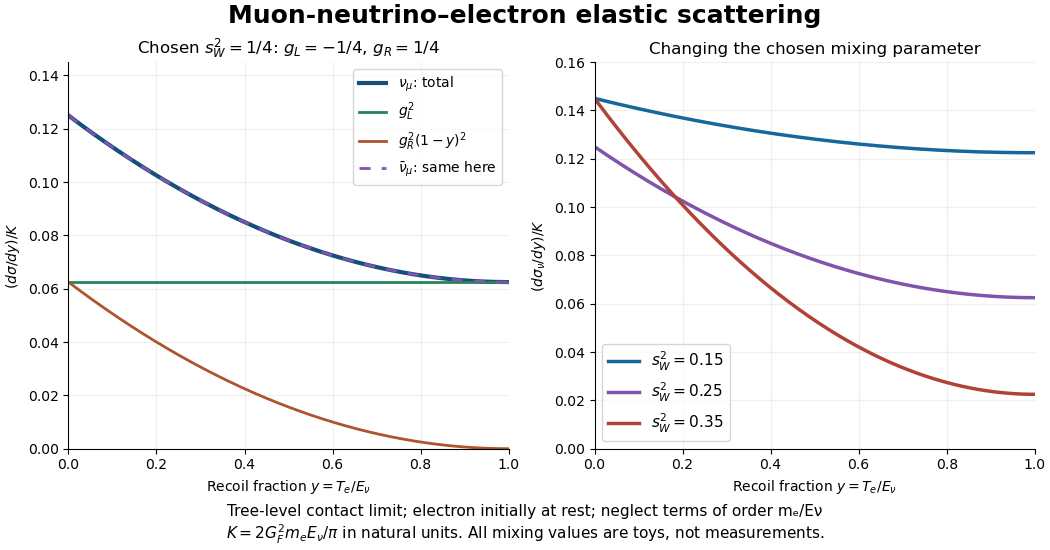
Unlike a visible electron recoil, the scattered neutrino is unrecorded. A measured recoil spectrum must therefore be compared with incident neutrino flux, energy distribution, acceptance, detection efficiency and backgrounds. A shape or rate tests a specified theoretical model only after these experimental ingredients have been supplied.
If a neutral-current vertex has prefactor and chiral coefficients , then , with and . For one Standard Model charged lepton, ; for an active neutrino, . A prefactor instead requires doubled coefficients. Mixing these conventions creates a factor-of-four error in squared amplitudes.
A flavor-changing neutral current changes fermion flavor without changing electric charge. Such currents are absent at tree level in the Standard Model and are strongly suppressed at loop level by the Glashow-Iliopoulos-Maiani mechanism.
Unitarity of the CKM matrix cancels flavour-independent contributions to weak flavour-changing neutral amplitudes. In a quark loop, equal internal masses would give a common contribution whose off-diagonal CKM sum vanishes; unequal masses leave a suppressed nonzero amplitude. This explains why neutral kaon mixing occurs through loops rather than a tree neutral-current vertex.
The Glashow-Iliopoulos-Maiani mechanism uses the unitarity of the quark mixing matrix to cancel flavor-changing neutral-current amplitudes when equal-charge quark masses are degenerate. The remaining loop amplitudes are suppressed by quark-mass differences.
Articles by others on the same topic



Neutral current is a term that refers to the current that flows in the neutral conductor of an electrical system, particularly in alternating current (AC) systems. The neutral wire serves as a return path for current in a balanced system. In a three-phase system, for example, it helps to ensure that the load is evenly distributed among the phases.