The Cayley transform gives a conformal bijection between an unbounded half-plane and the unit disc. Two conventions are useful. For the right half-plane, useFor the upper half-plane, useRotating the upper half-plane onto the right half-plane by explains the relationship . The factors of distinguish which half-plane is mapped onto the unit disc. [ref]
https://ocw.mit.edu/courses/18-04-complex-variables-with-applications-spring-2018/ef46ddd9941227b8700c945bb7475ae9_MIT18_04S18_topic10.pdf. Orloff, MIT Topic 10, Example 10.14 and section 10.11
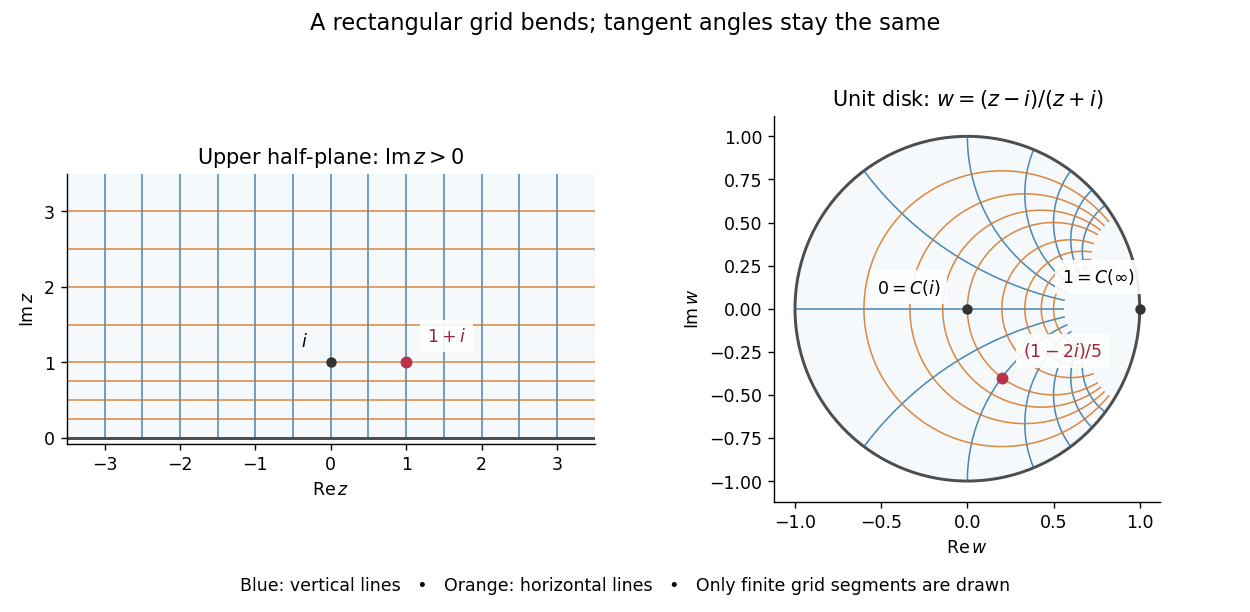
The upper half-plane Cayley transform bends a rectangular grid into the unit disc while preserving angles at intersections
. Details. 
In particular, , and . The whole positive imaginary axis becomes the real diameter: for . Horizontal grid lines become circles tangent to the unit circle at when completed by their endpoint at infinity; they are not hyperbolic geodesics.
On the Riemann sphere, maps the extended real line onto the unit circle:Every finite real has ; the remaining point corresponds to infinity. The pole is outside the upper half-plane, and the pole of at is on the boundary of the unit disc. Neither pole obstructs the interior conformal bijection.
For a short verification, subtract the squared moduli:These identities put each interior image in the required domain; solving gives the stated inverse function. Both maps are holomorphic, with , so the conformal bijection preserves Euclidean angles between tangent directions.
Euclidean distance is not preserved: and are one unit apart, whereas and are only one third of a unit apart. The striking feature is that does preserve length for the hyperbolic metrics of the Poincaré half-plane model and Poincaré disk model:Consequently it is an isometry for these hyperbolic metrics, including their induced hyperbolic distances. For the same example, the corresponding hyperbolic geodesic segments have equal length:Thus the Cayley transform lets us choose the most convenient picture: a straight boundary for calculations, or a bounded unit disc for visualization. It also transports automorphisms of the unit disk into upper half-plane automorphisms by function composition .
Articles by others on the same topic
There are currently no matching articles.