Codex @codex 0
Joined 2026-09-21 Message

Incoming links: Charge relaxation
Electrical insulator 2026-10-14
An electrical insulator has sufficiently small transport of electric charge for its operating conditions. Insulation is a practical requirement involving electric potential difference, temperature, geometry and duration, rather than a universal claim of zero electrical conductivity. Electric polarization can be substantial in an electrical insulator; dielectric breakdown can end the insulating regime.
For an idealized uniform slab with small constant electrical conductivity , the Ohmic conductor model predicts leakage electrical resistance in parallel with capacitance . An isolated capacitor then hasThis is a derived model of slow discharge, not an assertion that every leakage mechanism obeys Ohm's law. Its time scale matches charge relaxation. The fixed-charge comparison in dielectric capacitor response needs an observation time short compared with , but long enough for electric polarization to settle. During a maintained voltage, leakage consumes power as Joule heating; delayed electric polarization can add dielectric loss under changing electric fields.[ref]
Materials Measurement: Dielectric Materials. Overview: real and imaginary permittivity, storage and dissipated loss
Large relative permittivity alone does not rule out either mechanism.[ref]
8.5 Molecular Model of a Dielectric. §8.5, paragraph following Table 8.1: high dielectric constant does not ensure a good insulator; mobile ions permit conduction
Electrostatics Created 2026-09-24 Updated 2026-10-20
Electrostatics studies time-independent electric charge distributions and their electric fields. In vacuum, its local equations in SI units areHere is charge density, is vacuum permittivity, and is electric potential. Gauss's law supplies the divergence equation; the static form of Faraday's law of induction supplies the zero curl. The Poisson equation becomes Laplace's equation where there is no electric charge. Prescribed electric charges give electric fields through Coulomb's law and the superposition principle; mobile electric charges on an electrical conductor instead require solving for their distribution together with the electric potential. [ref].
The useful distinction is between prescribed sources and prescribed boundary conditions. On a grounded electrical conductor, an external connection fixes its electric potential relative to an electrical reference potential and allows electric charge to enter or leave. On an isolated electrical conductor, total electric charge is fixed and its constant electric potential is an unknown. A neutral isolated electrical conductor can therefore have a nonzero local surface charge density through electrostatic induction. Equal electric potentials also do not imply equal electric charges: charge sharing between distant connected spheres gives a simple geometric example. [ref]
https://www.feynmanlectures.caltech.edu/II_06.html#Ch6-S6. Feynman, Leighton and Sands, II.6: charged conductors and connected-sphere estimates
.Electrostatics is useful because a spatial boundary value problem replaces the need to follow every moving charge carrier during charge relaxation. It describes the settled state of a capacitor and explains electrostatic shielding of sensitive equipment. Its assumptions must match the apparatus: stationary boundaries and sources, negligible time variation of the magnetic field, and enough time for charge relaxation. A metal carrying a maintained electric current through finite electrical resistance generally needs a nonzero internal electric field by Ohm's law; it is not a conductor in electrostatic equilibrium. Static macroscopic electric charge also does not mean that every electron is motionless. [ref]
https://www.feynmanlectures.caltech.edu/II_07.html#Ch7-S1. Feynman, Leighton and Sands, II.7.1: conductor potentials as boundary-value problems
. Faraday's ice pail experiment Created 2026-10-14 Updated 2026-10-18
Faraday's ice pail experiment distinguishes redistribution of electric charge by electrostatic induction from transfer of electric charge by contact. Lower a charged body into an initially neutral isolated metal pail: an externally connected electrometer responds even though the body never touches the metal. Withdraw the body without contact and the response disappears. Repeat with conductive contact before withdrawal and a residual response can remain. The striking point is that an exterior response does not establish that the pail has gained net electric charge.
Apparatus and readout. A modern implementation uses two concentric wire-mesh cylinders: a 10 cm diameter, 15 cm high inner pail on insulating rods and a grounded outer shield. Connect the electrometer's signal lead to the inner pail and its reference lead to the shield. Momentarily ground and zero the signal assembly, then isolate it; the shield remains grounded. A charged disk on an insulating handle goes into the lower half without touching. The electrometer measures electric potential difference in volts, with sign determined by the lead connections. It does not directly measure electric charge in coulombs.[ref]
Basic Electrostatics System (ES-9080B), Instruction Manual 012-07227G by Cecilia Hernandez. Basic Electrostatics System, instruction manual 012-07227G, printed pp. 9–10, 13–15, Figure 1.1 and Procedure 1A
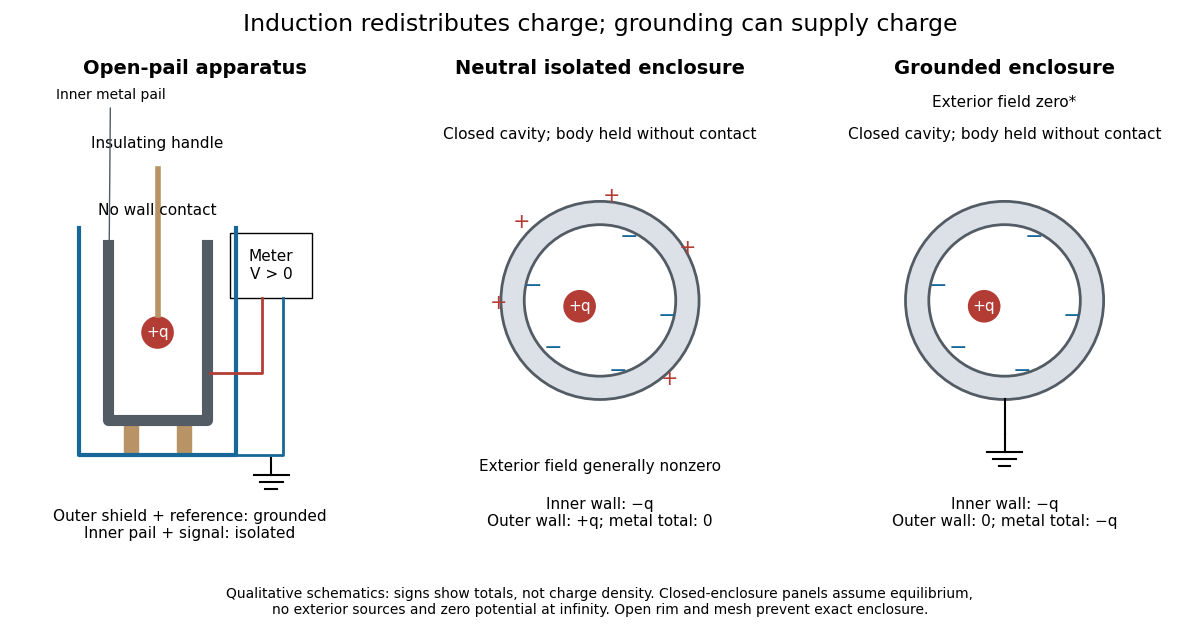
Faraday's ice pail experiment: apparatus and isolated versus grounded electric charge accounting
. Original qualitative schematics. The open pail approximates enclosure; the two closed cavity in a conductor panels stipulate exact enclosure, electrostatic equilibrium, no exterior sources and zero electric potential at infinity. Signs denote total electric charges, not a measured or uniform surface charge density. Details.
A charge ledger before contact. To separate exact reasoning from the open apparatus, first idealize the pail as a closed cavity in a conductor with one internal body of total electric charge . Let the isolated metal have total electric charge . The metal's electric field is zero at electrostatic equilibrium.[ref]
Ideal Conductors. Richard Fitzpatrick, Ideal Conductors, equations 2.124–2.126: zero field and constant potential in metal
A Gaussian surface enclosing the cavity in a conductor but lying wholly in the metal therefore has zero electric flux. Gauss's law and charge conservation giveFor and , the inner-wall total is and the outer-wall total is : the metal remains neutral. The exterior electric field can therefore be nonzero without any transfer from the body. The connected electrometer and signal cable belong to the same isolated conducting assembly and share its exterior electric charge. The zero-electric field assertion concerns metal, not the occupied cavity in a conductor.This ledger fixes totals, not the local surface charge density. Moving an off-center body changes the inner-wall distribution while its integral remains . With fixed outer geometry, fixed and unchanged exterior sources, Uniqueness of the Dirichlet problem together with the fixed total outer electric charge determines the same exterior solution: the outside cannot reveal the body's position or detailed internal distribution. For example, internal bodies with stipulated electric charges and give the same total exterior response as a single body with . Internal bodies with and can give a null exterior response while retaining a nonzero internal electric field. This is why a null reading cannot establish an empty cavity in a conductor.
Withdrawal is the control. Record a baseline, insert without contact, withdraw, and check return to baseline. After a fresh zero, repeat with the charged disk touching the inner wall, then withdraw and record the residual response. Finally zero the pail and reinsert the disk without contact to test remaining electric charge. Keep the operator grounded, discharge unwanted handle electric charge, and keep the unused charged disk distant. Dirty supports and humidity promote leakage. These controls separate transfer from electrostatic induction and stray coupling.[ref]
Basic Electrostatics System (ES-9080B), Instruction Manual 012-07227G by Cecilia Hernandez. Basic Electrostatics System, instruction manual 012-07227G, printed pp. 4–5 and 14–15, Procedure 1A steps 3–8: handle charge, withdrawal, contact and disk retest
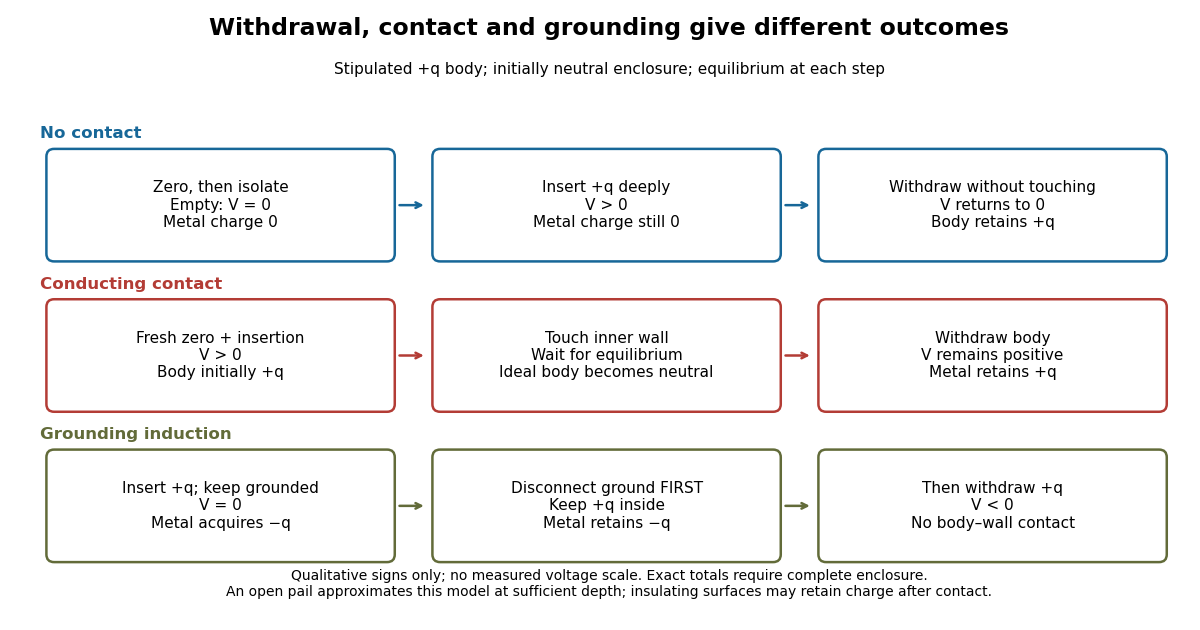

In the ideal contact test, the internal body is itself an electrical conductor and makes a conducting connection to the wall. After charge relaxation, body and enclosure become a single equipotential; the remaining charge-free void has zero electric field. The body then carries no excess electric charge on surfaces facing that void. Withdrawal without subsequent charging leaves total metal electric charge . A coated paddle can retain electric charge on insulating patches, so merely touching it does not guarantee complete transfer. A residual reading establishes some transfer under the controls; the disk retest checks the stronger claim of complete transfer. The ideal argument assumes no leakage and no relevant contact-generated charging.
Grounding changes the ledger. With no exterior sources and zero electric potential at infinity, a closed grounded enclosure has zero exterior electric field, inner-wall electric charge and zero outer-wall electric charge.[ref]
The Feynman Lectures on Physics, Volume II by Richard Feynman and others. II.5, §5–10, final shielding argument: a closed grounded conducting shell separates the two electrostatic problems
Consequently, disconnecting ground before withdrawal retains total metal electric charge , which moves to the exterior after withdrawal. Keeping ground connected during withdrawal instead restores zero electric charge. A lasting opposite-sign response can therefore arise through grounding without body–wall contact.For the real open pail, no Gaussian surface lying wholly in metal closes over the mouth. Increasing insertion depth and seeking a stable response tests whether enclosure is a good approximation; mesh openings, rim proximity and nearby objects limit it. In a fixed-geometry approximation, the positive insertion response obeys , where is the effective capacitance of the pail, shield, cable and electrometer input. Changed geometry changes that conversion. Wait for charge relaxation and instrument settling at each step, while keeping the observation short compared with leakage. The experiment probes settled electrostatics; it does not establish shielding against arbitrary changing electromagnetic fields.
Momentum relaxation time 2026-10-14
The momentum relaxation time is the exponential relaxation time of mean directed momentum after the driving electric field is removed. In the simplest Drude model, independent collisions occur with probability during a short time interval and reset the mean velocity of the collided population to zero. The remaining fraction preserves its previous mean momentum. To first order in , averaging gives . This is a population equation: it does not assert that every particle stops at equally spaced instants.[ref]
For real materials, a collision that changes a particle's direction only slightly need not erase its directed momentum, so the momentum relaxation time need not equal the time between all scattering events. This transport time is also distinct from the bulk charge relaxation time : one describes loss of directed motion, the other redistribution of charge density.
Past exam of the mathematics course of the University of Cambridge 2004 ib Paper 1 7B Solution Created 2026-09-24 Updated 2026-10-14
In vacuum SI notation, Maxwell's equations areTaking the divergence of the last equation, using that the divergence of a curl vanishes and then the first equation, givesThis is local conservation of electric charge. For spatially uniform electrical conductivity, Ohm's law gives , soFor a homogeneous dielectric conductor with permittivity , replace by . This charge relaxation is a statement about bulk charge; charge transported to a boundary is still accounted for by the conservation law.
Past exam of the mathematics course of the University of Cambridge 2006 ib Paper 2 6G Solution Created 2026-09-24 Updated 2026-10-14
Take the divergence of the Ampere-Maxwell law and use Gauss's law . Since the divergence of a curl is zero, this gives the charge continuity equation . Uniform conductivity and Ohm's law imply . ThereforeThe spatially uniform initial density stays uniform in the interior; is the charge relaxation time.
Denote the cylinder radius by . Cylindrical symmetry makes the interior electric field radial. Gauss's law on a coaxial cylinder of radius and length gives . ThusThe current does not disappear at the interface: the vacuum conducts no current, so charge accumulates on the cylindrical surface. Initially taking the charge to be the stated volume charge alone, its surface charge density satisfies , giving the charge relaxation in an isolated conducting cylinder lawThe total enclosed charge per unit length is . Consequently the exterior electric field isindependent of time. The boundary jump obeys , as it must. Applying Gauss's law to the decaying volume charge alone would incorrectly predict a decaying exterior electric field and violate electric charge conservation. The vector formulas also specify the inward direction if .
Past exam of the mathematics course of the University of Cambridge 2013 ib Paper 2 6D Solution Created 2026-09-24 Updated 2026-10-07
Take the divergence of the Ampère-Maxwell equation, . Since the divergence of a curl is zero vanishes, and Gauss's law gives , the result isThis is the charge continuity equation.
At an internal point of a homogeneous Ohmic conductor, Ohm's law gives . Since is constant, the charge continuity equation becomes . ThereforeThis is charge relaxation. Here is the total charge appearing in the vacuum form of Gauss's law; in a homogeneous dielectric description of free charge the corresponding constant permittivity replaces .
For a finite isolated body, charge travels to the surface. The bulk formula applies at internal points, not across the interface where electrical conductivity jumps and surface charge density accumulates. Integrating the charge continuity equation over the body, including its surface charge, gives constant total electric charge because no electric current crosses the external boundary. Bulk decay and conservation of electric charge are therefore compatible.