Electrical conductivity measures the local response of current density to electric field. In the rest frame of an isotropic Ohmic conductor, the local form of Ohm's law isLarger positive electrical conductivity gives larger current density at the same electric field. It is a bulk material coefficient, distinct from the geometry-dependent electrical conductance of a whole component and from a sheet's surface conductivity. Electrical resistivity is in this scalar model. [ref]
https://openstax.org/books/university-physics-volume-2/pages/9-3-resistivity-and-resistance. Ling, Sanny and Moebs, §9.3: conductivity and resistivity
.The local and whole-wire forms fit together particularly neatly. For uniform current in a straight homogeneous wire, with length , wire cross-sectional area , constant electrical conductivity and terminal electric potential difference , the axial electric field has magnitude . ThusFor the defined electrical resistance example , , and , the local values are and ; integrating gives . One material law therefore supplies both a spatial description and a terminal relation.
The scalar form requires isotropy. In an anisotropic material the response can instead be a tensor, , and current density need not be parallel to electric field; uniaxial conductivity tensor is one existing example. These statements concern the material's rest frame. A moving electrical conductor instead uses the moving-conductor Ohm law.
In a steady series circuit, both electron and hole conventional currents contribute in the intrinsic semiconductor, while one electron population carries the metal current. Taking magnitudes along the current direction gives the displayed relation, with in the intrinsic region. The large metal carrier density can yield a much smaller drift speed despite its smaller cross-section. Interface conversion between electron and hole transport does not violate total current continuity.
Electrical conductivity arising from motion of ions. In a dilute, uncorrelated vacancy model, a mobile oxygen vacancy has effective charge and moves opposite to the oxygen ions that fill it.
With the explicitly stated convention , the tracer and collective diffusion coefficients are related by . The Nernst-Einstein relation then gives . State the convention, since reciprocal definitions can otherwise cause confusion.
The activation free-energy barrier for an ion to hop between sites. ionic conductivity also depends on the concentration of mobile defects and correlations between successive hops.
For dilute, independently migrating carriers of number density , charge and diffusion coefficient , balancing drift with diffusion gives mobility per applied force. Multiplying drift velocity by charge density yields . State which species defines and : a vacancy diffusivity must be combined with vacancy density. Correlated motion requires a correction rather than automatic use of a tracer diffusivity.
The density and diffusivity in must refer to the same carrier species and correlation convention. Oxygen vacancy diffusivity belongs with vacancy density; tracer diffusion of oxygen atoms is not automatically the vacancy diffusivity. A transport inversion may determine an effective density without uniquely determining a chemical defect concentration.
An alternating electric current and its electromagnetic field concentrate near a conductor's surface. For a local isotropic good conductor with real electrical conductivity , magnetic permeability , and , the field penetrates over the skin depth .
With fields proportional to , a homogeneous Ohmic medium obeys the displayed relation by combining the two curl Maxwell equations. The physical passive branch has . For real positive conductivity much larger than , it reduces to with skin depth . Field amplitude and intensity then decay with respective lengths and . A frequency-dependent conductivity must be retained when charge-carrier inertia matters.
A coating substantially thinner than the skin depth does not screen the substrate as a bulk conductor would. Thickness of a few skin depths suppresses the field reaching the substrate exponentially. A unique required thickness additionally needs an allowed residual field or loss criterion.
In the normal skin-effect regime of a good conductor, and the surface resistance is . For identical geometries, resistance ratios depend on the square root of magnetic permeability divided by conductivity.
For a wave penetrating a nonmagnetic good conductor in the direction with time convention , its wavenumber is , with skin depth . If , Faraday's law of induction gives . Thus the field ratio is , equal to the displayed expression. Magnetic and electric fields have equal exponential penetration lengths but a phasor phase difference ; has the positive phase relative to in this convention.
The skin depth is the distance over which a field amplitude falls by inside a conductor. In the local good-conductor limit, . Intensity then falls by over one skin depth; amplitude and intensity penetration lengths differ by a factor two.
The tensor relating local current density to electric field. Its inverse, when it exists, is the electrical resistivity tensor; sheet conductivity uses surface current density instead.
Complex conductivity relates the complex amplitudes of current density and electric field at an angular frequency in sinusoidal response. Its modulus gives the amplitude ratio, while its argument encodes their relative phase. Both the exponential time convention and whether amplitudes are peak or root mean square values must be stated when interpreting phase or average power.
Electrical resistivity is the inverse of scalar electrical conductivity in an isotropic Ohmic medium. In its rest frame, , so the electric field does work per unit volume . In Gaussian units, finite conductivity gives magnetic diffusivity ; neglecting this diffusion is a distinct approximation from neglecting electron inertia in Hall magnetohydrodynamics.
A phenomenological label for metallic responses that depart from ordinary Fermi-liquid expectations, commonly including a broad approximately temperature-linear resistivity regime in some cuprates. The observed range depends on doping, field and material. A linear law alone does not uniquely identify the scattering mechanism, and the ordinary metal's high-temperature phonon-linear resistivity is not by itself evidence of the same regime.
The resistivity tensor is the matrix relating electric field to current density in linear local transport. It is the matrix inverse of the conductivity tensor, not the componentwise reciprocal. A Hall response produces antisymmetric off-diagonal components. In a multicarrier system, the conductivities add because each species sees the same electric field; invert only after summing the species' conductivity tensors.
The residual resistivity is the low-temperature electrical resistivity remaining in a normal metal when thermally excited scattering becomes negligible. Static disorder, impurities and boundaries can relax carrier momentum without requiring a thermal population of phonons. Its value depends on sample purity and structure; a superconducting transition is a different phenomenon.
Matthiessen's rule approximates the total electrical resistivity of a metal by the sum of separate scattering contributions. For a common parabolic energy band, approximately independent scattering mechanisms give for the respective momentum relaxation times, and hence . Correlated scattering, strongly angle-dependent processes or a complicated changing energy band structure can invalidate the simple addition.
The sheet resistivity tensor relates tangential electric field to surface current density: . It is the matrix inverse of the sheet conductivity tensor, when that inverse exists. Its SI unit is the ohm, rather than the ohm times metre used for bulk electrical resistivity. With a transverse response, individual tensor components are not generally reciprocals of the corresponding sheet conductivity components.
For a spin-degenerate parabolic two-dimensional band, the Drude model gives and . Their product is the displayed mass-independent mean free path. A Fermi-surface transport interpretation requires a sufficiently degenerate electron gas; a quantum lifetime need not equal the transport relaxation time.
The in-plane dissipative response along an imposed sheet current. In an isotropic Hall system, matrix inversion gives . It is a sheet quantity in ohms, while a homogeneous strip's measured longitudinal resistance additionally includes its length-to-width ratio.
A uniaxial electrical conductivity has one distinguished direction and equal response in its orthogonal plane. Its eigenvalues are in and along , so it is invertible precisely when . For an electric field perpendicular to , the electric current density is . Positive dissipation requires both eigenvalues to be nonnegative, a physical constraint separate from algebraic invertibility. For , one has , and is equivalent to ; the conductivity then vanishes along .
An electrical conductor supports mobile charge carriers and hence an electric current under a field. In a band description, a partially filled band or available overlapping bands supply nearby accessible states. The contrast with a band insulator depends on band filling as well as spectral gaps; semiconductors provide carriers through thermal excitation or doping.
An ideal planar conductor is an equipotential boundary in electrostatics. The electric field just outside is normal to it, while the electric field inside its metal vanishes. If grounded and infinite, the method of images implements the boundary by reflected opposite electric charges.
A material whose current density is proportional to its electric field, with proportionality given by its electrical conductivity.
In a homogeneous Ohmic conductor, a steady electric current density obeys and . Uniform axial current in a straight cylinder follows if its side is insulated and its flat end faces are equipotentials. The electric potential then solves Laplace's equation with those boundary conditions, and uniqueness makes it linear in the axial coordinate. Steadiness alone does not impose these contact conditions: nonuniform end potentials can produce nonuniform current even with an insulating side. Bending also generally redistributes current; in an annular conductor the azimuthal current density is proportional to the inverse radius.
In a homogeneous Ohmic conductor, the charge continuity equation and Gauss's law imply exponential decay of the bulk charge density, . For an isolated finite body, bulk charge moves to its boundary; the accumulating surface charge density preserves total electric charge. The formula uses a constant permittivity and the corresponding free-charge convention, or for total charge in the vacuum form of Gauss's law.
A uniform cylindrical volume charge relaxes exponentially under Ohm's law and the continuity equation for electric charge. In a cylinder of radius initially carrying no surface charge, the radial conduction current deposits on its surface. Total charge per unit length remains , so the exterior radial electric field is time independent even though the interior field decays. Neglecting the deposited surface charge violates charge conservation.
The Drude model explains finite electrical conductivity by balancing charge carrier acceleration in an electric field against loss of directed momentum through collisions. Its useful surprise is that continuous microscopic motion can produce a constant macroscopic current density: the applied electric field continually restores the directed momentum lost to the material. The simplest version has one mobile species, constant number density , electric charge , mass , and momentum relaxation time , in a stationary, homogeneous, isotropic material. At zero magnetic field, its mean drift velocity and current density obeyFor electrons, with positive elementary charge , so . The electron drift velocity points against a constant electric field, whereas conventional current points along it. Random microscopic velocities can have zero mean without being zero individually; drift velocity is this population mean, rather than each particle's speed.[ref]
The same first-order linear differential equation predicts both Drude current relaxation after switching an electric field and the Drude frequency response to a sinusoidal electric field. Together they let a measured electrical conductivity be interpreted in terms of a density, a mass, and a time scale; a single constant-field measurement determines only their combination .
The original 1900 paper Zur Elektronentheorie der Metalle by Paul Drude sought a common account of electrical transport and heat transfer using mobile charged particles and ideas from the kinetic theory of gases. Its introduction, especially printed pp. 568–569, explains that comparing different transport phenomena could constrain the populations of free and bound charged particles. The modern momentum relaxation time formulation above is a useful presentation of the model, not a verbatim translation of the original notation or its historical assumptions about mass.[ref]
Zur Elektronentheorie der Metalle by Paul Drude. pp. 568–569: motivation for combining transport phenomena; OCR has spelling and formula errors
The momentum relaxation time is the exponential relaxation time of mean directed momentum after the driving electric field is removed. In the simplest Drude model, independent collisions occur with probability during a short time interval and reset the mean velocity of the collided population to zero. The remaining fraction preserves its previous mean momentum. To first order in , averaging gives . This is a population equation: it does not assert that every particle stops at equally spaced instants.[ref]
For real materials, a collision that changes a particle's direction only slightly need not erase its directed momentum, so the momentum relaxation time need not equal the time between all scattering events. This transport time is also distinct from the bulk charge relaxation time : one describes loss of directed motion, the other redistribution of charge density.
Switch on a constant electric field at . For prescribed initial current density , the exact Drude model solution is the displayed formula. For electrons, the corresponding drift velocity isStarting from zero drift velocity, the current density reaches of its limiting value after one momentum relaxation time. Switching the electric field off at instead gives for . A finite step of electric field changes the acceleration immediately but leaves drift velocity and current density continuous.
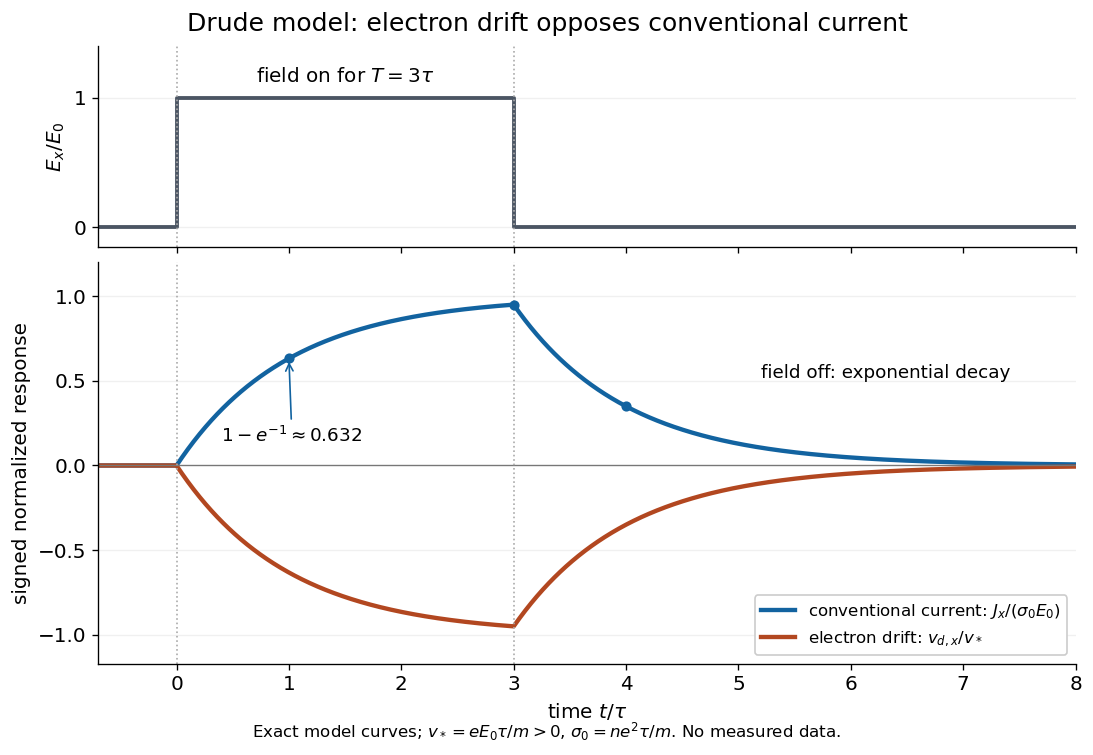

More generally, multiplying the current density equation by an integrating factor givesThis is the causal response of a first-order relaxation equation: only earlier electric fields enter the integral. It also shows why instantaneous Ohm's law is an approximation when the electric field changes appreciably during a momentum relaxation time.
Use physical electric fields and current densities , with peak complex amplitudes. After the initial transient has decayed, substitution into the Drude model equation gives the complex conductivityHere the mobile species is electrons. With the alternative convention, the denominator is and the imaginary part changes sign; the physical response is identical.[ref]
For with , the real-time current density isThus a positive argument of complex conductivity in the convention means that current density lags the electric field. At , its real part and imaginary part are both , its modulus is , and the lag is .
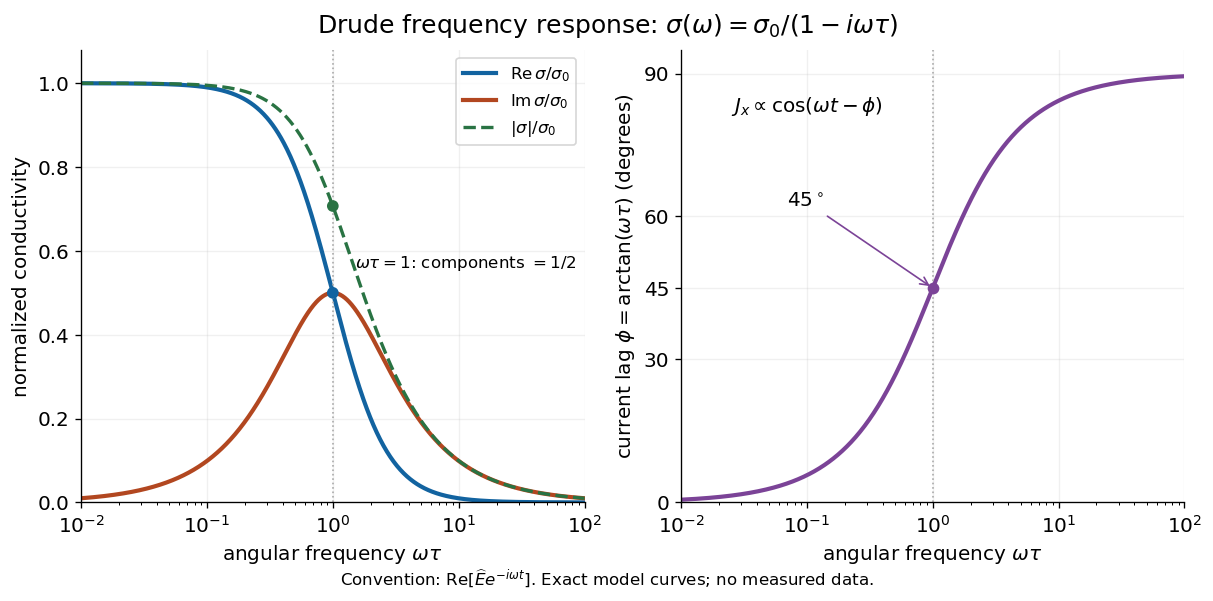

For , complex conductivity tends to the positive constant : current density nearly follows the electric field. For within this model,The current density amplitude decreases and its response becomes predominantly inertial. Average power absorbed per volume is . These limits describe the material response to a specified local electric field, not the complete electromagnetic response of a finite specimen with contacts. The Drude response has its pole at , consistent with the decaying causal response of a first-order relaxation equation.
The simple Drude model does not predict the microscopic momentum relaxation time. It neglects electronic band structure and Fermi-Dirac statistics; a useful semiclassical extension replaces by an appropriate band effective mass, but neither a single scalar mass nor one constant momentum relaxation time describes every material. Several charge carriers, energy-dependent scattering, and transitions between electronic bands can spoil the simple Drude frequency response. A successful low-angular frequency fit does not justify extrapolation to arbitrarily large angular frequencies.
For charge , field , time dependence and circular components , the active positive-frequency response is the plus component and its denominator contains . Reversing the field or exchanging helicity labels swaps the signs. A printed circular conductivity must state those conventions together.
A doped semiconductor at frequencies far below its bound-electron resonances can haveFor a weakly absorbing nonmagnetic half-space adjacent to vacuum, the normal-incidence optical reflectance is minimized near refractive-index matching, . When and is small this gives . The zero of the real part of , near , is a distinct frequency. Increasing the carrier density shifts the minimum to shorter wavelength if the carrier effective mass and background response remain fixed. With appreciable loss, the minimum must be found from the full complex Fresnel equations.
For a weakly absorbing doped semiconductor with one dominant carrier species and approximately constant background dielectric function , the Drude model gives a normal-incidence reflectivity minimum near . Thus , with and . Eliminating the plasma frequency proves the displayed mass estimate. The real-dielectric zero instead has and is the nearby screened plasma edge, so its wavelength requires a different denominator. With appreciable loss, fit the full complex Fresnel equations rather than identifying the minimum with an exactly real dielectric value.
A motivating laboratory realization is The Hall Effect and Conductivity in Germanium by Rex Tayloe. The handout specifies a germanium sample holder with temperature and magnetic field control, a low-voltage supply, digital meters, and a current-reversing switch. Measure the sample dimensions, map the contacts, and establish the directions of electric current, magnetic field, and transverse voltage. At fixed temperature and zero magnetic field, sweep positive and negative electric currents and record longitudinal electric potential differences. A straight voltage-versus-electric current relation tests Ohm's law; sample geometry converts its slope to electrical resistivity. For the Hall effect, minimize the zero-field transverse offset and measure transverse voltage at all four combinations of and , repeating for several electric currents. The readouts test longitudinal proportionality, transverse polarity, and transverse proportionality to electric current. These are protocol instructions, not reported measurement outcomes.[ref]
The Hall Effect and Conductivity in Germanium by Rex Tayloe. pp. 1–3, Equipment, Fig. 1, and At room temperature: conductivity sweep and four polarity combinations
For interpreting such measurements, an ideal uniform bar of wire cross-sectional area with longitudinal sensing contacts separated by gives . Four-terminal sensing suppresses voltage drops in current contacts when the voltage meter draws negligible electric current; it does not fix uncertain dimensions or a nonuniform current density. Reverse electric current and use to reject a constant voltage offset. Keep temperature stable, allow the current density to settle, and reduce electric current to test for Joule heating. Those are controls for interpreting the material coefficient, rather than reasons to assume every measured curve is linear.
For the transverse measurement define , , width along , and thickness along . Define , so givesExtract the part odd in both electric current and magnetic field usingThis combination rejects a constant offset and longitudinal pickup even in magnetic field. It cannot reject another signal with the same two reversal symmetries. Check field polarity and magnitude independently; a sign error in the contact map changes the inferred Hall coefficient.
For one Drude model species in transverse open circuit, the steady Lorentz force balance is with . Its component gives . ConsequentlyLongitudinal electrical conductivity and the Hall coefficient therefore separate number density from charge carrier mobility in this single-species model. Inferring a momentum relaxation time additionally requires an appropriate mass. A constant-field longitudinal measurement alone cannot supply all three.
A Hall coefficient is not universally the reciprocal of signed number density. For example, adding independent electron and electron hole contributions with densities and positive charge carrier mobilities in the weak-magnetic field limit givesThe Hall coefficient can vanish even while electrical conductivity is positive, and its sign weights charge carrier mobility as well as number density. The germanium handout explicitly asks students to track possible transverse sign changes with temperature; it does not establish a universal single-carrier interpretation. Real electronic band structure and unequal scattering also limit that interpretation.[ref]
The Hall Effect and Conductivity in Germanium by Rex Tayloe. p. 1, Experiment, and p. 3, As a function of temperature: tracking carrier sign and Hall-voltage sign changes
The Drude model relative permittivity is . At frequencies large compared with the collision rate but below , its leading real part is negative and the physical spatial wave-number branch has positive imaginary part. The field therefore decays into the conductor; close to the threshold the full complex response must be retained.
Articles by others on the same topic
There are currently no matching articles.