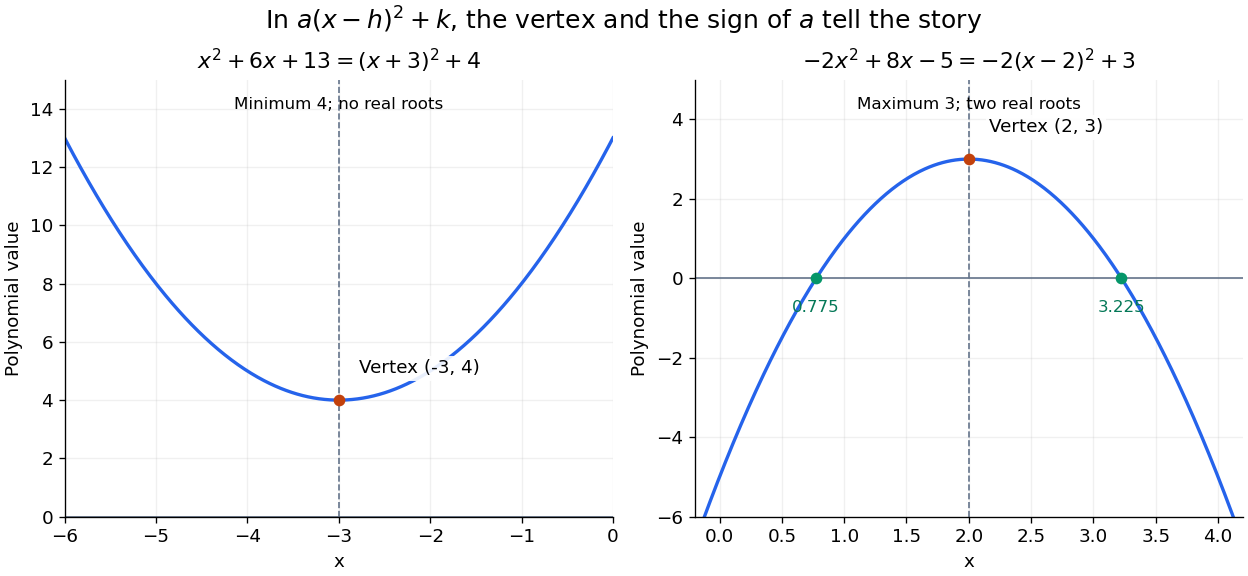
Write the quadratic polynomial asIts function graph is a parabola with vertex of a parabola . Equal offsets from give equal values, since . If , the minimum is ; if , the maximum is . In both cases it is attained only at .
For the nonmonic quadratic polynomialthe negative leading coefficient reverses the inequality: . Its maximum is at . Its coefficients are different from those of the positive example, but the same form exposes the shape of both function graphs.

Completing the square also simplifies an integral containing the exponential function:The substitution removes the linear term and leaves the standard Gaussian integral. The same shift that locates the minimum makes this integral recognizable.
Setting gives . A positive gives two distinct roots of a polynomial in the real numbers; zero gives a repeated root of a polynomial at ; a negative value gives a pair of complex conjugate roots of a polynomial. For the downward-opening example, the two roots of a polynomial are , approximately and .
The discriminant packages the same calculation, becauseSince , the sign of determines which of the three cases occurs. This derives the quadratic formula by a polynomial identity, and explains its structure: first shift to , then take a square root. For the upward-opening example, gives the complex conjugate roots of a polynomial .
Articles by others on the same topic
There are currently no matching articles.