Completing the square rewrites a quadratic polynomial so that its minimum or maximum and its roots of a polynomial become easy to read. The linear term is absorbed into a shift of the variable; the resulting polynomial identity changes the description, rather than the values of the polynomial.
For coefficients in the real numbers, with ,First factor out the leading coefficient from , then add and subtract inside the bracket. The cross term in is , exactly the term needed. Multiplication by restores . Thus the half-coefficient is , rather than unless the quadratic polynomial is a monic polynomial. Expanding the right-hand side verifies the polynomial identity directly.[ref]
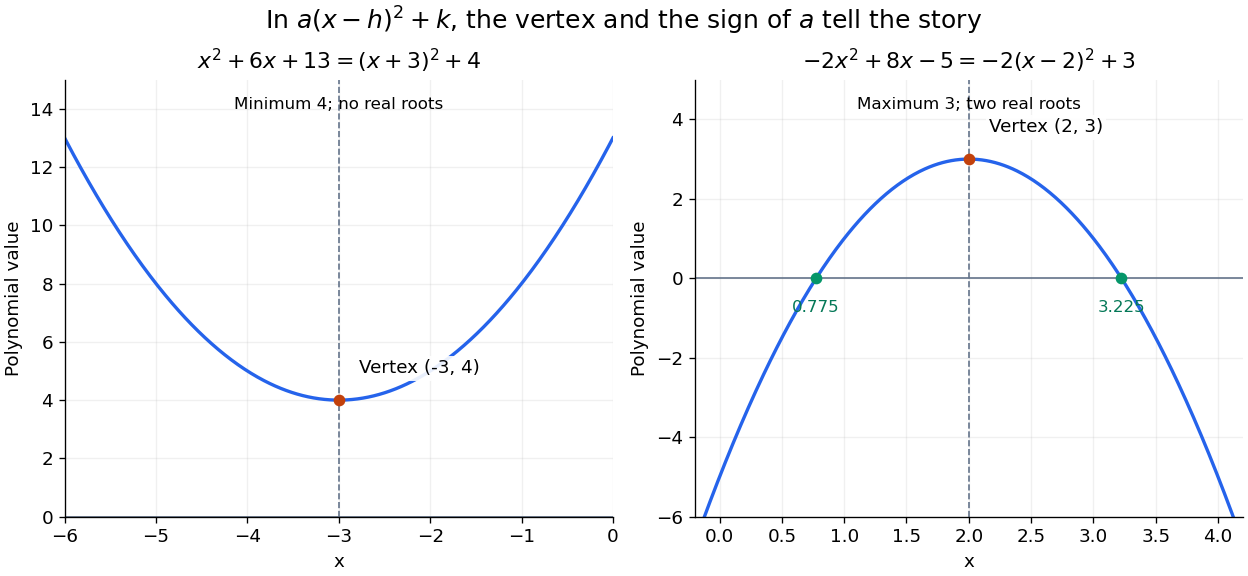
For an original example,For every in the real numbers, , with equality only at . The minimum is therefore , reached at ; no calculus is needed, and there are no roots of a polynomial in the real numbers. The expanded coefficients conceal these conclusions more effectively than the completed square does.
Start with a square of side length and add two rectangles, each with side lengths and . The total area is . Place the rectangles along two adjacent sides of the square: the missing corner is a by square, of area . Filling it produces a square of side length .
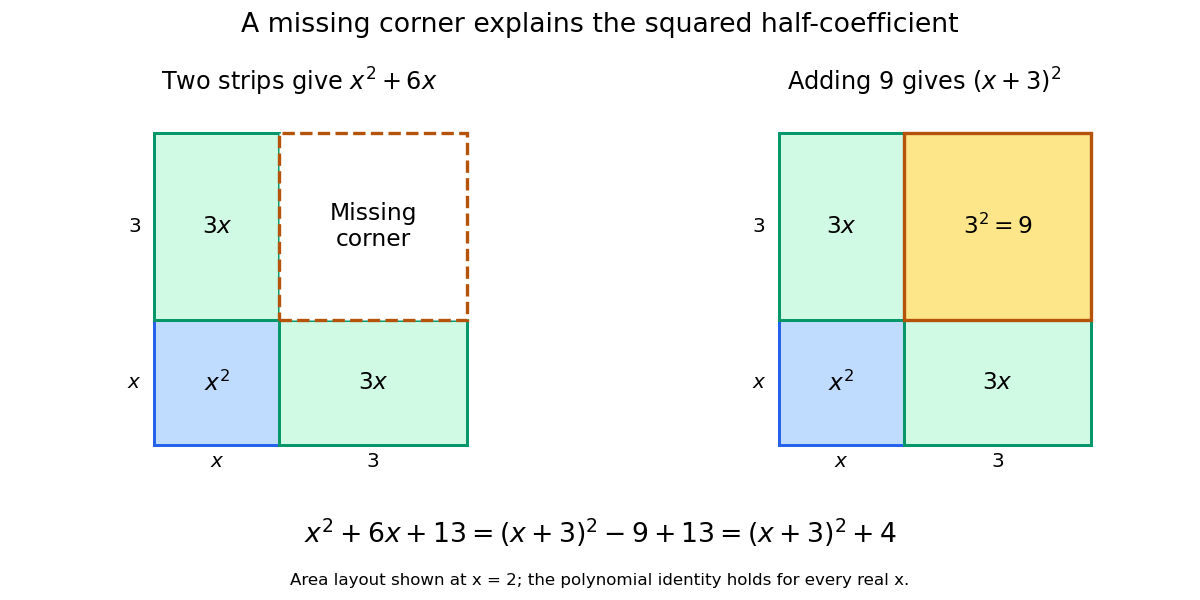
The area picture explains why the half-coefficient is squared. It also separates two operations that are easy to confuse: adding changes , whereas adding and subtracting preserves the expression. When solving an equation instead, adding to one side requires adding to the other side too.
Write the quadratic polynomial asIts function graph is a parabola with vertex of a parabola . Equal offsets from give equal values, since . If , the minimum is ; if , the maximum is . In both cases it is attained only at .
For the nonmonic quadratic polynomialthe negative leading coefficient reverses the inequality: . Its maximum is at . Its coefficients are different from those of the positive example, but the same form exposes the shape of both function graphs.
Completing the square also simplifies an integral containing the exponential function:The substitution removes the linear term and leaves the standard Gaussian integral. The same shift that locates the minimum makes this integral recognizable.
Setting gives . A positive gives two distinct roots of a polynomial in the real numbers; zero gives a repeated root of a polynomial at ; a negative value gives a pair of complex conjugate roots of a polynomial. For the downward-opening example, the two roots of a polynomial are , approximately and .
The discriminant packages the same calculation, becauseSince , the sign of determines which of the three cases occurs. This derives the quadratic formula by a polynomial identity, and explains its structure: first shift to , then take a square root. For the upward-opening example, gives the complex conjugate roots of a polynomial .
Al-Khwarizmi presented geometric completions of squares in his treatment of quadratic equations. His exposition used verbal instructions, positive lengths and areas, rather than the modern algebraic notation used here. The area assembly above illustrates the same principle with a different expression and arrangement. The modern polynomial identity also covers negative values of the variable and roots of a polynomial in the complex numbers, which need no interpretation as positive side lengths.[ref]
Al-Khwarizmi by John Joseph O'Connor and Edmund Frederick Robertson. MacTutor, Abu Ja'far Muhammad ibn Musa Al-Khwarizmi: six standard equation forms, verbal algebra and geometric square completion
Articles by others on the same topic



Completing the square is a mathematical technique used to transform a quadratic equation (or expression) of the form \( ax^2 + bx + c \) into a perfect square trinomial. This method allows us to solve quadratic equations, analyze their graphs, and derive the vertex form of a quadratic function. ### Steps to Complete the Square: 1. **Start with a quadratic expression** in the standard form: \[ ax^2 + bx + c \] 2.