Start with a square of side length and add two rectangles, each with side lengths and . The total area is . Place the rectangles along two adjacent sides of the square: the missing corner is a by square, of area . Filling it produces a square of side length .
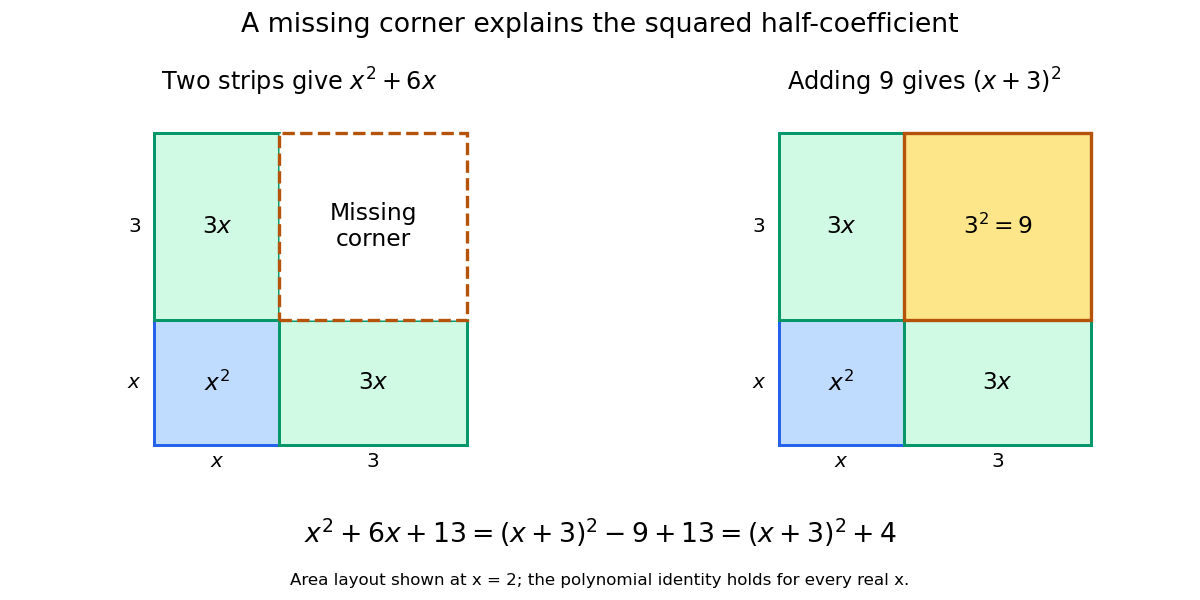

The area picture explains why the half-coefficient is squared. It also separates two operations that are easy to confuse: adding changes , whereas adding and subtracting preserves the expression. When solving an equation instead, adding to one side requires adding to the other side too.
Articles by others on the same topic
There are currently no matching articles.