Expand the sine of the complex number using hyperbolic functions:
Its squared complex modulus is
Taking nonnegative square roots proves . Equality holds exactly when .
Use these standard facts about a power series: it is absolutely convergent at every point strictly inside its radius of convergence and divergent at every point strictly outside it. Also, the triangle inequality implies that a sum or difference of two absolutely convergent series is absolutely convergent.
Let be the radius of convergence of the coefficientwise sum. For ,
Hence .
Suppose . If , choose a finite with and choose of complex modulus . The sum series and the series both converge absolutely there, so
contradicting . Thus . Interchanging the series covers , proving the sum of power series with unequal radii of convergence rule:
The argument also covers a zero radius or an infinite larger radius. When the two radii are equal, cancellation can enlarge the radius, so the inequality of the radii matters.
The polar form of a complex number and the roots of unity give
since . Using the complex conjugate to compute the squared complex modulus,
The residue runs through every class modulo , already with . The cosine is even, so the nine angles give five distinct values, represented by . They are distinct because cosine is strictly decreasing on and these representative angles lie in that interval. Hence
Every listed value is attained by choosing and .
For any complex number , , while the complex modulus is multiplicative and unchanged by complex conjugation. Consequently
Both sides are nonnegative, so taking square roots proves the triangle inequality:
The proposed further inequality fails for perpendicular vectors in the complex plane. Taking , gives
Away from the negative real axis, the complex conjugate has principal complex argument . Consequently
Taking the complex modulus gives , hence . The remaining equation is , so
On the negative real axis, both and have principal complex argument , so the left-hand side has modulus , not two. There are no additional solutions there. The printed second term is the principal power of , not the complex conjugate of .
The principal complex exponentiation gives . Equality to one requires its complex modulus to be one, hence , and then its complex argument requires . Thus all solutions are positive real, namely
Substitution verifies every value, and the modulus condition excludes every nonreal value.
For a nonzero complex number, write with and principal complex argument . The principal complex logarithm and corresponding complex exponentiation are
The value at zero is not defined by this formula. The choice of complex argument matters: these are single-valued principal powers, rather than all values of a multivalued complex logarithm.
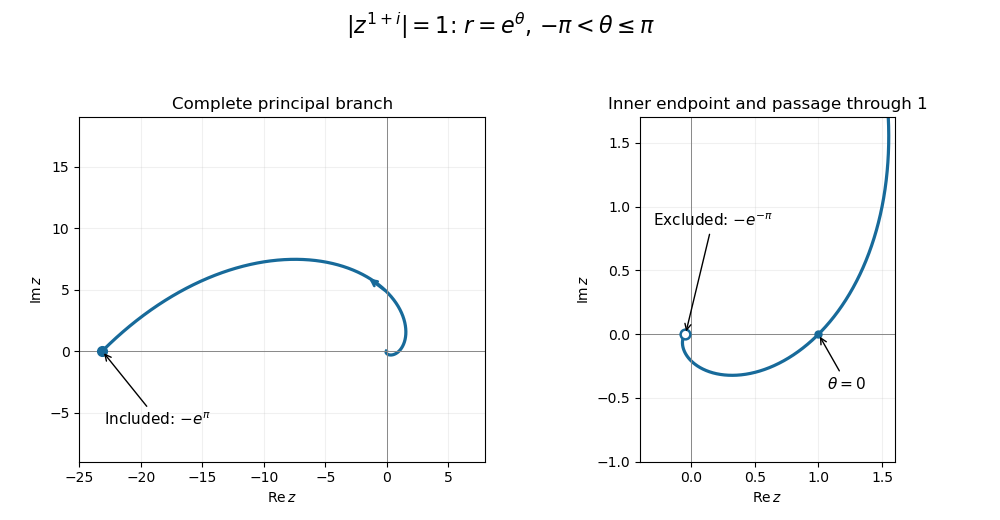
For the requested sketch, . Its complex exponential has complex modulus , so
This is one turn of a logarithmic spiral, with increasing radius as the polar angle increases. It passes through at , approaches the excluded endpoint from below the negative real axis, and ends at the included endpoint from above that axis. The endpoint distinction follows from the chosen principal complex argument.
Figure 1.
One turn of the principal-power logarithmic spiral, with open inner and closed outer endpoints
. Details.
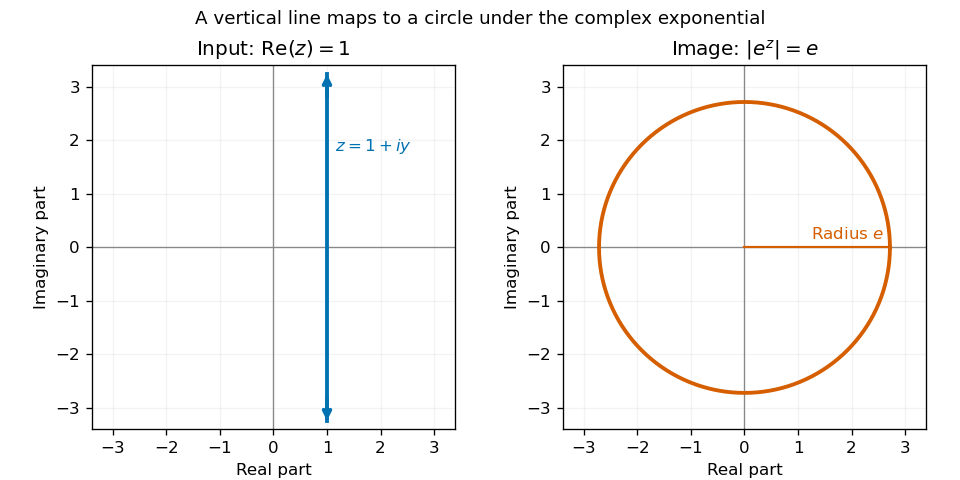
Write with . In the complex plane, this is the vertical line through . The complex exponential gives , so its complex modulus is always . Conversely, every point of that modulus has an complex argument and is obtained in this way. The image is the entire circle centered at zero with radius , traversed repeatedly as varies; it is not a disk.
Figure 1.
The vertical line with real part one maps under the complex exponential to the circle of radius e
. Details.
For , the complex exponential has complex modulus . Equality to the positive real number therefore forces and . The latter holds precisely when is an integer multiple of . Hence all solutions are
Substitution verifies every listed value; the modulus and angle arguments exclude any others.
Put . Comparing imaginary parts gives , so . Comparing real parts then gives . The left side is positive, so squaring is legitimate only with , but even then it would give . This contradiction proves there is no solution. Equivalently, with nonzero imaginary part the complex modulus is strictly greater than the real part.
Write . Using the complex conjugate, the squared complex modulus on the left is . Squaring the equality and dividing by , which is nonzero, gives
Completing the square identifies the candidate circle:
Its centre is on the real axis and its radius is in the complex plane.
It remains to exclude extraneous points introduced by squaring. On this circle, , so the original right-hand side satisfies
Thus taking the nonnegative square root recovers the original equality at every point of the circle. This is a circle from an affine complex-modulus equation, with the sign check essential to the geometric conclusion.
A real or complex sequence is a Cauchy sequence if
For , the complex modulus gives
Thus the same works for both coordinate Cauchy sequences. Conversely, if both real coordinate Cauchy sequences converge to and , then . This proves the needed completeness for complex numbers from the assumed completeness of the real numbers.
Now suppose converges. Its real partial sums form a Cauchy sequence. Given , sufficiently late tails therefore satisfy . For , the triangle inequality yields
The complex partial sums are a Cauchy sequence, hence converge by the coordinate argument. Therefore absolute convergence implies convergence for a complex series.
Write , with because the triangle is nondegenerate. Let be its circumcenter. Equality of the complex modulus values gives . Equality of , after expanding the squares, gives
Thus the real part and imaginary part determine
Using the complex conjugate , we also have
Therefore
The nonzero denominator is exactly the nondegeneracy condition. If is real, the three distinct collinear points do not have a finite circumcenter.
The logarithm's argument is , with complex modulus one. The principal complex logarithm is therefore , giving
If denotes all logarithm values rather than the principal branch, they are for : the real part remains zero and the imaginary part changes by integer multiples of . The principal value is the conventional single-valued answer.
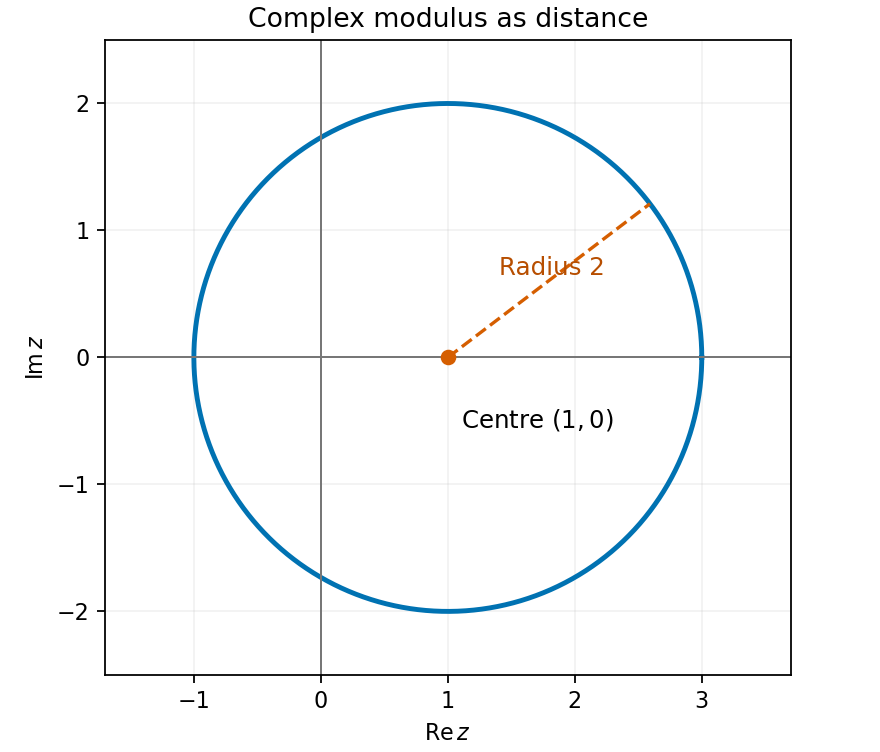
Write . The complex modulus condition is equivalent to . Thus the locus is a circle of radius two centred at in the complex plane. Its extreme points are , , and .
Figure 1.
Circle in the complex plane with centre one and radius two
. Details.
Write a square root as , with real. Equating the real part and imaginary part of its square gives and . Taking complex modulus also gives . Therefore
Since , the signs agree. The two roots are
The changes both signs together, rather than independently.
Using the exponential definition of hyperbolic cosine, multiply by the nonzero quantity . This yields , hence .
If , its complex modulus requires , so ; its phase then requires . Thus all complex solutions are
There are no real solutions, since real .
The original PDF asks for cube roots of . Their complex modulus is , and their arguments are , . Converting to Cartesian form gives
Cubing any one gives the positive real number .
The complex number has complex modulus and argument . A cube root has modulus , and its argument is one third of . Hence the three distinct roots are
Their displayed arguments are , , and ; the last is equivalently in the principal range.