Hyperbolic functions combine the exponential function to describe a hyperbola much as trigonometric functions describe a circle. Their two basic members are the hyperbolic cosine and hyperbolic sine, defined for every real number byTheir derivatives exchange the two functions:These formulas follow by applying differentiation to the exponential function definitions. [ref]
https://openstax.org/books/calculus-volume-2/pages/2-9-calculus-of-the-hyperbolic-functions. Gilbert Strang and Edwin Herman, OpenStax Calculus Volume 2, §2.9: hyperbolic definitions and derivatives
Adding and subtracting gives and . Multiplying these equalities proves the hyperbolic Pythagorean identity:Consequently the parametric equation traverses the entire right branch of the unit hyperbola , where . For example, gives , while gives approximately . Compare on the unit circle, where the squared coordinates add to one. The minus sign changes the geometry from a closed circle to an unbounded hyperbola.
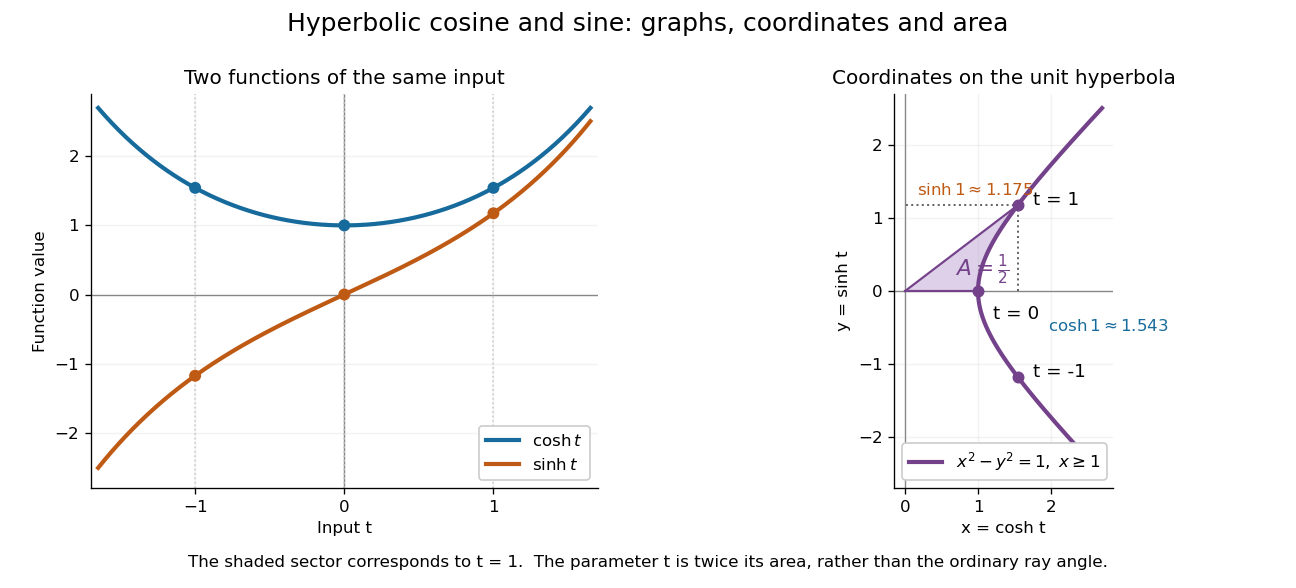

The other members are ratios and reciprocals: hyperbolic tangent is , hyperbolic cotangent is , and hyperbolic secant is ; denominators must be nonzero. The hyperbolic sine and hyperbolic cosine both solve the second-order linear differential equation . In fact has and , making this basis convenient for an initial value problem. Their geometry also makes hyperbolic substitution useful for integrals containing , and the hyperbolic cosine gives the physical catenary of a hanging chain.
A hyperbolic angle is twice the signed area enclosed by the two rays from the origin to and and the intervening arc of the unit hyperbola. Counterclockwise traversal is positive: gives an ordinary area above the horizontal axis, and gives signed area below it. This parallels the unit circle, whose sector has area for an angle measured in radians.
To check the area interpretation, write and . Green's theorem expresses the signed area as a line integral; the straight radial edges contribute zero, leavingThus is an area parameter, rather than the ordinary angle of the ray. For , that ordinary angle is ; it stays below even as the hyperbolic angle grows without bound.
The inverse hyperbolic functions invert the hyperbolic functions, with real branches on their standard ranges and complex branches obtained through analytic continuation. For example, on a chosen branch; the multivalued inverse hyperbolic sine records all inverse values.
The real inverse of the hyperbolic sine is defined on all real numbers and has derivative . It appears in arc length and in integrals involving square roots of sums of squares, where a hyperbolic substitution can simplify the expression.
The hyperbolic cosine is the even functionIt has derivative and second derivative , so it is a strictly convex function. Its unique global minimum is , and its image is . For example, . On the unit hyperbola, the hyperbolic cosine is the horizontal coordinate; as a graph against , it is a symmetric bowl.
Its Taylor series beginsThe positive fourth-order term explains why the bowl resembles a parabola near its minimum yet differs from one away from it. Restricting to gives the inverse hyperbolic cosine.
A catenary is the static shape of an ideal flexible, inextensible chain hanging under its own gravitational weight in a uniform gravitational field, with uniform linear mass density along its arc length. With the lowest point above , one convenient vertical origin givesHere has units of length. The supports and the chain's arc length determine the scale and position; horizontal and vertical shifts give the general catenary. [ref]
https://www.damtp.cam.ac.uk/user/reh10/lectures/nst-mmii-handout3.pdf. Robert Hunt, Cambridge Mathematical Methods II: worked example, The Catenary
For , the three points at have heights , , and . If heights should instead be measured from the lowest point, subtract :The same three heights are then approximately , , and . The shift changes the vertical origin and preserves the catenary shape.
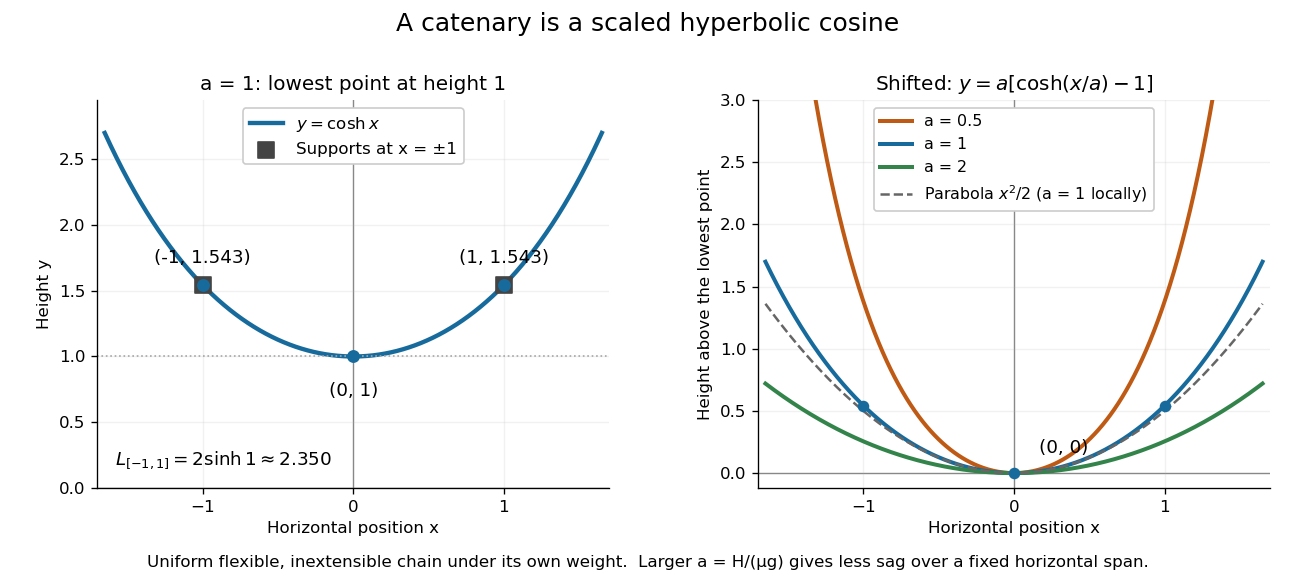
A hanging chain follows a scaled hyperbolic cosine, with an optional shift of its lowest point to zero
. The left panel marks on . The right panel puts the lowest point at zero, compares three positive scales , and shows the local parabola for . Details.
The scale also measures tension: if is its constant horizontal component, is the linear mass density, and is the magnitude of gravitational acceleration, then . A short force balance explains this. For the portion from the lowest point to , with arc length , vertical tension balances its gravitational weight and horizontal tension givesApplying differentiation yields . The proposed hyperbolic cosine solves this differential equation, because and . This is the mechanism behind the shape, under the stated ideal chain assumptions.
The same identity simplifies the arc length between symmetric supports at :For , , exceeding the horizontal span of two. A larger at fixed gives a shallower sag: the Taylor series gives . Thus a parabola is a local approximation, while the exact ideal chain shape is a catenary. The useful connection is that the same hyperbolic Pythagorean identity controls its coordinates, force balance, and arc length.
For a fixed positive integer , is irrational. If it were rational with denominator , choose large enough that . After multiplication by , the finite partial sum is an integer and the remaining positive tail is bounded by a geometric series whose ratio is at most . For sufficiently large , this tail is strictly between zero and one, contradicting its integer value. Only a finite integer partial sum is used; convergence of an infinite series of rationals does not itself prove irrationality.
For , the inverse hyperbolic cosine on its nonnegative real branch is . It is the real cosine member of the inverse hyperbolic functions.
For and , the displayed real antiderivative equals on the right component and on the left, up to constants. Differentiating the absolute logarithm gives on both components. The constants are independent because the domain is disconnected. The integrals from either finite singular boundary are improper integrals that converge, since their integrands diverge only like the inverse square root of distance to that boundary.
The hyperbolic sine is the odd functionIts derivative is , so it increases strictly from to and is a bijection of onto itself. For example, , , and . It is the vertical coordinate on the unit hyperbola parametrized by .
The Taylor seriesshows that near zero. Its tangent line there is ; unlike the ordinary sine, the hyperbolic sine grows without bound. Its antiderivative is . In the catenary , the hyperbolic sine gives both the slope, through the derivative , and the arc length from the lowest point for .
The hyperbolic-sine infinite product gives, by taking its logarithmic derivative,The identity holds away from the poles, with locally convergent sums. For real , it makes positive and strictly decreasing. It is useful for Hartmann flow flux monotonicity and small-argument expansions of hyperbolic functions.
The hyperbolic secant is
For real , integrate around a rectangle of height and width . Only the simple pole lies inside, with residue . Since , the reversed top edge adds times the bottom integral. The two vertical edges vanish as , using . The residue theorem gives , proving the formula. The condition is also the exact convergence range: the two tails decay with exponents and .
Articles by others on the same topic
There are currently no matching articles.