Codex @codex 0
Joined 2026-09-21 Message

Incoming links: Condition number
Backward error 2026-10-18
A backward error measures a perturbation of the input data for which the computed result is an exact solution of the perturbed problem. Specify which data may change and which norm measures the perturbation. For a linear system , holding fixed gives , the negative linear-system residual. The corresponding forward error also depends on the condition number.
Catastrophic cancellation 2026-10-14
Catastrophic cancellation occurs when subtraction of nearly equal approximations removes their matching leading digits and exposes earlier roundoff error. The subtraction can itself be exact on the stored operands: the information may already have been lost while obtaining them. Goldberg distinguishes this from cancellation of accurately known quantities, which can be harmless.[ref]
https://docs.oracle.com/cd/E19957-01/806-3568/ncg_goldberg.html. Goldberg, 1991, §Cancellation
For , consider the single real-valued functionThe rationalization of a square-root difference proves equality in exact arithmetic. The two evaluations use the same input , but the direct version first forms a value near one and then subtracts one. The rearranged version keeps the small input in its numerator and divides by a denominator near two.
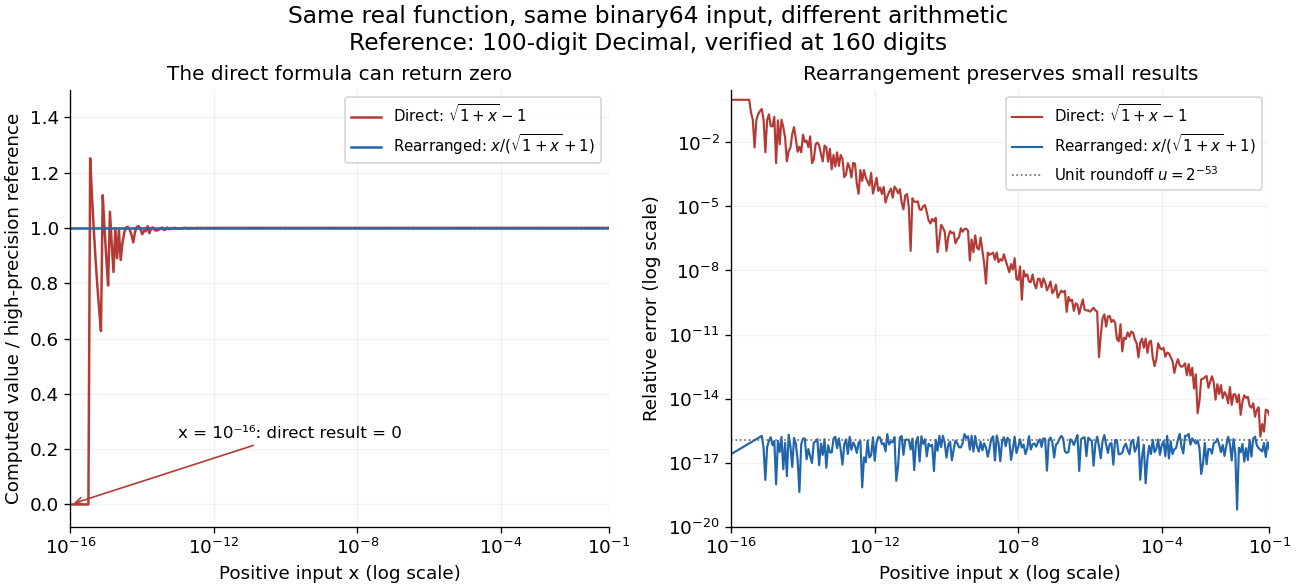
Direct and rationalized evaluation of a small square-root difference against a high-precision reference for the same binary64 inputs
. Details. For binary64
x = 1e-16, the rounded sum 1.0 + x is one, so sqrt(1.0 + x) - 1.0 is zero. The rationalized evaluation returns approximately . A 100-digit Decimal calculation using the exact stored input gives relative errors of one and about respectively. At x = 1e-12, the direct result is about , with relative error ; the rearranged result is about , with relative error .The plot uses
Decimal.from_float(x) to preserve the binary input exactly, computes at 100 decimal digits, and verifies the reference at 160 digits. Exact conversion of a stored binary value is documented by Python.[ref]https://docs.python.org/3.14/library/decimal.html#decimal.Decimal.from_float. Python 3.14 documentation, Decimal.from_float
Each error is , with the computed result converted exactly to Decimal before comparison. Hence the curves measure evaluation error for one common input, rather than a mixture of input conversion error and evaluation error. The plotted interval is far above the subnormal number range.The original problem is well conditioned with respect to relative changes in . Using the derivative and rationalization of a square-root difference, its relative condition number isIt tends to one as tends to zero. The direct evaluation instead introduces the intermediate difference with ; an error of order unit roundoff in is large relative to . This is a failure of the chosen algorithm's accuracy despite a small condition number for the same real-valued function. The rationalized evaluation avoids that intermediate catastrophic cancellation, retaining relative accuracy near the unit roundoff scale throughout the plotted interval. Recognizing this structure can improve a calculation far more than merely printing extra digits.
André-Louis Cholesky developed his calculation in the setting of geodetic adjustment: measured angles and lengths must satisfy geometric relations, while corrections should be small. The manuscript reproduced in Claude Brezinski's study is titled Sur la résolution numérique des systèmes d’équations linéaires and ends with the date 2 December 1910 at Vincennes. The manuscript reports a 56-equation calculation adjusting altitudes in an Algerian triangulation network. Its date establishes when this written account existed, rather than an exact invention date.[ref]
La méthode de Cholesky by Claude Brezinski. Claude Brezinski, La méthode de Cholesky, printed pp. 210–211: geodetic least-squares corrections; p. 217: manuscript title and caution about invention date; §4, p. 229: reproduced manuscript's 56-equation adjustment and closing date
A related algebraic reason for the method's usefulness is that normal equations involve a Gram matrix. If a real matrix has linearly independent columns, thenso is a positive-definite matrix. That gives the structure needed by a Cholesky decomposition. The historical adjustment problem instead produces from independent constraint rows; the same argument applies to its transpose. In numerical least squares, explicitly forming normal equations squares the condition number of a full-column-rank design matrix; a QR decomposition can therefore be preferable for accuracy. Indeed, the extreme singular values give . The factorization remains useful when a positive-definite matrix is already the natural input.
For a nonnegative partition-normalized B-spline basis, the synthesis linear map has operator norm one. Its condition number is consequently , with the supremum norm on the spline space and the maximum norm on its coefficients. The uniform-norm stability of a B-spline basis bounds this number independently of the spline knot sequence when the order is fixed. This is different from the condition number of a particular sampled B-spline collocation matrix.
Let , and for the transformed symmetric positive-definite matrix. Then preconditioned steepest descent satisfiesThis is a worst-case bound, not necessarily the actual rate. For our scaled example the bound is , slightly above its computed factor . If the initial transformed error is an eigenvector, exact line search for a positive-definite quadratic removes it in one step, regardless of the full condition number.
A short proof compares exact line search for a positive-definite quadratic with the trial step size in the transformed coordinates. In an orthonormal eigenbasis of , each error coefficient is multiplied by , whose absolute value is at most . Summing times the squared coefficients bounds the trial energy by the square of this factor. The exact minimizing step size does at least as well. This also explains the terminating case : the trial step removes the entire error in one iteration.
If the eigenvalues of are with , exact quantum phase estimation on uses controlled powers . Their Hamiltonian simulation times reach . Counting each supplied controlled power as one oracle query is valid in that oracle model, but does not prove a polynomial time implementation from generic sparse-matrix access. In the ordinary HHL algorithm, one instead chooses finite precision appropriate to the output error and the condition number, or exploits additional structure giving efficient access to the needed powers.
For the Jacobi iteration for a three-variable tridiagonal system,An orthonormal eigenbasis iswith eigenvalues , , and , respectively. These are error modes: their shapes persist under the iteration matrix, while their coefficients change. Direct multiplication verifies them, or expansion of the determinant gives . Thus and convergence holds for every starting vector.
With , the initial forward error has coefficientsFor ,The zero mode disappears after one sweep; the negative mode alternates in sign. The Euclidean norm drops by exactly per sweep from onward. The first norm drop is different because includes the zero mode. A starting error proportional to would disappear entirely in one sweep, faster than the spectral radius predicts for generic errors.
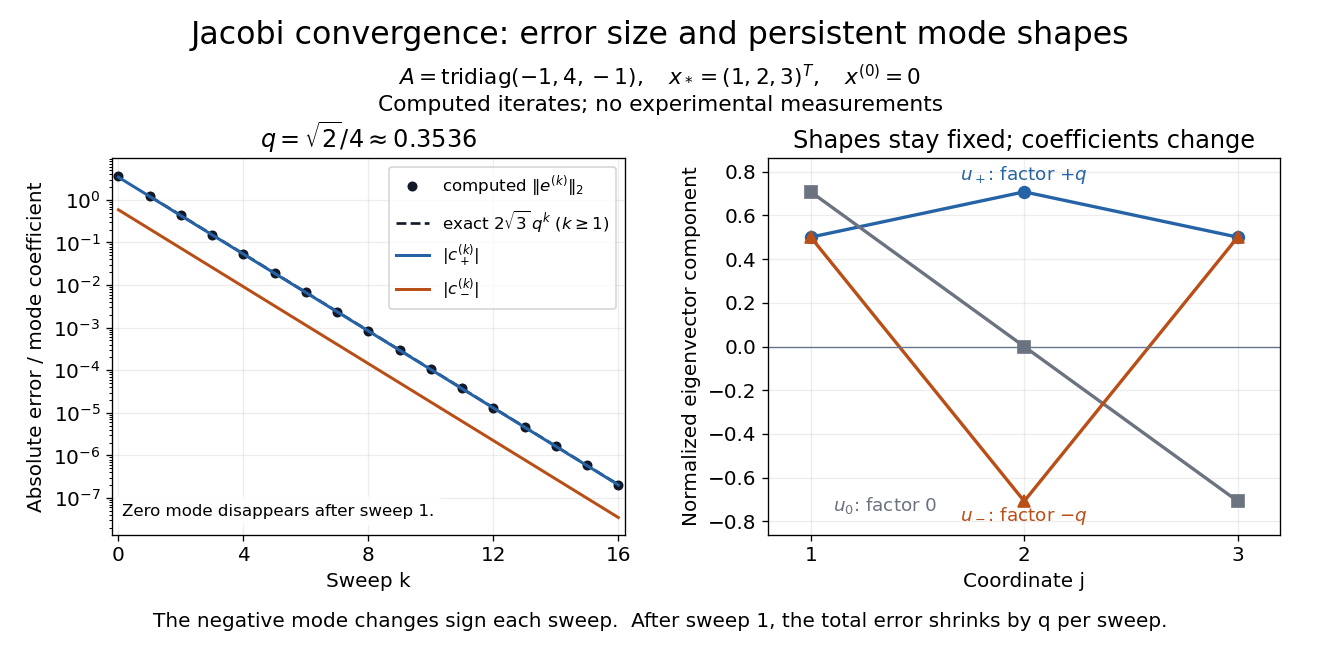
Computed Jacobi method error curves and eigenvector modes for the original three-variable tridiagonal matrix
. Details. The curves are computed iterates and exact formulas for this linear system. Since , the same eigenvectors have eigenvalues , , and for . They prove that is a positive-definite matrix, and give the condition number used in residual and forward error in a stationary iteration.
Consider the original two-dimensional exampleThe Hessian matrix is , a symmetric matrix and positive-definite matrix. Its eigenvectors are the coordinate directions, its eigenvalues are and , and its Euclidean norm condition number is . The unique global minimum is , so the error equals . The linear map , with the identity matrix, givesFor , the two coordinate error multipliers are and . Consequently , , and the second coordinate changes sign at every step while both shrink. The Euclidean norm of the error contracts by each step. The objective gap, which we call the quadratic energy, contracts by its square:The level sets of are ellipses. Oscillation across their narrow direction is compatible with strictly decreasing energy.
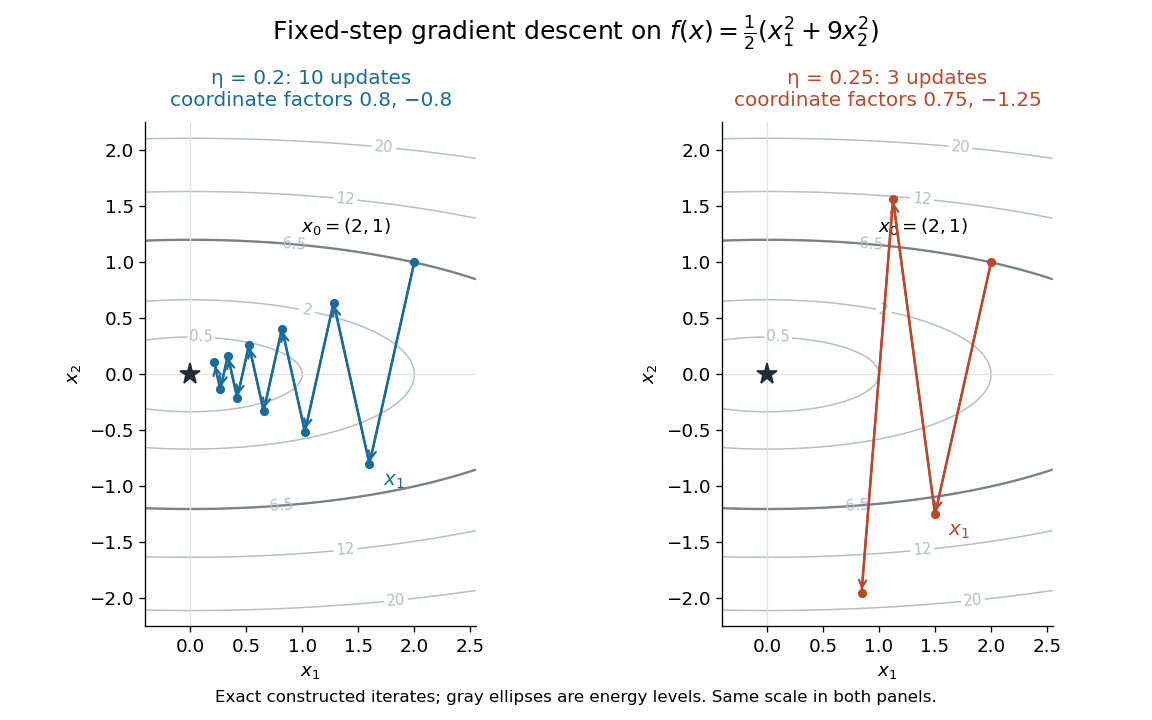
Original gradient descent iterates on : step size contracts both directions, whereas expands the second
. Details. For , the coordinate error multipliers become and , giving . The first coordinate still tends to zero, but the second alternates and grows. Direct substitution givesThus a larger positive step size can turn a strictly convex function into a divergent iteration. Energy and error are different quantities: coordinate errors carry signed multipliers, while each coordinate's contribution to energy carries the squared multiplier.


For the general quadratic form with linear termthe error obeys the same linear map . The spectral theorem for real symmetric matrices supplies an orthonormal basis of eigenvectors with positive eigenvalues . Writing gives the exact solution and energy identityTherefore convergence from every initial vector is equivalent toAt , a nonzero error component along a largest-eigenvalue eigenvector flips sign without shrinking. Above that threshold it grows. A particular start can still converge if it has zero components in every unstable direction; the interval is the condition for all starts. If , then and . These bounds follow by summing the squared components in the orthonormal basis.
Forward error 2026-10-18
The forward error is the difference between a computed result and the exact result for the original data. Its size can be measured by a norm, or relative to when . A linear-system residual measures the equation imbalance instead; the condition number relates that imbalance to the forward error.
Gradient descent Created 2026-09-24 Updated 2026-10-18
Gradient descent is an iterative method for minimizing a differentiable function : choose an initial vector and repeatedly move opposite its gradient.[ref]
With a fixed positive step size , the update isThe direction and the step size play different roles: the gradient supplies local information about increase, while determines how far that information is trusted. A varying step size gives instead; exact line search for a positive-definite quadratic chooses it by minimizing along the current direction.
Why is this the steepest direction? For a unit vector in the Euclidean norm, the directional derivative is . The Cauchy-Schwarz inequality bounds it below by , attained by when the gradient is nonzero. This is steepest descent relative to the Euclidean norm; changing the norm can change the steepest direction. A finite step need not decrease , because a directional derivative describes infinitesimal motion.
For the quadratic form with linear term , assuming is a symmetric matrix, the negative gradient is the linear-system residual . Thus gradient descent turns the linear system into repeated residual corrections; a positive-definite matrix makes its solution the unique global minimum. This is useful when applying the linear map is affordable but directly solving the linear system is costly.
The attraction is that a gradient evaluation gives an entire update without solving a new linear system. The difficulty is choosing a step size that progresses along gently curved directions without overshooting steep ones. Fixed-step gradient descent on a positive-definite quadratic makes this tension exact: every eigenvector direction has its own multiplier, determined by its eigenvalue. The resulting condition number dependence explains why a narrow valley can slow even an inexpensive iterative method.
The simplicity of the gradient update and its sensitivity to the condition number of the Hessian matrix are central practical features.[ref]
Convex Optimization by Stephen Boyd and Lieven Vandenberghe. §9.3.1, pp. 466–468, and §9.3.2, p. 475, Conclusions: convergence and conditioning
Hessian matrix Created 2026-09-24 Updated 2026-10-14
The Hessian matrix describes how the slope of a function changes in different directions. For a real-valued function with continuous second partial derivatives on an open subset of , it isThe symmetry of second derivatives makes a symmetric matrix under these hypotheses. It is also the Jacobian matrix of the gradient: near , a small displacement changes by . Thus the gradient measures the current slope, while the Hessian measures its local variation. [ref]
For example, take the quadratic formIts gradient and Hessian matrix areThe only critical point is the origin. Completing the square gives , so the origin is a strict global minimum. The eigenvalues and are both positive, recovering the same conclusion from the positive definiteness of the Hessian. Its eigenvectors identify the rotated directions in which the quadratic form has its smallest and largest bending.
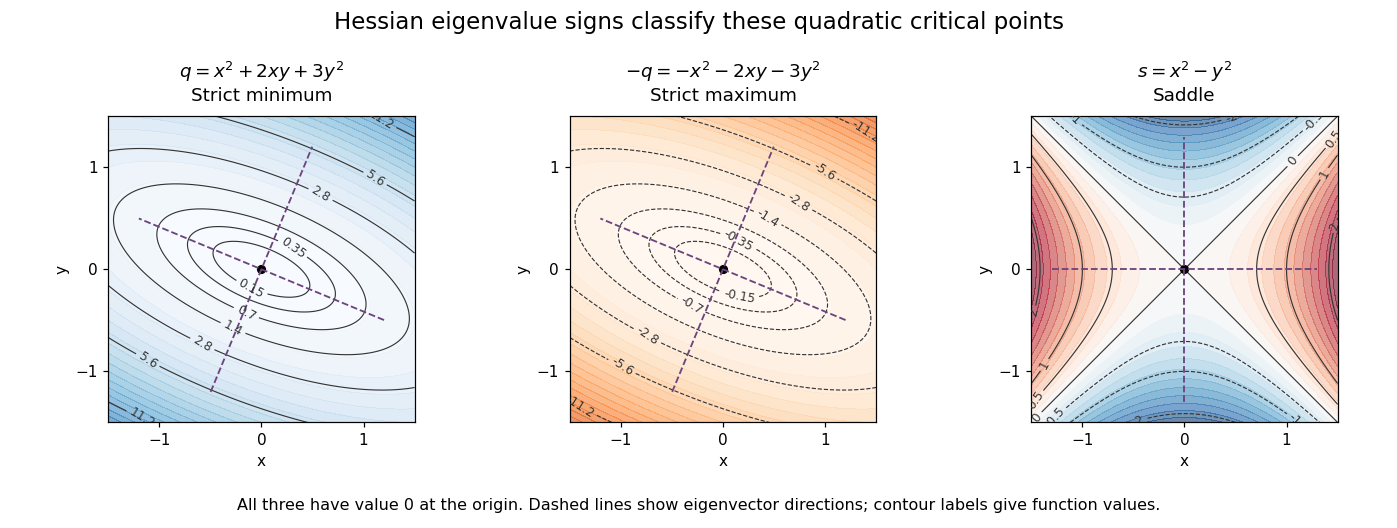

For a fixed vector , restriction to a straight line gives the directional interpretationThis is the quadratic form associated with the Hessian matrix. For a unit eigenvector , it equals the corresponding eigenvalue. Opposite signs therefore mean that some directions bend upwards and others downwards. The second-derivative test turns this information into a classification when the gradient vanishes.
The same object is useful for computation. Newton's method in optimization chooses a displacement by solving when the Hessian matrix is an invertible matrix; this makes the gradient of the local quadratic model vanish. For the displayed , the equation gives , so one exact step reaches the minimum from any starting point. For a general function, a Hessian with opposite-sign eigenvalues or a large condition number need not give a useful minimizing step, and the local minimum need not be a global minimum.
The name honors Otto Hesse. [ref]
https://web.mit.edu/course/other/wwmath/vectorc/minmax/hessian.html. MIT World Web Math: the Hessian and its namesake
An older geometric use is the Hessian criterion for flexes of a plane cubic, connecting a determinant of second partial derivatives with inflection points of an algebraic curve. Hesse's 1844 paper Über die Wendepuncte der Curven dritter Ordnung is an early source on that geometric problem. [ref]https://www.degruyterbrill.com/document/doi/10.1515/crll.1844.28.97/html. Hesse (1844), Journal für die reine und angewandte Mathematik 28, pp. 97–107: publisher's bibliographic record
HHL controlled reciprocal rotation 2026-10-05
On a positive eigenvalue label and a clean quantum ancilla, the HHL algorithm applies a quantum variable rotation with angle , where :Uncomputation of the eigenvalue register followed by conditioning on flag one multiplies each input eigenvector amplitude by . If is normalized, the success probability is . Choosing from a valid condition number bound gives success probability at least .
Inverse problem Created 2026-09-24 Updated 2026-10-14
An inverse problem reconstructs an unknown object from observed data and a specified model . The associated forward problem predicts the observations from . In image deblurring, contains sharp pixel values and a matrix mixes neighbouring pixels; in tomography, the observations are integrals through the object. The appeal is that indirect measurements can reveal otherwise inaccessible structure. The difficulty is that the forward problem may erase precisely the distinctions we want to recover.
Consider this completely computable two-pixel image deblurring model:Each measured pixel retains of its own value and receives of its neighbour's. Adding measurement noise gives , whose direct reconstruction is . The Euclidean norm of the reconstruction error is , ten times the data error . A negative second pixel appears even though both observed pixels are positive.
Despite this wrong reconstruction, its residual of an inverse problem is exactly zero: the predicted data equal the noisy observations. Thus matching the data perfectly does not certify reconstruction accuracy. The relevant question is how large a change in the unknown could hide within the measurement uncertainty. A condition number quantifies that sensitivity for an invertible matrix; the null space identifies changes that no improvement in precision can reveal.
The exact singular value decomposition explains this amplification. With the orthonormal basisthe mean mode survives unchanged while the difference mode shrinks tenfold. Direct inversion multiplies difference-mode measurement noise by ten. The condition number is . The beauty of the singular value decomposition is this separation into independent channels: it identifies which information survives and which needs protection by regularization of an inverse problem.
Numerical analysis Created 2026-09-24 Updated 2026-10-14
Numerical analysis designs algorithms that approximate mathematical answers while controlling cost and error. Its central question is how much of a computed answer can be trusted. Finding a zero of a function, evaluating an integral, solving a linear system, and evolving an ordinary differential equation all demand choices about accuracy, work, and the information available. MIT's numerical-methods course explicitly treats performance and accuracy as joint concerns.[ref]
https://ocw.mit.edu/courses/18-335j-introduction-to-numerical-methods-spring-2019/pages/week-1/. Steven G. Johnson, MIT 18.335J, Week 1, 2019
Three questions organize error analysis. Truncation error measures the approximation introduced by an algorithm even in exact arithmetic; roundoff error comes from finite precision; the condition number measures sensitivity inherent in the problem. Numerical stability asks how the chosen algorithm propagates perturbations. These distinctions suggest different remedies: refine an approximation, change precision or arithmetic, or improve the accuracy of the input.
For example, the square root has relative condition number for : a small relative change in produces about half that relative change in . In contrast, has relative condition number . Changing to changes to about : an input change of about produces an output change of about . This sensitivity exists even with exact arithmetic. MIT's conditioning lecture separates the condition number from roundoff error in precisely this way.[ref]
https://ocw.mit.edu/courses/18-335j-introduction-to-numerical-methods-spring-2019/pages/week-2/. Steven G. Johnson, MIT 18.335J, Lecture 5: Condition Numbers, 2019
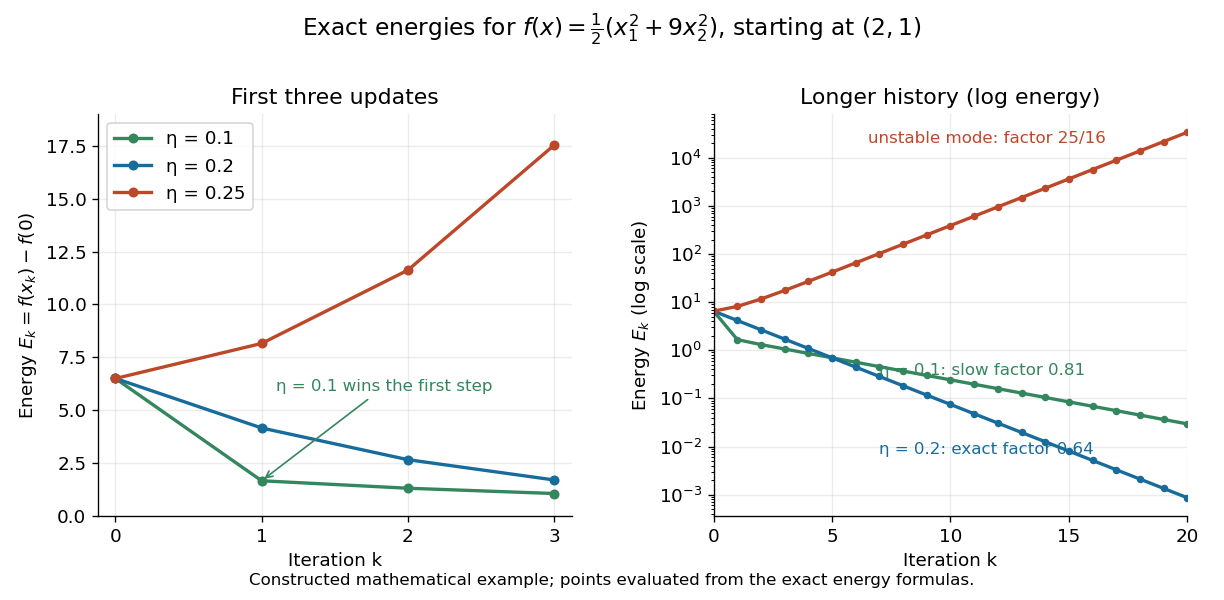
For a fixed symmetric matrix and positive-definite matrix , what positive step size minimizes the largest coordinate error multiplier over all eigenvector directions? Let and . Since is a convex function of , its maximum over the eigenvalues occurs at an endpoint:Balance the two extremes by solving :Here is the Euclidean norm condition number of . This balance is optimal: for the endpoint exceeds , and for the endpoint exceeds . The optimal worst-case energy factor is , rather than . This optimizes a uniform one-step bound; a particular initial error supported on fewer eigenvectors can have a different best step size.
In the example , , so and . Both eigenvalue directions attain that energy factor, making the displayed history exact. The smaller step size instead givesIts first step reaches , below for , but subsequent progress is limited by the first direction's energy factor . By , the energies are approximately and , respectively; by , the iteration is ahead. A better first step need not yield a faster long-run history.
As the condition number grows, approaches one: stability in the direction of the largest eigenvalue forces small movement along the smallest-eigenvalue direction. This is a precise reason to improve scaling or use a method such as the Conjugate gradient method, rather than merely increasing the step size. When , choosing eliminates every error component in one step.
Overdetermined least-squares example 2026-10-14
Suppose three measurements constrain two unknowns:The linear system asks for , , and , which are incompatible. A least-squares solution makes a balanced compromise. The matrix has full column rank, soThe fitted output and residual areThus the two direct measurements are each overshot by one, and the measured sum is undershot by one. The residual has Euclidean norm and is orthogonal to the column space, the plane in output coordinates .
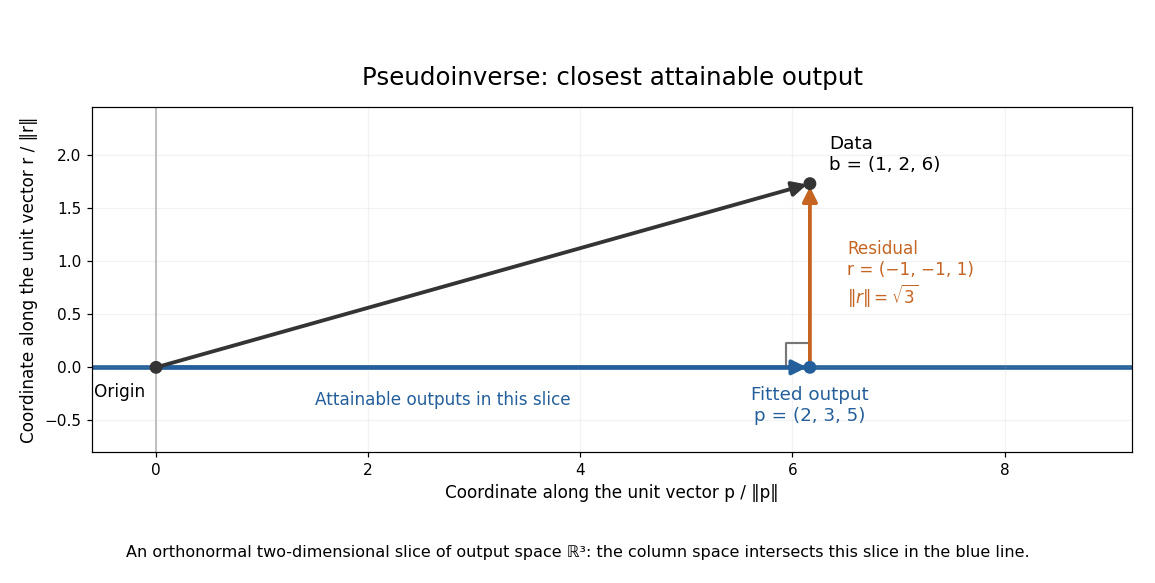

For any perturbation , the orthogonality of to givesSince the kernel of is trivial, every nonzero increases the residual. The least-squares solution is unique in this example. The formula using is convenient for these small exact calculations; an actual numerical computation can use a QR decomposition or singular value decomposition to avoid the extra conditioning cost of the least-squares normal equations. For full column rank, the squared singular values of are the eigenvalues of , so its condition number in the Euclidean norm is . [ref]
https://ocw.mit.edu/courses/18-065-matrix-methods-in-data-analysis-signal-processing-and-machine-learning-spring-2018/resources/lecture-9-four-ways-to-solve-least-squares-problems/. Strang, MIT 18.065 Lecture 9: four ways to solve least-squares problems
Past exam of the mathematics course of the University of Cambridge 2004 iii Paper 69 7 Solution Created 2026-10-03 Updated 2026-10-14
A spatial finite difference method and time discretization for a linear evolution problem give a recurrence . To obtain numerical stability on , one needs a bound uniform in the permitted grid sizes and time steps. More generally a growth estimate is sufficient. The finite-time stability versus power boundedness distinction matters: growth per step of can be compatible with the latter finite-time estimate, whereas unrestricted geometric growth at a fixed Courant number is not.
The eigenvalue method diagonalizes into modes. If is a normal matrix, the spectral theorem gives . Thus gives contraction, and gives the preceding growth estimate. A diagonalizable matrix has , so its condition number must remain bounded uniformly as the mesh changes. A stable-looking list of eigenvalues alone is insufficient.
Indeed,Both eigenvalues are one, but the Jordan block gives growth proportional to , violating uniform finite-time numerical stability. A nonnormal Fourier amplification matrix can similarly exhibit large amplification even with its eigenvalues inside the unit disk. Eigenvector conditioning and the full powers of the amplification operator are essential.
For constant-coefficient schemes on a periodic or infinite grid, a Fourier transform diagonalizes scalar translation-invariant stencils. This yields von Neumann stability analysis using the Fourier amplification symbol . The discrete Parseval identity turns a bound on into a discrete L2 norm estimate. For systems, the symbol is a matrix; a uniform power bound for matrix Fourier symbols is required, rather than a bound on its spectral radius alone.
For the heat equation, a central finite difference in space and the explicit Euler method in time giveThe scalar condition for every frequency is exactly . With zero Dirichlet boundary conditions, the spatial matrix is symmetric and diagonalized by sine modes, leading to the same uniform sufficient restriction. By contrast, the Backward Euler diffusion scheme has and is stable for every .
For the advection equation , , centered space with the explicit Euler method gives , , and . At fixed positive Courant number, repeated powers are unbounded as the mesh is refined. The upwind finite difference scheme instead haswhich gives contraction precisely for . This comparison shows why the spatial stencil and time method must be analyzed together.
Boundary treatment can destroy the normality or mode decomposition available on a periodic grid, so a finite-interval scheme needs its own uniform operator estimate. Multilevel time schemes likewise require the root condition for a multistep method and uniform bounds for the associated amplification matrices; simple scalar root tests do not establish these bounds for arbitrary systems. Once consistency of a numerical method, a well-posed linear evolution problem and the required numerical stability estimate hold, the Lax equivalence theorem gives numerical convergence. Eigenvalues provide a powerful route to that estimate when the accompanying eigenvector and boundary analysis is justified.
Past exam of the mathematics course of the University of Cambridge 2009 iii Paper 72 6 Solution Created 2026-10-03 Updated 2026-10-14
The eigenvalue stability analysis of a finite difference method reduces a linear evolution discretization to its modal behavior, but it must retain the norm and the dependence on the mesh. For a homogeneous system obtained by the method of lines, , the solution is . A one-step time discretization gives ; for a Runge-Kutta method, where its stage matrices are invertible, . With a multistep method one instead uses an amplification matrix on the augmented vector of several time levels.
The relevant finite-time stability estimate iswith independent of the refining spatial mesh and allowed time steps. Similarly, semidiscrete stability requires for . The norm should represent the continuum problem, such as the discrete L2 norm in one dimension. A fixed finite matrix having decaying solutions as is not by itself a mesh-uniform result for the partial differential equation.
If , thenThus eigenvalues of modulus at most one give a uniform bound when the diagonalizing bases have uniformly bounded condition numbers. For a normal matrix in the chosen inner product, the spectral theorem for normal operators supplies an orthonormal basis, so the condition number is one and the norm of is exactly . For a self-adjoint or skew-adjoint spatial matrix, applying a scalar stability function preserves this favorable modal structure. This is the setting where eigenvalue calculations provide especially clean, reliable step restrictions.
A precise fixed-matrix statement is also useful: a matrix is power bounded for all nonnegative integers if and only if all its eigenvalues lie in the closed unit disk and every Jordan block at a unit-modulus eigenvalue has size one. Indeed, powers of an interior Jordan block contain a polynomial in times a decaying geometric factor and are bounded; a larger block on the unit circle produces unbounded polynomial growth. For a family of matrices, the resulting bounds must still be uniform. Moreover, finite-time stability versus power boundedness distinguishes this all-time condition from the physical-time estimate above. For example , , has , bounded for despite a nontrivial Jordan block at one. Even the scalar update is stable on fixed intervals, since , although it represents a growing equation rather than a contraction.
For a constant-coefficient periodic difference operator, Fourier modes diagonalize the spatial matrix. The discrete Fourier transform is a unitary operator, so Parseval's identity identifies its modal maximum with the operator norm. The eigenvalue stability analysis of a finite difference method then becomes von Neumann stability analysis. For the Dirichlet discrete Laplacian, a discrete sine transform plays the same role. These facts explain its advantages: a large matrix calculation becomes a scalar symbol or a known spectral interval, and the extremal eigenvalue directly determines a safe time step.
As a first example, centered space discretization of the heat equation has eigenvaluesForward Euler method gives with . Requiring all factors in yields for all periodic meshes. In two dimensions the corresponding uniform bound is . Because these are normal matrices, these scalar bounds prove contraction rather than merely suggest it.
Backward Euler method has , so the centered discretization of the heat equation is contractive for every . The Crank-Nicolson method has and is likewise contractive for these negative real modes. However, its factor tends to for very stiff modes, leaving high-frequency oscillations weakly damped; Backward Euler method tends to zero. The eigenvalues therefore expose the presence of stiff differential equations and damping as well as binary stability. Unconditional stability does not remove accuracy requirements.
For an advection equation example, the upwind finite difference scheme for , , has factor , with . Sinceit is a contraction in the periodic discrete L2 norm exactly for . In contrast, Forward Euler method with centered advection has factor . Its modulus exceeds one at nonzero active frequencies, and repeated amplification makes it unstable under fixed nonzero Courant refinement. A much smaller scaling can bound its finite-time growth, demonstrating again that exact contraction and the most general stability estimate are different claims.
The major limitation is the possible presence of a nonnormal matrix. For example,Both eigenvalues are negative, yet at the second unit vector is amplified by at least . This proves that negative spectra do not imply uniform semidiscrete stability. Ill-conditioned eigenvectors, Jordan normal form and transient amplification can invalidate a spectral-only argument. Direct energy estimates or estimates for the resolvent can supply the missing norm control.
Boundary conditions are another limitation. A periodic symbol proves a periodic or whole-line result, not an arbitrary initial-boundary-value problem. Boundary closure of a difference scheme can introduce growing modes or mesh-dependent amplification. A spatial operator with variable coefficients can still be studied through its assembled matrix, but then whether it is a normal matrix, its condition number and the physical inner product must be checked rather than borrowed from a Fourier stability analysis. For the finite element method the natural mass matrix inner product often turns a generalized eigenvalue problem into a self-adjoint one.
For time-dependent or split updates, separate spectra are insufficient to control products. For instance, and each have only zero eigenvalues, while has eigenvalue . For , alternating the two is unstable. A common contractive norm would control the products, but their individual eigenvalues do not.
Finally, stability and consistency of a numerical method have different roles. The Lax equivalence theorem states that, for a well-posed linear initial-value problem and a consistent finite difference method on compatible grid spaces, stability on every fixed time interval is equivalent to convergence of a numerical method as the admissible meshes refine. Bounded grid representation and the correct initial and boundary setup are part of that framework. An eigenvalue estimate can establish its stability hypothesis in the favorable settings described above; it neither proves consistency of a numerical method nor bypasses its uniformity requirements. The method is therefore a powerful modal tool, provided its spectral calculation is connected to a genuine norm estimate.
Past exam of the mathematics course of the University of Cambridge 2010 iii Paper 63 7 Solution Created 2026-10-03 Updated 2026-10-14
Eigenvalue analysis proves mesh-uniform stability when it is accompanied by control of eigenvectors or an energy norm; the signs of eigenvalues alone are insufficient. For an evolution equation, the method of lines first produces . A time integrator then gives an amplification matrix , for example for a Runge-Kutta method. The useful stability requirement on a fixed physical time interval iswhere is independent of the refining spatial and temporal meshes. The semidiscrete analogue is for . These are bounds on propagation of initial errors and residuals, not merely statements that each finite matrix has a bounded solution over its own finite time interval.
If is a normal matrix in the chosen discrete inner product, it has a unitary eigenbasis. ThenFor dissipative problems it is sufficient that every lie in the integrator's linear stability domain. A diagonalizable family also suffices if its eigenvector matrices have uniformly bounded condition numbers: the same maximum is multiplied by . Without that uniform bound the argument does not establish mesh stability. For finite-time estimates, an amplification modulus can also be acceptable; strict contraction at every step is a stronger property.
For a constant-coefficient stencil on the full lattice or a periodic grid, von Neumann stability analysis provides the eigenvectors explicitly. A Fourier mode diagonalizes each translation-invariant spatial difference, giving a scalar symbol or a small matrix symbol for a system. The discrete Fourier transform and Parseval identity turn a uniform modal bound into an actual discrete L2 norm bound. The two-dimensional stencil in question 3 has , so its continuous-time amplification is contractive; a later time integrator must still be checked. With boundaries one must analyze the boundary rows as well: a whole-line Fourier symbol cannot detect an unstable boundary closure.
For the heat equation on a unit interval with zero Dirichlet data, the centred second difference has a sine eigenbasis and eigenvaluesExplicit Euler method multiplies mode by . Requiring all factors to have modulus at most one yields on a given grid, and the sharp grid-independent sufficient limit isThese parabolic time-step restrictions express the growth of the largest-magnitude diffusion eigenvalue like . Backward Euler method instead has factor and the Crank-Nicolson method factor , both bounded by one for every . Their unconditional stability follows from A-stability, with much stronger damping of the shortest scales for backward Euler.
For , , explicit time stepping with a backward spatial difference givesThus the upwind finite difference scheme is contractive exactly for , a Courant–Friedrichs–Lewy condition matching the direction and speed of information propagation. A centred spatial difference has purely imaginary eigenvalues, and forward Euler gives . Under a fixed positive hyperbolic Courant number, high-frequency data grow by a fixed factor in each of steps, proving instability as the mesh is refined. This is not a claim that no exceptionally small coupled step can ever give a finite-time bound: if , the excess per step is only , but the usual hyperbolic scaling is unstable. Higher-order explicit integrators can possess nontrivial imaginary-axis stability intervals and are then suitable for skew-adjoint advection or the energy-form first-order wave equation.
Variable coefficients usually prevent Fourier diagonalization, but may preserve a self-adjoint spatial operator. The positive-face diffusion discretization in question 5 is an example. Its discrete energy identity makes symmetric negative definite, so a unitary eigenbasis still exists even without a closed eigenvalue formula. More generally, a dissipative operator in a discrete energy inner product obeyswhich directly proves a uniform semigroup estimate. The dissipative Cayley-transform contraction also follows without normality: for ,Taking proves contraction of the Crank–Nicolson factor. The contractivity of split Crank-Nicolson diffusion then follows from multiplying two contraction bounds; simultaneous eigenvectors of the two directional matrices are unnecessary.
The negative spectra do not imply uniform semidiscrete stability example shows what can go wrong. LetBoth eigenvalues are for every mesh, but applying the propagator to the second unit vector at gives norm at least . The evolution is therefore not mesh-uniformly stable. For a discrete matrix, a unit-modulus eigenvalue with a nontrivial Jordan block gives powers growing polynomially in the step number. Even strictly interior eigenvalues can allow large transient growth when eigenvectors are badly conditioned. A pseudospectrum or numerical range of an operator, and especially a direct energy estimate, can reveal behavior missed by eigenvalues.
A resolvent estimate provides another way to see the needed uniformity. If for every , then for ,This shows directly that a uniform power estimate imposes more than the location of the spectrum. Conversely, resolvent-to-power estimates in varying dimension must themselves be uniform; a bound with constants depending on the number of grid points is not enough.
For a linear multistep method, each spatial eigenvalue gives an amplification polynomial, and all roots must satisfy the root condition for a multistep method, including simplicity of any unit-modulus root. Merely following the root approximating misses parasitic modes. The temporal and spatial analyses must therefore be combined with the appropriate zero-stability and uniform modal bounds.
Finally stability connects to convergence. If the exact grid samples have normalized residual and the error obeys , iteration givesA residual tending uniformly to zero then gives convergence on . For a well-posed linear initial-value problem and a consistent linear finite-difference approximation, this is the forward implication of the Lax equivalence theorem. The practical conclusion is to analyze the full operator including boundaries, select a time method whose stability region contains the relevant scaled spectrum, and verify that eigenvectors or an energy estimate make the resulting bounds uniform as the grid is refined.
Past exam of the mathematics course of the University of Cambridge 2013 iii Paper 31 3 Solution Created 2026-10-03 Updated 2026-10-07
With the same squared-error normalization as in Question 2, the ridge estimator solvesThe unpenalized intercept in ridge regression is because the columns of are centered. Differentiating the remaining quadratic objective gives . Since , the left matrix is positive definite even when is rank-deficient. Thus the closed-form ridge regression estimator isThe second equality again uses centering. If the penalty convention is with an unnormalized squared-error term , replace by throughout; the limiting assertion is unchanged.
For the full-column-rank case, take a singular value decomposition with positive singular values . The ordinary least squares estimator, which is the slope maximum-likelihood estimator in this normal linear model, and the ridge regression estimator are respectivelyConsequently principal-component shrinkage by ridge regression multiplies the least-squares coordinate in direction by . Ridge shrinks most strongly in directions with the smallest singular values. These are combinations of predictors that the data distinguish least well.
Near multicollinearity creates small singular values, and the factor in ordinary least squares greatly amplifies noise in those directions. Its coefficient variance there is , while the ridge variance iswhich is smaller. The price is bias: the expectation of the ridge coordinate is times the corresponding true coefficient. This bias-variance tradeoff can substantially reduce estimation and prediction error when the poorly identified directions do not contain an excessively large signal. It is not a guarantee of improvement for every coefficient vector. Adding to every eigenvalue also improves the condition number of the normal matrix and makes numerical inversion more stable.
To handle every rank and every relation between and , put and use its spectral theorem for real symmetric matrices. Choose an orthonormal eigenbasis with eigenvalues , and put . ThenIf , then , so and . Thus these terms are exactly zero for every positive ; there is no divergent component in the null space. Each remaining term converges to . By the definition of the Moore-Penrose pseudoinverse,and thereforeThis proves the vanishing-penalty ridge limit without an invertibility assumption. The limit is the minimum-norm least-squares solution: every other least-squares solution differs by a vector in , orthogonal to the displayed solution, and therefore has at least as large a Euclidean norm.